
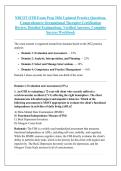
NBCOT OTR Exam Prep 2026 Updated Practice Questions,
Comprehensive Occupational Therapist Certification
Review, Detailed Explanations, Verified Answers, Complete
Success Workbook
The exam content is organized around four domains based on the 2022 practice
analysis:
• Domain 1: Evaluation and Assessment — 23%
• Domain 2: Analysis, Interpretation, and Planning — 23%
• Domain 3: Select and Manage Interventions — 38%
• Domain 4: Competency and Practice Management — 16%
Domain 3 alone accounts for more than one-third of the exam
Domain 1: Evaluation and Assessment (23%)
1. An OTR is evaluating a 72-year-old client who recently suffered a
cerebrovascular accident (CVA) affecting the right hemisphere. The client
demonstrates left-sided neglect and impulsive behavior. Which of the
following assessments is MOST appropriate to evaluate the client's functional
independence in activities of daily living (ADLs)?
A) Mini-Mental State Examination (MMSE)
B) Functional Independence Measure (FIM)
C) Beck Depression Inventory
D) Glasgow Coma Scale
Rationale: The FIM is a widely used standardized assessment that measures
functional independence in ADLs, including self-care, mobility, and cognition.
While the MMSE assesses cognitive status, the FIM directly evaluates the client's
ability to perform daily tasks, which is the priority for this client with neglect and
impulsivity. The Beck Depression Inventory screens for depression, and the
Glasgow Coma Scale assesses level of consciousness.
,2. An OTR is evaluating a 6-year-old child with autism spectrum disorder
(ASD) who demonstrates difficulty with sensory processing. The child's
parents report that the child becomes distressed during transitions and avoids
certain textures. Which assessment tool is MOST appropriate to evaluate
sensory processing patterns?
A) Bruininks-Oseretsky Test of Motor Proficiency (BOT-2)
B) Sensory Profile 2
C) Peabody Developmental Motor Scales (PDMS-2)
D) Beery-Buktenica Developmental Test of Visual-Motor Integration (VMI)
Rationale: The Sensory Profile 2 is designed to evaluate sensory processing
patterns in children, including sensory seeking, avoiding, sensitivity, and
registration. It gathers information from caregivers about how the child responds to
sensory experiences in daily life. The BOT-2 and PDMS-2 assess motor skills, and
the VMI assesses visual-motor integration.
3. An OTR is evaluating a client with a C6 spinal cord injury (SCI). Which of
the following functional abilities is MOST likely to be preserved with this level
of injury?
A) Independent ambulation
B) Independent feeding with adaptive equipment
C) Independent bowel and bladder management
D) Independent transfers
Rationale: A C6 SCI (tetraplegia) typically allows for independent feeding with
adaptive equipment such as universal cuffs and plate guards. Tenodesis grasp may
be present, enabling some functional hand use. Independent ambulation,
bowel/bladder management, and transfers typically require assistance at this level.
4. An OTR is evaluating a client with a distal radius fracture who is 4 weeks
status post open reduction internal fixation (ORIF). Which of the following
assessments is MOST appropriate to measure wrist range of motion (ROM)?
A) Goniometry
B) Manual muscle testing (MMT)
,C) Semmes-Weinstein monofilament testing
D) Two-point discrimination
Rationale: Goniometry is the standard method for measuring joint ROM. MMT
assesses muscle strength, while Semmes-Weinstein monofilament testing and two-
point discrimination assess sensory function. At 4 weeks post-ORIF, assessing
ROM is appropriate to track progress and guide intervention.
5. An OTR is evaluating a client with Parkinson's disease who reports
difficulty with handwriting and buttoning shirts. Which of the following
assessments is MOST appropriate to evaluate fine motor coordination?
A) Nine-Hole Peg Test
B) Berg Balance Scale
C) Timed Up and Go (TUG)
D) Functional Reach Test
Rationale: The Nine-Hole Peg Test is a standardized assessment of fine motor
dexterity and coordination. The Berg Balance Scale, TUG, and Functional Reach
Test assess balance and mobility, not fine motor skills.
6. An OTR is evaluating a client with a suspected peripheral neuropathy. The
client reports numbness and tingling in the hands and feet. Which assessment
is MOST appropriate to evaluate sensory function?
A) Semmes-Weinstein monofilament testing
B) Goniometry
C) Manual muscle testing
D) Dynamometry
Rationale: Semmes-Weinstein monofilament testing assesses light touch sensation
and is commonly used to evaluate peripheral neuropathy. Goniometry measures
ROM, MMT assesses strength, and dynamometry measures grip strength.
7. An OTR is evaluating a client who has experienced a traumatic brain
injury (TBI). The client is in a minimally conscious state and demonstrates
, inconsistent responses to stimuli. Which assessment is MOST appropriate to
evaluate the client's level of consciousness?
A) Coma Recovery Scale-Revised (CRS-R)
B) Mini-Mental State Examination (MMSE)
C) Montreal Cognitive Assessment (MoCA)
D) Functional Independence Measure (FIM)
Rationale: The CRS-R is specifically designed to assess level of consciousness
and detect signs of awareness in individuals with disorders of consciousness. The
MMSE and MoCA require higher cognitive functioning, and the FIM assesses
functional independence.
8. An OTR is evaluating a client with a hip fracture who is 2 days post-
surgical repair. The client reports pain and is reluctant to move. Which of the
following is the MOST appropriate initial assessment?
A) Pain assessment using a visual analog scale
B) Gait assessment
C) Berg Balance Scale
D) Six-Minute Walk Test
Rationale: Pain assessment is the priority in the immediate post-surgical period.
The visual analog scale allows the client to quantify pain, which guides
intervention and mobility progression. Gait assessment and balance tests are
inappropriate at 2 days post-surgery due to pain and surgical precautions.
9. An OTR is evaluating a client with rheumatoid arthritis (RA) who reports
difficulty with morning stiffness and fatigue. Which assessment is MOST
appropriate to evaluate the client's ability to perform daily activities?
A) Canadian Occupational Performance Measure (COPM)
B) Goniometry
C) Manual muscle testing
D) X-ray imaging
Rationale: The COPM is a client-centered, semi-structured interview that
identifies self-perceived performance issues in daily activities and measures
Comprehensive Occupational Therapist Certification
Review, Detailed Explanations, Verified Answers, Complete
Success Workbook
The exam content is organized around four domains based on the 2022 practice
analysis:
• Domain 1: Evaluation and Assessment — 23%
• Domain 2: Analysis, Interpretation, and Planning — 23%
• Domain 3: Select and Manage Interventions — 38%
• Domain 4: Competency and Practice Management — 16%
Domain 3 alone accounts for more than one-third of the exam
Domain 1: Evaluation and Assessment (23%)
1. An OTR is evaluating a 72-year-old client who recently suffered a
cerebrovascular accident (CVA) affecting the right hemisphere. The client
demonstrates left-sided neglect and impulsive behavior. Which of the
following assessments is MOST appropriate to evaluate the client's functional
independence in activities of daily living (ADLs)?
A) Mini-Mental State Examination (MMSE)
B) Functional Independence Measure (FIM)
C) Beck Depression Inventory
D) Glasgow Coma Scale
Rationale: The FIM is a widely used standardized assessment that measures
functional independence in ADLs, including self-care, mobility, and cognition.
While the MMSE assesses cognitive status, the FIM directly evaluates the client's
ability to perform daily tasks, which is the priority for this client with neglect and
impulsivity. The Beck Depression Inventory screens for depression, and the
Glasgow Coma Scale assesses level of consciousness.
,2. An OTR is evaluating a 6-year-old child with autism spectrum disorder
(ASD) who demonstrates difficulty with sensory processing. The child's
parents report that the child becomes distressed during transitions and avoids
certain textures. Which assessment tool is MOST appropriate to evaluate
sensory processing patterns?
A) Bruininks-Oseretsky Test of Motor Proficiency (BOT-2)
B) Sensory Profile 2
C) Peabody Developmental Motor Scales (PDMS-2)
D) Beery-Buktenica Developmental Test of Visual-Motor Integration (VMI)
Rationale: The Sensory Profile 2 is designed to evaluate sensory processing
patterns in children, including sensory seeking, avoiding, sensitivity, and
registration. It gathers information from caregivers about how the child responds to
sensory experiences in daily life. The BOT-2 and PDMS-2 assess motor skills, and
the VMI assesses visual-motor integration.
3. An OTR is evaluating a client with a C6 spinal cord injury (SCI). Which of
the following functional abilities is MOST likely to be preserved with this level
of injury?
A) Independent ambulation
B) Independent feeding with adaptive equipment
C) Independent bowel and bladder management
D) Independent transfers
Rationale: A C6 SCI (tetraplegia) typically allows for independent feeding with
adaptive equipment such as universal cuffs and plate guards. Tenodesis grasp may
be present, enabling some functional hand use. Independent ambulation,
bowel/bladder management, and transfers typically require assistance at this level.
4. An OTR is evaluating a client with a distal radius fracture who is 4 weeks
status post open reduction internal fixation (ORIF). Which of the following
assessments is MOST appropriate to measure wrist range of motion (ROM)?
A) Goniometry
B) Manual muscle testing (MMT)
,C) Semmes-Weinstein monofilament testing
D) Two-point discrimination
Rationale: Goniometry is the standard method for measuring joint ROM. MMT
assesses muscle strength, while Semmes-Weinstein monofilament testing and two-
point discrimination assess sensory function. At 4 weeks post-ORIF, assessing
ROM is appropriate to track progress and guide intervention.
5. An OTR is evaluating a client with Parkinson's disease who reports
difficulty with handwriting and buttoning shirts. Which of the following
assessments is MOST appropriate to evaluate fine motor coordination?
A) Nine-Hole Peg Test
B) Berg Balance Scale
C) Timed Up and Go (TUG)
D) Functional Reach Test
Rationale: The Nine-Hole Peg Test is a standardized assessment of fine motor
dexterity and coordination. The Berg Balance Scale, TUG, and Functional Reach
Test assess balance and mobility, not fine motor skills.
6. An OTR is evaluating a client with a suspected peripheral neuropathy. The
client reports numbness and tingling in the hands and feet. Which assessment
is MOST appropriate to evaluate sensory function?
A) Semmes-Weinstein monofilament testing
B) Goniometry
C) Manual muscle testing
D) Dynamometry
Rationale: Semmes-Weinstein monofilament testing assesses light touch sensation
and is commonly used to evaluate peripheral neuropathy. Goniometry measures
ROM, MMT assesses strength, and dynamometry measures grip strength.
7. An OTR is evaluating a client who has experienced a traumatic brain
injury (TBI). The client is in a minimally conscious state and demonstrates
, inconsistent responses to stimuli. Which assessment is MOST appropriate to
evaluate the client's level of consciousness?
A) Coma Recovery Scale-Revised (CRS-R)
B) Mini-Mental State Examination (MMSE)
C) Montreal Cognitive Assessment (MoCA)
D) Functional Independence Measure (FIM)
Rationale: The CRS-R is specifically designed to assess level of consciousness
and detect signs of awareness in individuals with disorders of consciousness. The
MMSE and MoCA require higher cognitive functioning, and the FIM assesses
functional independence.
8. An OTR is evaluating a client with a hip fracture who is 2 days post-
surgical repair. The client reports pain and is reluctant to move. Which of the
following is the MOST appropriate initial assessment?
A) Pain assessment using a visual analog scale
B) Gait assessment
C) Berg Balance Scale
D) Six-Minute Walk Test
Rationale: Pain assessment is the priority in the immediate post-surgical period.
The visual analog scale allows the client to quantify pain, which guides
intervention and mobility progression. Gait assessment and balance tests are
inappropriate at 2 days post-surgery due to pain and surgical precautions.
9. An OTR is evaluating a client with rheumatoid arthritis (RA) who reports
difficulty with morning stiffness and fatigue. Which assessment is MOST
appropriate to evaluate the client's ability to perform daily activities?
A) Canadian Occupational Performance Measure (COPM)
B) Goniometry
C) Manual muscle testing
D) X-ray imaging
Rationale: The COPM is a client-centered, semi-structured interview that
identifies self-perceived performance issues in daily activities and measures


