
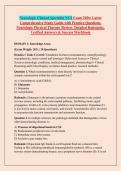
Neurologic Clinical Specialist NCS Exam 2026: Latest
Comprehensive Study Guide with Practice Questions,
Neurologic Physical Therapy Review, Detailed Rationales,
Verified Answers & Success Workbook
DOMAIN 1: Knowledge Areas
(Exam Weight: 20% | 20 Questions)
Domain 1 Tasks Covered: Foundation Sciences (neuroanatomy, neurophysiology,
neuroplasticity, motor control and learning) • Behavioral Sciences • Clinical
Sciences (neurologic conditions, medical management, pharmacology) • Clinical
Reasoning and Critical Inquiry (evidence-based practice, research methods)
Question 1. Which neurotransmitter is most directly involved in excitatory
synaptic transmission within the corticospinal tract?
A) γ-Aminobutyric acid (GABA)
B) Glutamate
C) Dopamine
D) Acetylcholine
Rationale: Glutamate is the primary excitatory neurotransmitter in the central
nervous system, including the corticospinal pathway, facilitating motor signal
propagation. GABA (A) is the primary inhibitory neurotransmitter. Dopamine (C)
is involved in motor control, motivation, and reward. Acetylcholine (D) is involved
in neuromuscular junction transmission and autonomic function.
Question 2. In multiple sclerosis, the pathologic hallmark that distinguishes it from
other demyelinating diseases is:
A) Presence of oligoclonal bands in CSF
B) Predominant peripheral nerve involvement
C) Immediate onset after trauma
D) Exclusive gray-matter loss
Rationale: Oligoclonal IgG bands in cerebrospinal fluid are a characteristic
finding in MS, reflecting intrathecal immunoglobulin synthesis. MS is a central
nervous system demyelinating disease, not a peripheral nerve disorder (B). It is not
,caused by trauma (C). It involves both white and gray matter (D), though white
matter lesions are more prominent.
Question 3. According to the ASIA Impairment Scale, a patient with sensory
sparing but no motor function below the neurological level is classified as:
A) AIS A
B) AIS B
C) AIS C
D) AIS D
Rationale: AIS B denotes sensory incomplete injury—some sensory function
preserved below the level, but no motor function. AIS A (A) is complete injury.
AIS C (C) is motor incomplete with muscle grade less than 3. AIS D (D) is motor
incomplete with muscle grade 3 or greater.
Question 4. Which of the following is a common side effect of baclofen that PTs
must monitor during gait training?
A) Hypertension
B) Sedation and decreased coordination
C) Hyperthermia
D) Increased spasticity
Rationale: Baclofen, a GABA-B agonist, can cause central nervous system
depression leading to sedation and impaired coordination. It does not cause
hypertension (A) or hyperthermia (C). It is used to reduce spasticity, not increase it
(D).
Question 5. The "Bobath" (NDT) approach primarily aims to:
A) Strengthen antagonist muscles through high-load resistance
B) Facilitate normal movement patterns by inhibiting abnormal tone
C) Provide electrical stimulation to denervated muscles
D) Emphasize isolated joint motions only
Rationale: Neurodevelopmental Treatment (Bobath) focuses on inhibiting
abnormal tone and facilitating functional movement patterns. High-load resistance
(A) is not consistent with NDT principles. Electrical stimulation (C) is a separate
modality. Isolated joint motions (D) are not the focus of NDT.
,Question 6. In a patient with unilateral vestibular hypofunction, the most
appropriate bedside test to confirm peripheral involvement is:
A) Head-Impulse Test (HIT) showing corrective saccade
B) Romberg test with eyes open
C) Finger-to-nose test
D) Babinski sign
Rationale: A corrective saccade on the HIT indicates a deficient vestibulo-ocular
reflex, typical of peripheral vestibular loss. Romberg with eyes open (B) is not a
vestibular test. Finger-to-nose (C) assesses cerebellar function. Babinski sign (D)
assesses corticospinal tract integrity.
Question 7. Which imaging modality best visualizes acute ischemic stroke within
the first 6 hours?
A) Non-contrast CT
B) T1-weighted MRI
C) Diffusion-weighted MRI (DWI)
D) PET scan
Rationale: Diffusion-weighted MRI (DWI) is the most sensitive imaging modality
for detecting acute ischemic stroke within the first hours of onset. Non-contrast CT
(A) may be normal in the hyperacute phase. T1-weighted MRI (B) is less sensitive
for acute ischemia. PET (D) is not typically used for acute stroke evaluation.
Question 8. Which principle of neuroplasticity is BEST described by the phrase
"neurons that fire together, wire together"?
A) Hebbian plasticity
B) Diaschisis
C) Wallerian degeneration
D) Denervation supersensitivity
Rationale: Hebbian plasticity refers to the strengthening of synaptic connections
through repeated co-activation of neurons. Diaschisis (B) refers to decreased
function in areas remote from a lesion. Wallerian degeneration (C) is anterograde
degeneration of axons. Denervation supersensitivity (D) is increased receptor
sensitivity after denervation.
Question 9. A patient with Parkinson's disease is most likely to demonstrate which
gait characteristic?
, A) Hemiplegic gait
B) Festinating gait with reduced arm swing
C) Ataxic gait
D) Steppage gait
Rationale: Parkinsonian gait is characterized by festination (shuffling, accelerating
steps), reduced arm swing, and difficulty initiating movement. Hemiplegic gait (A)
is seen after stroke. Ataxic gait (C) is seen with cerebellar disorders. Steppage gait
(D) is seen with foot drop.
Question 10. Which outcome measure is MOST appropriate for assessing balance
and fall risk in a patient with chronic stroke?
A) Berg Balance Scale
B) Manual Muscle Testing
C) Goniometry
D) Visual Analog Scale
Rationale: The Berg Balance Scale is a validated outcome measure for balance
and fall risk in patients with stroke. MMT (B) assesses strength. Goniometry (C)
assesses ROM. VAS (D) assesses pain.
Question 11. Which tract is responsible for carrying unconscious proprioceptive
information to the cerebellum?
A) Dorsal column-medial lemniscus
B) Spinothalamic tract
C) Spinocerebellar tract
D) Corticospinal tract
Rationale: The spinocerebellar tract carries unconscious proprioceptive
information from muscle spindles, Golgi tendon organs, and joint receptors to the
cerebellum. The dorsal column-medial lemniscus (A) carries conscious
proprioception and vibration. The spinothalamic tract (B) carries pain and
temperature. The corticospinal tract (D) carries motor commands.
Question 12. A patient with a lesion in the left middle cerebral artery territory
would MOST likely present with:
A) Right-sided hemiparesis and aphasia
B) Left-sided hemiparesis and neglect
Comprehensive Study Guide with Practice Questions,
Neurologic Physical Therapy Review, Detailed Rationales,
Verified Answers & Success Workbook
DOMAIN 1: Knowledge Areas
(Exam Weight: 20% | 20 Questions)
Domain 1 Tasks Covered: Foundation Sciences (neuroanatomy, neurophysiology,
neuroplasticity, motor control and learning) • Behavioral Sciences • Clinical
Sciences (neurologic conditions, medical management, pharmacology) • Clinical
Reasoning and Critical Inquiry (evidence-based practice, research methods)
Question 1. Which neurotransmitter is most directly involved in excitatory
synaptic transmission within the corticospinal tract?
A) γ-Aminobutyric acid (GABA)
B) Glutamate
C) Dopamine
D) Acetylcholine
Rationale: Glutamate is the primary excitatory neurotransmitter in the central
nervous system, including the corticospinal pathway, facilitating motor signal
propagation. GABA (A) is the primary inhibitory neurotransmitter. Dopamine (C)
is involved in motor control, motivation, and reward. Acetylcholine (D) is involved
in neuromuscular junction transmission and autonomic function.
Question 2. In multiple sclerosis, the pathologic hallmark that distinguishes it from
other demyelinating diseases is:
A) Presence of oligoclonal bands in CSF
B) Predominant peripheral nerve involvement
C) Immediate onset after trauma
D) Exclusive gray-matter loss
Rationale: Oligoclonal IgG bands in cerebrospinal fluid are a characteristic
finding in MS, reflecting intrathecal immunoglobulin synthesis. MS is a central
nervous system demyelinating disease, not a peripheral nerve disorder (B). It is not
,caused by trauma (C). It involves both white and gray matter (D), though white
matter lesions are more prominent.
Question 3. According to the ASIA Impairment Scale, a patient with sensory
sparing but no motor function below the neurological level is classified as:
A) AIS A
B) AIS B
C) AIS C
D) AIS D
Rationale: AIS B denotes sensory incomplete injury—some sensory function
preserved below the level, but no motor function. AIS A (A) is complete injury.
AIS C (C) is motor incomplete with muscle grade less than 3. AIS D (D) is motor
incomplete with muscle grade 3 or greater.
Question 4. Which of the following is a common side effect of baclofen that PTs
must monitor during gait training?
A) Hypertension
B) Sedation and decreased coordination
C) Hyperthermia
D) Increased spasticity
Rationale: Baclofen, a GABA-B agonist, can cause central nervous system
depression leading to sedation and impaired coordination. It does not cause
hypertension (A) or hyperthermia (C). It is used to reduce spasticity, not increase it
(D).
Question 5. The "Bobath" (NDT) approach primarily aims to:
A) Strengthen antagonist muscles through high-load resistance
B) Facilitate normal movement patterns by inhibiting abnormal tone
C) Provide electrical stimulation to denervated muscles
D) Emphasize isolated joint motions only
Rationale: Neurodevelopmental Treatment (Bobath) focuses on inhibiting
abnormal tone and facilitating functional movement patterns. High-load resistance
(A) is not consistent with NDT principles. Electrical stimulation (C) is a separate
modality. Isolated joint motions (D) are not the focus of NDT.
,Question 6. In a patient with unilateral vestibular hypofunction, the most
appropriate bedside test to confirm peripheral involvement is:
A) Head-Impulse Test (HIT) showing corrective saccade
B) Romberg test with eyes open
C) Finger-to-nose test
D) Babinski sign
Rationale: A corrective saccade on the HIT indicates a deficient vestibulo-ocular
reflex, typical of peripheral vestibular loss. Romberg with eyes open (B) is not a
vestibular test. Finger-to-nose (C) assesses cerebellar function. Babinski sign (D)
assesses corticospinal tract integrity.
Question 7. Which imaging modality best visualizes acute ischemic stroke within
the first 6 hours?
A) Non-contrast CT
B) T1-weighted MRI
C) Diffusion-weighted MRI (DWI)
D) PET scan
Rationale: Diffusion-weighted MRI (DWI) is the most sensitive imaging modality
for detecting acute ischemic stroke within the first hours of onset. Non-contrast CT
(A) may be normal in the hyperacute phase. T1-weighted MRI (B) is less sensitive
for acute ischemia. PET (D) is not typically used for acute stroke evaluation.
Question 8. Which principle of neuroplasticity is BEST described by the phrase
"neurons that fire together, wire together"?
A) Hebbian plasticity
B) Diaschisis
C) Wallerian degeneration
D) Denervation supersensitivity
Rationale: Hebbian plasticity refers to the strengthening of synaptic connections
through repeated co-activation of neurons. Diaschisis (B) refers to decreased
function in areas remote from a lesion. Wallerian degeneration (C) is anterograde
degeneration of axons. Denervation supersensitivity (D) is increased receptor
sensitivity after denervation.
Question 9. A patient with Parkinson's disease is most likely to demonstrate which
gait characteristic?
, A) Hemiplegic gait
B) Festinating gait with reduced arm swing
C) Ataxic gait
D) Steppage gait
Rationale: Parkinsonian gait is characterized by festination (shuffling, accelerating
steps), reduced arm swing, and difficulty initiating movement. Hemiplegic gait (A)
is seen after stroke. Ataxic gait (C) is seen with cerebellar disorders. Steppage gait
(D) is seen with foot drop.
Question 10. Which outcome measure is MOST appropriate for assessing balance
and fall risk in a patient with chronic stroke?
A) Berg Balance Scale
B) Manual Muscle Testing
C) Goniometry
D) Visual Analog Scale
Rationale: The Berg Balance Scale is a validated outcome measure for balance
and fall risk in patients with stroke. MMT (B) assesses strength. Goniometry (C)
assesses ROM. VAS (D) assesses pain.
Question 11. Which tract is responsible for carrying unconscious proprioceptive
information to the cerebellum?
A) Dorsal column-medial lemniscus
B) Spinothalamic tract
C) Spinocerebellar tract
D) Corticospinal tract
Rationale: The spinocerebellar tract carries unconscious proprioceptive
information from muscle spindles, Golgi tendon organs, and joint receptors to the
cerebellum. The dorsal column-medial lemniscus (A) carries conscious
proprioception and vibration. The spinothalamic tract (B) carries pain and
temperature. The corticospinal tract (D) carries motor commands.
Question 12. A patient with a lesion in the left middle cerebral artery territory
would MOST likely present with:
A) Right-sided hemiparesis and aphasia
B) Left-sided hemiparesis and neglect


