Test Bank
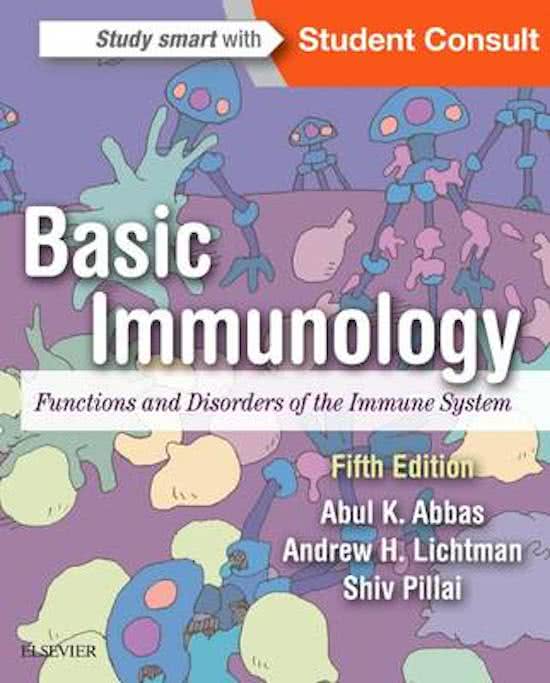
Basic Immunology
Functions and Disorders of the Immune System
7th Edition by Abass, Lichtman &Pillai
ISBN: 9780443105197
, Test Bank for Basic Immunology: Functions and Disorders
of the Immune System 7th Edition by Abass, Lichtman
&Pillai |A Comprehensive NCLEX-Style Sample Review of
650 Multichoice Questions and Answers with Clinical
Rationale Covering the Full Scope of the Textbook |
Guaranteed Pass
Table of Contents
Chapter Title Question Range
1 Introduction to the Immune System Q1–Q55
2 Innate Immunity Q56–Q110
3 Antigen Capture and Presentation to Lymphocytes Q111–Q160
4 Antigen Recognition in the Adaptive Immune System Q161–Q210
5 T Cell–Mediated Immunity: Activation of T Lymphocytes Q211–Q260
6 Effector Mechanisms of T Cell–Mediated Immunity Q261–Q305
7 Humoral Immune Responses: Activation of B Lymphocytes Q306–Q355
8 Effector Mechanisms of Humoral Immunity Q356–Q400
9 Immunologic Tolerance and Autoimmunity Q401–Q445
10 Tumor and Transplantation Immunology Q446–Q490
11 Hypersensitivity Q491–Q535
12 Congenital and Acquired Immunodeficiencies Q536–Q580
Appendix Clinical Cases (Integrated Review) Q581–Q650
,Chapter 1: Introduction to the Immune System
1. Which of the following best describes a fundamental property that distinguishes
adaptive immunity from innate immunity?
A. Adaptive immunity relies on germline-encoded receptors
B. Adaptive immunity responds more rapidly than innate immunity upon first
exposure
C. Adaptive immunity exhibits specificity and memory
D. Adaptive immunity is present in all multicellular organisms
Correct Answer: C
Rationale: Adaptive immunity is characterized by exquisite specificity for distinct
antigens and the development of immunologic memory, enabling more rapid and
effective responses upon re-exposure. Innate immunity relies on germline-encoded
receptors, responds within hours, and is present in all multicellular organisms.
Adaptive immunity is found only in vertebrates.
DIF: 1 KEY: C MSC: Recall NOT: Chapter 1, Overview
2. A researcher isolates a cytokine that is produced by activated T lymphocytes and
acts on the same cell that secreted it. This mode of action is called:
A. Endocrine
B. Paracrine
C. Autocrine
D. Juxtracrine
Correct Answer: C
Rationale: Autocrine action refers to a cytokine acting on the same cell that
secreted it. Paracrine action refers to action on nearby cells, and endocrine action
refers to systemic effects via the bloodstream.
DIF: 1 KEY: C MSC: Recall NOT: Chapter 1, Cytokines
3. Which of the following is a general property of cytokines?
A. They are stored as preformed molecules primed for rapid release
B. They are constitutively transcribed and released
, C. Their synthesis is transient and initiated by new gene transcription
D. They are produced only by lymphocytes
Correct Answer: C
Rationale: Cytokines are not usually stored as preformed molecules. Their
synthesis is initiated by new gene transcription resulting from cellular activation,
and the transcriptional activation is transient. The mRNAs encoding most
cytokines are unstable and rapidly degraded, so cytokine synthesis is transient.
DIF: 2 KEY: C MSC: Comprehension NOT: Chapter 1, Cytokines
4. The primary lymphoid organs where lymphocytes mature are:
A. Spleen and lymph nodes
B. Thymus and bone marrow
C. Tonsils and Peyer's patches
D. Skin and mucosal surfaces
Correct Answer: B
Rationale: Lymphocytes mature in the primary (central) lymphoid organs: the
thymus (T cells) and bone marrow (B cells). Secondary lymphoid organs include
lymph nodes, spleen, and mucosal-associated lymphoid tissues where adaptive
immune responses are initiated.
DIF: 1 KEY: B MSC: Recall NOT: Chapter 1, Lymphoid Organs
5. Which of the following best describes clonal selection in the adaptive immune
system?
A. Antigen-independent proliferation of lymphocytes before infection
B. Antigen-specific lymphocytes are selected and expanded upon antigen
encounter
C. Random generation of lymphocyte specificities during an active infection
D. Deletion of self-reactive lymphocytes in the thymus
Correct Answer: B
Rationale: Clonal selection is the fundamental principle that lymphocytes
expressing receptors specific for an antigen are selected by that antigen to
proliferate and differentiate into effector cells and memory cells. This occurs after
antigen encounter.
Basic Immunology
Functions and Disorders of the Immune System
7th Edition by Abass, Lichtman &Pillai
ISBN: 9780443105197
, Test Bank for Basic Immunology: Functions and Disorders
of the Immune System 7th Edition by Abass, Lichtman
&Pillai |A Comprehensive NCLEX-Style Sample Review of
650 Multichoice Questions and Answers with Clinical
Rationale Covering the Full Scope of the Textbook |
Guaranteed Pass
Table of Contents
Chapter Title Question Range
1 Introduction to the Immune System Q1–Q55
2 Innate Immunity Q56–Q110
3 Antigen Capture and Presentation to Lymphocytes Q111–Q160
4 Antigen Recognition in the Adaptive Immune System Q161–Q210
5 T Cell–Mediated Immunity: Activation of T Lymphocytes Q211–Q260
6 Effector Mechanisms of T Cell–Mediated Immunity Q261–Q305
7 Humoral Immune Responses: Activation of B Lymphocytes Q306–Q355
8 Effector Mechanisms of Humoral Immunity Q356–Q400
9 Immunologic Tolerance and Autoimmunity Q401–Q445
10 Tumor and Transplantation Immunology Q446–Q490
11 Hypersensitivity Q491–Q535
12 Congenital and Acquired Immunodeficiencies Q536–Q580
Appendix Clinical Cases (Integrated Review) Q581–Q650
,Chapter 1: Introduction to the Immune System
1. Which of the following best describes a fundamental property that distinguishes
adaptive immunity from innate immunity?
A. Adaptive immunity relies on germline-encoded receptors
B. Adaptive immunity responds more rapidly than innate immunity upon first
exposure
C. Adaptive immunity exhibits specificity and memory
D. Adaptive immunity is present in all multicellular organisms
Correct Answer: C
Rationale: Adaptive immunity is characterized by exquisite specificity for distinct
antigens and the development of immunologic memory, enabling more rapid and
effective responses upon re-exposure. Innate immunity relies on germline-encoded
receptors, responds within hours, and is present in all multicellular organisms.
Adaptive immunity is found only in vertebrates.
DIF: 1 KEY: C MSC: Recall NOT: Chapter 1, Overview
2. A researcher isolates a cytokine that is produced by activated T lymphocytes and
acts on the same cell that secreted it. This mode of action is called:
A. Endocrine
B. Paracrine
C. Autocrine
D. Juxtracrine
Correct Answer: C
Rationale: Autocrine action refers to a cytokine acting on the same cell that
secreted it. Paracrine action refers to action on nearby cells, and endocrine action
refers to systemic effects via the bloodstream.
DIF: 1 KEY: C MSC: Recall NOT: Chapter 1, Cytokines
3. Which of the following is a general property of cytokines?
A. They are stored as preformed molecules primed for rapid release
B. They are constitutively transcribed and released
, C. Their synthesis is transient and initiated by new gene transcription
D. They are produced only by lymphocytes
Correct Answer: C
Rationale: Cytokines are not usually stored as preformed molecules. Their
synthesis is initiated by new gene transcription resulting from cellular activation,
and the transcriptional activation is transient. The mRNAs encoding most
cytokines are unstable and rapidly degraded, so cytokine synthesis is transient.
DIF: 2 KEY: C MSC: Comprehension NOT: Chapter 1, Cytokines
4. The primary lymphoid organs where lymphocytes mature are:
A. Spleen and lymph nodes
B. Thymus and bone marrow
C. Tonsils and Peyer's patches
D. Skin and mucosal surfaces
Correct Answer: B
Rationale: Lymphocytes mature in the primary (central) lymphoid organs: the
thymus (T cells) and bone marrow (B cells). Secondary lymphoid organs include
lymph nodes, spleen, and mucosal-associated lymphoid tissues where adaptive
immune responses are initiated.
DIF: 1 KEY: B MSC: Recall NOT: Chapter 1, Lymphoid Organs
5. Which of the following best describes clonal selection in the adaptive immune
system?
A. Antigen-independent proliferation of lymphocytes before infection
B. Antigen-specific lymphocytes are selected and expanded upon antigen
encounter
C. Random generation of lymphocyte specificities during an active infection
D. Deletion of self-reactive lymphocytes in the thymus
Correct Answer: B
Rationale: Clonal selection is the fundamental principle that lymphocytes
expressing receptors specific for an antigen are selected by that antigen to
proliferate and differentiate into effector cells and memory cells. This occurs after
antigen encounter.