
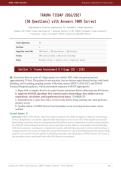
TRAUMA FISDAP 2026/2027 50-Question Comprehensive Practice Exam
TRAUMA FISDAP 2026/2027
(50 Questions) with Answers 100% Correct
Comprehensive Practice Examination for Paramedic Trauma Education
Aligned with FISDAP Trauma Exam Blueprint | National Registry of EMT (NREMT) Paramedic Trauma Standards |
Prehospital Trauma Life Support (PHTLS) Guidelines 2026/2027 Edition
Total Questions 50
Sections 6
Cognitive Level Mix 20% Recall / 50% Application / 30% Analysis
Format 80% scenario-based / 20% direct knowledge
Style Multiple choice, 4 options (A-D), single best answer
Section 1: Trauma Assessment & Triage (Q1 - Q10)
Q1: You arrive first on scene of a high-speed, two-vehicle MVC with one patient ejected
approximately 20 feet. The patient is unconscious, has an obvious open femur fracture with brisk
bleeding, and is making gurgling sounds. Following current PHTLS (2026/2027) and FISDAP
Trauma Blueprint guidance, which assessment sequence is MOST appropriate?
A. Begin with a complete head-to-toe rapid trauma assessment before addressing any life threats.
B. Apply the MARCH algorithm: first control massive hemorrhage, then address airway,
respirations, circulation, and hypothermia/head injury. *[CORRECT]*
C. Immobilize the C-spine first with a cervical collar before doing anything else, then perform a
primary survey.
D. Quickly obtain a SAMPLE history from bystanders so the receiving trauma center can be
notified.
Correct Answer: B
Rationale: PHTLS (9th edition, 2026/2027 update) endorses the MARCH sequence (Massive hemorrhage,
Airway, Respiration, Circulation, Hypothermia/Head injury) over classic ABC when significant external
hemorrhage is present, because exsanguination kills before airway compromise in many trauma patients.
The FISDAP Trauma Blueprint likewise expects providers to first address catastrophic external bleeding
with direct pressure, tourniquets, or hemostatic agents, and only then proceed to airway and breathing. A
complete head-to-toe exam (A) delays life-saving interventions, C-spine immobilization before hemorrhage
control (C) is unsafe when the patient is bleeding externally, and obtaining a SAMPLE history (D) is part of
the secondary survey performed only after life threats are managed.
Aligned with FISDAP Trauma Blueprint | NREMT Paramedic Standards | PHTLS 2026/2027 Page 1
,TRAUMA FISDAP 2026/2027 50-Question Comprehensive Practice Exam
Q2: A 24-year-old male pedestrian was struck by an SUV traveling approximately 35 mph. He is
alert, oriented to person only, and complains of chest and left-upper-quadrant abdominal pain.
Vital signs: HR 122, BP 104/68, RR 24, SpO2 94% on room air. GCS is 13 (E3, V4, M6). Which GCS
component scoring is MOST correct?
A. Eye opening = 3 (to pain), Verbal = 4 (confused), Motor = 6 (obeys commands).
B. Eye opening = 4 (spontaneous), Verbal = 4 (confused), Motor = 5 (localizes pain).
C. Eye opening = 3 (to verbal), Verbal = 4 (confused), Motor = 6 (obeys commands).
*[CORRECT]*
D. Eye opening = 4 (spontaneous), Verbal = 3 (inappropriate words), Motor = 6 (obeys commands).
Correct Answer: C
Rationale: The patient is described as alert and oriented to person only. 'Alert' but disoriented maps to eye
opening to verbal stimulus (E3) because the eyes are already open in an alert patient but the verbal
stimulus is what keeps him engaged; verbal response is confused (V4) because he is oriented to person only
(not place or time); motor response is obeys commands (M6) when the patient follows commands such as '
squeeze my fingers' or 'wiggle your toes.' FISDAP and NREMT expect accurate component scoring because
trend monitoring hinges on correct baselines. Options A and B mismatch the alert-but-disoriented picture,
and option D overstates verbal impairment (inappropriate words = V3 would imply comprehensible but
non-conversational speech, not mere disorientation).
Q3: Which of the following patients BEST meets CDC Field Triage Guidelines (2024/2026 update)
Step One — physiologic criteria — mandating transport to the highest-level trauma center within
geographic capability?
A. A 35-year-old restrained driver with a GCS of 14 and a systolic BP of 110 mmHg.
B. a 28-year-old fall victim with a respiratory rate of 10 breaths/min and a GCS of 11.
*[CORRECT]*
C. A 50-year-old cyclist with a closed tibia-fibula fracture and a systolic BP of 130 mmHg.
D. A 42-year-old assault victim with a laceration to the scalp and a GCS of 15.
Correct Answer: B
Rationale: CDC Field Triage Guidelines Step One (physiologic) criteria are: GCS ≤ 13, systolic BP < 110
mmHg, or respiratory rate < 10 or > 29 breaths/min (< 20 in infants < 1 year). A respiratory rate of 10 and
GCS of 11 meet two physiologic criteria and require transport to the highest-level trauma center. Patients in
A, C, and D do not meet physiologic thresholds; they may still meet anatomic (Step Two) or mechanism
(Step Three) criteria, but Step One specifically captures the most critically injured who cannot compensate.
FISDAP Trauma Blueprint and NREMT paramedic standards require recognition of these objective
physiologic triggers.
Aligned with FISDAP Trauma Blueprint | NREMT Paramedic Standards | PHTLS 2026/2027 Page 2
, TRAUMA FISDAP 2026/2027 50-Question Comprehensive Practice Exam
Q4: Which statement BEST describes the relationship between the 'Golden Hour' and 'Platinum 10
Minutes' as they relate to prehospital trauma care?
A. The Golden Hour is the window in which a trauma surgeon must be on scene; the Platinum 10 is
the time to package the patient.
B. The Golden Hour refers to the time from injury to definitive surgical care; the Platinum 10
Minutes refers to the goal of completing on-scene assessment, life-saving interventions, and
packaging within 10 minutes. *[CORRECT]*
C. Both terms are synonymous and refer to the 60-minute window between injury and arrival at a
trauma center.
D. The Platinum 10 Minutes refers to the time spent in the trauma bay before operative
management; the Golden Hour is the time from arrival to surgery.
Correct Answer: B
Rationale: The Golden Hour, popularized by R Adams Cowley, reflects the principle that critically injured
patients have the best outcomes when definitive surgical care is delivered within 60 minutes of injury. The
Platinum 10 Minutes is the prehospital corollary emphasized by PHTLS and FISDAP: scene time should be
minimized to roughly 10 minutes when feasible, with rapid assessment, life-saving interventions
(hemorrhage control, airway management, needle decompression), and patient packaging completed
expeditiously. Options A, C, and D misattribute these time targets — the Platinum 10 is a prehospital
scene-time benchmark, not a trauma-bay or surgeon-on-scene concept.
Q5: A 19-year-old male is involved in a motorcycle crash at an estimated 55 mph. He was wearing a
helmet but was thrown approximately 30 feet. He is unresponsive, has unequal pupils (left 6 mm,
right 3 mm), and exhibits decerebrate posturing to painful stimuli. His ventilation is irregular at 8
breaths/min. What is the MOST likely mechanism of injury pattern requiring the highest index of
suspicion?
A. Isolated closed head injury with no concern for cervical spine injury.
B. Significant traumatic brain injury with possible increased intracranial pressure AND
concomitant cervical spine injury requiring spinal motion restriction. *[CORRECT]*
C. Simple concussion that will resolve with observation in the field.
D. Cardiac tamponade secondary to blunt chest impact.
Correct Answer: B
Rationale: An unresponsive patient with anisocoria, decerebrate posturing, and irregular respirations
displays classic signs of severe TBI with impending herniation (Cushing's triad variant). Additionally, any
patient with a significant mechanism of injury and altered mental status must be presumed to have a
concomitant cervical spine injury until proven otherwise; PHTLS endorses spinal motion restriction in
such cases. Option A ignores the cervical spine risk, option C dramatically underestimates injury severity,
and option D is unsupported by the presentation. FISDAP and NREMT both emphasize index of suspicion —
predicting injury patterns from mechanism and presentation.
Aligned with FISDAP Trauma Blueprint | NREMT Paramedic Standards | PHTLS 2026/2027 Page 3
TRAUMA FISDAP 2026/2027
(50 Questions) with Answers 100% Correct
Comprehensive Practice Examination for Paramedic Trauma Education
Aligned with FISDAP Trauma Exam Blueprint | National Registry of EMT (NREMT) Paramedic Trauma Standards |
Prehospital Trauma Life Support (PHTLS) Guidelines 2026/2027 Edition
Total Questions 50
Sections 6
Cognitive Level Mix 20% Recall / 50% Application / 30% Analysis
Format 80% scenario-based / 20% direct knowledge
Style Multiple choice, 4 options (A-D), single best answer
Section 1: Trauma Assessment & Triage (Q1 - Q10)
Q1: You arrive first on scene of a high-speed, two-vehicle MVC with one patient ejected
approximately 20 feet. The patient is unconscious, has an obvious open femur fracture with brisk
bleeding, and is making gurgling sounds. Following current PHTLS (2026/2027) and FISDAP
Trauma Blueprint guidance, which assessment sequence is MOST appropriate?
A. Begin with a complete head-to-toe rapid trauma assessment before addressing any life threats.
B. Apply the MARCH algorithm: first control massive hemorrhage, then address airway,
respirations, circulation, and hypothermia/head injury. *[CORRECT]*
C. Immobilize the C-spine first with a cervical collar before doing anything else, then perform a
primary survey.
D. Quickly obtain a SAMPLE history from bystanders so the receiving trauma center can be
notified.
Correct Answer: B
Rationale: PHTLS (9th edition, 2026/2027 update) endorses the MARCH sequence (Massive hemorrhage,
Airway, Respiration, Circulation, Hypothermia/Head injury) over classic ABC when significant external
hemorrhage is present, because exsanguination kills before airway compromise in many trauma patients.
The FISDAP Trauma Blueprint likewise expects providers to first address catastrophic external bleeding
with direct pressure, tourniquets, or hemostatic agents, and only then proceed to airway and breathing. A
complete head-to-toe exam (A) delays life-saving interventions, C-spine immobilization before hemorrhage
control (C) is unsafe when the patient is bleeding externally, and obtaining a SAMPLE history (D) is part of
the secondary survey performed only after life threats are managed.
Aligned with FISDAP Trauma Blueprint | NREMT Paramedic Standards | PHTLS 2026/2027 Page 1
,TRAUMA FISDAP 2026/2027 50-Question Comprehensive Practice Exam
Q2: A 24-year-old male pedestrian was struck by an SUV traveling approximately 35 mph. He is
alert, oriented to person only, and complains of chest and left-upper-quadrant abdominal pain.
Vital signs: HR 122, BP 104/68, RR 24, SpO2 94% on room air. GCS is 13 (E3, V4, M6). Which GCS
component scoring is MOST correct?
A. Eye opening = 3 (to pain), Verbal = 4 (confused), Motor = 6 (obeys commands).
B. Eye opening = 4 (spontaneous), Verbal = 4 (confused), Motor = 5 (localizes pain).
C. Eye opening = 3 (to verbal), Verbal = 4 (confused), Motor = 6 (obeys commands).
*[CORRECT]*
D. Eye opening = 4 (spontaneous), Verbal = 3 (inappropriate words), Motor = 6 (obeys commands).
Correct Answer: C
Rationale: The patient is described as alert and oriented to person only. 'Alert' but disoriented maps to eye
opening to verbal stimulus (E3) because the eyes are already open in an alert patient but the verbal
stimulus is what keeps him engaged; verbal response is confused (V4) because he is oriented to person only
(not place or time); motor response is obeys commands (M6) when the patient follows commands such as '
squeeze my fingers' or 'wiggle your toes.' FISDAP and NREMT expect accurate component scoring because
trend monitoring hinges on correct baselines. Options A and B mismatch the alert-but-disoriented picture,
and option D overstates verbal impairment (inappropriate words = V3 would imply comprehensible but
non-conversational speech, not mere disorientation).
Q3: Which of the following patients BEST meets CDC Field Triage Guidelines (2024/2026 update)
Step One — physiologic criteria — mandating transport to the highest-level trauma center within
geographic capability?
A. A 35-year-old restrained driver with a GCS of 14 and a systolic BP of 110 mmHg.
B. a 28-year-old fall victim with a respiratory rate of 10 breaths/min and a GCS of 11.
*[CORRECT]*
C. A 50-year-old cyclist with a closed tibia-fibula fracture and a systolic BP of 130 mmHg.
D. A 42-year-old assault victim with a laceration to the scalp and a GCS of 15.
Correct Answer: B
Rationale: CDC Field Triage Guidelines Step One (physiologic) criteria are: GCS ≤ 13, systolic BP < 110
mmHg, or respiratory rate < 10 or > 29 breaths/min (< 20 in infants < 1 year). A respiratory rate of 10 and
GCS of 11 meet two physiologic criteria and require transport to the highest-level trauma center. Patients in
A, C, and D do not meet physiologic thresholds; they may still meet anatomic (Step Two) or mechanism
(Step Three) criteria, but Step One specifically captures the most critically injured who cannot compensate.
FISDAP Trauma Blueprint and NREMT paramedic standards require recognition of these objective
physiologic triggers.
Aligned with FISDAP Trauma Blueprint | NREMT Paramedic Standards | PHTLS 2026/2027 Page 2
, TRAUMA FISDAP 2026/2027 50-Question Comprehensive Practice Exam
Q4: Which statement BEST describes the relationship between the 'Golden Hour' and 'Platinum 10
Minutes' as they relate to prehospital trauma care?
A. The Golden Hour is the window in which a trauma surgeon must be on scene; the Platinum 10 is
the time to package the patient.
B. The Golden Hour refers to the time from injury to definitive surgical care; the Platinum 10
Minutes refers to the goal of completing on-scene assessment, life-saving interventions, and
packaging within 10 minutes. *[CORRECT]*
C. Both terms are synonymous and refer to the 60-minute window between injury and arrival at a
trauma center.
D. The Platinum 10 Minutes refers to the time spent in the trauma bay before operative
management; the Golden Hour is the time from arrival to surgery.
Correct Answer: B
Rationale: The Golden Hour, popularized by R Adams Cowley, reflects the principle that critically injured
patients have the best outcomes when definitive surgical care is delivered within 60 minutes of injury. The
Platinum 10 Minutes is the prehospital corollary emphasized by PHTLS and FISDAP: scene time should be
minimized to roughly 10 minutes when feasible, with rapid assessment, life-saving interventions
(hemorrhage control, airway management, needle decompression), and patient packaging completed
expeditiously. Options A, C, and D misattribute these time targets — the Platinum 10 is a prehospital
scene-time benchmark, not a trauma-bay or surgeon-on-scene concept.
Q5: A 19-year-old male is involved in a motorcycle crash at an estimated 55 mph. He was wearing a
helmet but was thrown approximately 30 feet. He is unresponsive, has unequal pupils (left 6 mm,
right 3 mm), and exhibits decerebrate posturing to painful stimuli. His ventilation is irregular at 8
breaths/min. What is the MOST likely mechanism of injury pattern requiring the highest index of
suspicion?
A. Isolated closed head injury with no concern for cervical spine injury.
B. Significant traumatic brain injury with possible increased intracranial pressure AND
concomitant cervical spine injury requiring spinal motion restriction. *[CORRECT]*
C. Simple concussion that will resolve with observation in the field.
D. Cardiac tamponade secondary to blunt chest impact.
Correct Answer: B
Rationale: An unresponsive patient with anisocoria, decerebrate posturing, and irregular respirations
displays classic signs of severe TBI with impending herniation (Cushing's triad variant). Additionally, any
patient with a significant mechanism of injury and altered mental status must be presumed to have a
concomitant cervical spine injury until proven otherwise; PHTLS endorses spinal motion restriction in
such cases. Option A ignores the cervical spine risk, option C dramatically underestimates injury severity,
and option D is unsupported by the presentation. FISDAP and NREMT both emphasize index of suspicion —
predicting injury patterns from mechanism and presentation.
Aligned with FISDAP Trauma Blueprint | NREMT Paramedic Standards | PHTLS 2026/2027 Page 3


