This NYC Electrician Exam 2026/2027 study resource contains 50+ multiple-choice questions with answers, electrical calculations and NEC article/table references across 35 pages. It is designed for electrician exam review and covers circuit breakers, conductor ampacity, conduit fill, branch circuits, grounding, switchboards, overcurrent protection and electrical terminology. Early questions reference Article 100 definitions, Chapter 9 Table 1, Article 358.30(A), Article 210.20(A) and Table 310.16, with practical problems involving adjustable circuit-breaker settings, the 40% conduit-fill rule for three or more conductors, EMT support distances, continuous-load sizing and copper-conductor ampacity.
A substantial section addresses grounding, bonding, feeders and overcurrent protection. Students review grounded or neutral conductors, grounding electrodes, standard fuse and inverse-time circuit-breaker ratings, feeder-tap rules and service grounded-conductor sizing. The document also covers domestic water-heater circuit sizing, emergency-system unit equipment, busway overcurrent-protection exceptions, slash-rated circuit breakers and insulation requirements for grounded conductors. These questions repeatedly connect answers with specific NEC articles and tables, making the material useful for practicing code-book navigation as well as factual recall.
The resource provides extensive practice on transformers, motors and electrical power calculations. Transformer topics include vault fire-resistance requirements, outdoor dry-type transformer enclosures, autotransformer overcurrent protection and grounding autotransformers. Motor questions cover wound-rotor motors, motor terminal conduit, small-motor branch circuits, locked-rotor current, secondary conductors, motor overload protection, starter rheostats, motor controllers and grounding or guarding portable motors. Calculation examples include copper busbar current capacity and determining current for a 120-volt fluorescent-lighting circuit using power factor.
Another important area is raceways, boxes, panelboards and working clearances. Candidates review EMT dimensions and conductor capacity, box-fill limits, feeder definitions, panelboard bonding in healthcare facilities, wire-bending space and minimum electrical working clearances at 480 volts. The study set also addresses the maximum operating-handle height for switches and circuit breakers, spacing between current-carrying parts of opposite polarity and branch-circuit requirements for diagnostic equipment in healthcare facilities.
The document additionally tests fundamental electrical theory and diagnostic measurement. Topics include power factor as the ratio of true power to apparent power, conductance as the reciprocal of resistance, maximum power transfer, watt-hour meters, DC power factor and Wheatstone bridges. Troubleshooting questions cover fuse behavior, partial grounds or ground faults and insulation testing with a megger, including the voltage relationship used for insulation testing and the instrument voltage ranges stated in the study material.
The final sections emphasize hazardous locations and specialized electrical installations. Students encounter Class I and Class III locations, explosionproof equipment, conduit seals, ignitable fibers, motor guarding and grounding, healthcare electrical installations and service-entrance conductor requirements. The document cites provisions including Articles 430, 440, 450, 500, 501 and 517, alongside numerous other NEC references throughout the practice set. Because electrical codes and NYC licensing requirements can change between code cycles, candidates should verify the document’s article numbers, requirements and answers against the code edition officially required for their examination.
Relevant students: NYC electrician exam candidates, New York City electrician license candidates, Master Electrician candidates, Special Electrician candidates, electrical apprentices, journeyman electricians, electrical trade students, electrical technology students, NEC exam candidates, electrical contractors, maintenance electricians, industrial electricians, commercial electricians, motor-control technicians, and professionals reviewing electrical code calculations and installation requirements. The document identifies the assessment as the NYC Electrician Exam, but it does not provide a university or academic course code, so neither has been invented.
Keywords: NYC Electrician Exam 2026, NYC electrician exam questions and answers, New York City electrician exam, NYC electrician practice test, NYC electrical exam study guide, electrician exam 2026, electrician license exam, Master Electrician exam, Special Electrician exam, NEC exam questions, NEC code practice test, electrical code questions and answers, NEC Article 100, NEC Article 210, NEC Article 240, NEC Article 250, NEC Article 310, NEC Article 430, NEC Article 450, NEC Article 500, NEC Article 517, conductor ampacity, conduit fill calculations, EMT conduit, electrical box fill, branch circuit sizing, continuous load calculation, overcurrent protection, circuit breaker sizing, feeder tap rules, grounding and bonding, grounded conductor, neutral conductor sizing, transformer calculations, motor circuits, motor overload protection, motor controllers, power factor calculation, electrical working clearance, panelboard requirements, hazardous locations, Class I Division 1, Class III Division 2, megger testing, Wheatstone bridge, electrical troubleshooting, electrician code calculations, electrical licensing exam
Content preview
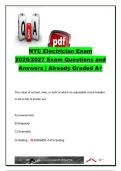
NYC Electrician Exam
2026/2027 Exam Questions and
Answers | Already Graded A+
The value of current, time, or both at which an adjustable circuit breaker
is set to trip is known as?
A) Inverse time
B) Ampacity
C) Automatic
D) Setting - ANSWER ✔✔D) Setting.
,Art. 100 Defintions
The cross-sectional area of three or more THW conductors in a conduit
must not exceed what percent of the cross-sectional area of the conduit?
A) 30%
B) 40%
C) 50%
D) 60% - ANSWER ✔✔B) 40 %
Chapter 9 Table 1
EMT must be supported within what distance from an outlet box, junction
box, device box, cabinet, conduit body or other terminations?
A) 3 feet
B) 4 feet
C) 5 feet
D) 6 feet - ANSWER ✔✔A) 3 feet
,Article 358.30 (A)
When a branch circuit feeds both noncontinuous and continuous loads,
the circuit must be sized to accommodate 100% of the noncontinuous
load plus what percent of the continuous load?
A) 110%
B) 115%
C) 120 %
D) 125% - ANSWER ✔✔D) 125%
Article. 210.20 (A)
What is the allowable Ampacity of a 600 MCM copper conductor type
TW?
A) 300 Amps
B) 350 Amps
C) 355 Amps
3
COPYRIGHT©JOSHCLAY 2026/2027. YEAR PUBLISHED 2026. COMPANY REGISTRATION NUMBER: 619652435. TERMS OF USE. PRIVACY
STATEMENT. ALL RIGHTS RESERVED
, D) 400 Amps - ANSWER ✔✔B) 350 Amps
Table- 310.16
The name given to a system or circuit conductor that is intentionally
grounded is?
A) Grounding Conductor
B) Bonding Conductor
C) High-leg conductor
D) Grounded or neutral conductor - ANSWER ✔✔D) Grounded or
Neutral Conductor
Article 100 Definitions
The panels of switchboards must be made of?
A) Moisture resistant, noncombustible material
B) Raintight material