

Chapter 1: Limits and Derivatives
Sources: "Problems in Calculus of One Variable" by I.A. Maron & "Putnam and Beyond" by Titu Andreescu
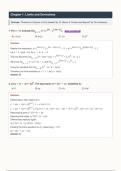
1. For x > 0, evaluate lim
1/n - x1/(n+1) ].
n→∞ n² [ x OLYMPIAD LEVEL
A) x ln(x) B) ln(x) C) 1/x D) ex
Solution:
Rewrite the expression: n² x
1/(n+1) [ x1/n - 1/(n+1) - 1 ] = n² x1/(n+1) [ x1/(n(n+1)) - 1 ].
Let u = 1 / (n(n+1)). As n → ∞, u → 0.
The limit becomes lim
1/(n+1) × [ (xu - 1) / u ].
n→∞ [n² / (n(n+1))] × x
We know lim
1/(n+1) = x0 = 1.
n→∞ n² / (n²+n) = 1, and limn→∞ x
Using the standard limit lim
u
u→0 (x - 1) / u = ln(x).
Therefore, the limit evaluates to 1 × 1 × ln(x) = ln(x).
Answer: B
n
2. Let y = (x + √(x²+1)) . The expression (x²+1)y'' + xy' simplifies to:
A) 0 B) ny C) n²y D) n²y²
Solution:
Differentiate y with respect to x:
y' = n(x + √(x²+1))n-1 [ 1 + x/√(x²+1) ].
y' = n(x + √(x²+1))n-1 [ (√(x²+1) + x) / √(x²+1) ] = n(x + √(x²+1))n / √(x²+1) = ny / √(x²+1).
Rearranging gives y' √(x²+1) = ny.
Squaring both sides: (y')²(x²+1) = n²y².
Differentiate implicitly again:
2y'y''(x²+1) + (y')²(2x) = 2n²yy'.
Dividing the entire equation by 2y' (assuming y' ≠ 0):
(x²+1)y'' + xy' = n²y.
Answer: C
, 3. Evaluate lim
x² sin(√t) dt ] / x³.
x→0 [ ∫0 CONCEPTUAL / FAST
A) 1/3 B) 2/3 C) 1 D) 0
Solution:
This is a 0/0 indeterminate form. Apply L'Hôpital's Rule alongside the Leibniz Integral Rule.
Derivative of the numerator: d/dx [ ∫
x²
0 sin(√t) dt ] = sin(√(x²)) · (2x) = 2x sin x.
Derivative of the denominator: 3x².
The limit becomes lim
x→0 (2x sin x) / (3x²) = limx→0 (2/3) (sin x / x).
Since lim
x→0 (sin x / x) = 1, the result is 2/3.
Answer: B
4. Evaluate lim
n→∞ Σ(k=1 to n) 1 / √(4n² - k²).
A) π/2 B) π/3 C) π/6 D) 1/2
Solution:
Factor out n² from the square root to convert the sum into a Riemann integral form:
Σ 1 / √(n²(4 - (k/n)²)) = (1/n) Σ 1 / √(4 - (k/n)²).
Let dx = 1/n and x = k/n. As n → ∞, the summation transitions into a definite integral from 0 to 1.
∫01 1 / √(4 - x²) dx = [ sin-1(x/2) ]01.
= sin-1(1/2) - sin-1(0) = π/6 - 0 = π/6.
Answer: C
5. Let f(x) = x |x|. What is the value of f''(0)?
A) 0 B) 2 C) -2 D) Does not exist
Solution:
The function can be written piecewise: f(x) = x² for x ≥ 0, and f(x) = -x² for x < 0.
Taking the first derivative: f'(x) = 2x for x ≥ 0, and f'(x) = -2x for x < 0. Thus, f'(x) = 2|x|.
The function f'(x) = 2|x| has a sharp corner at x = 0. The left-hand derivative approaches -2 and the right-
hand derivative approaches 2.
Because the left and right derivatives of f'(x) are not equal at x=0, f''(0) does not exist.
Answer: D
Chapter 2: Functions
Sources: "Problems in Calculus of One Variable" by I.A. Maron & "Putnam and Beyond" by Titu Andreescu
1. For x > 0, evaluate lim
1/n - x1/(n+1) ].
n→∞ n² [ x OLYMPIAD LEVEL
A) x ln(x) B) ln(x) C) 1/x D) ex
Solution:
Rewrite the expression: n² x
1/(n+1) [ x1/n - 1/(n+1) - 1 ] = n² x1/(n+1) [ x1/(n(n+1)) - 1 ].
Let u = 1 / (n(n+1)). As n → ∞, u → 0.
The limit becomes lim
1/(n+1) × [ (xu - 1) / u ].
n→∞ [n² / (n(n+1))] × x
We know lim
1/(n+1) = x0 = 1.
n→∞ n² / (n²+n) = 1, and limn→∞ x
Using the standard limit lim
u
u→0 (x - 1) / u = ln(x).
Therefore, the limit evaluates to 1 × 1 × ln(x) = ln(x).
Answer: B
n
2. Let y = (x + √(x²+1)) . The expression (x²+1)y'' + xy' simplifies to:
A) 0 B) ny C) n²y D) n²y²
Solution:
Differentiate y with respect to x:
y' = n(x + √(x²+1))n-1 [ 1 + x/√(x²+1) ].
y' = n(x + √(x²+1))n-1 [ (√(x²+1) + x) / √(x²+1) ] = n(x + √(x²+1))n / √(x²+1) = ny / √(x²+1).
Rearranging gives y' √(x²+1) = ny.
Squaring both sides: (y')²(x²+1) = n²y².
Differentiate implicitly again:
2y'y''(x²+1) + (y')²(2x) = 2n²yy'.
Dividing the entire equation by 2y' (assuming y' ≠ 0):
(x²+1)y'' + xy' = n²y.
Answer: C
, 3. Evaluate lim
x² sin(√t) dt ] / x³.
x→0 [ ∫0 CONCEPTUAL / FAST
A) 1/3 B) 2/3 C) 1 D) 0
Solution:
This is a 0/0 indeterminate form. Apply L'Hôpital's Rule alongside the Leibniz Integral Rule.
Derivative of the numerator: d/dx [ ∫
x²
0 sin(√t) dt ] = sin(√(x²)) · (2x) = 2x sin x.
Derivative of the denominator: 3x².
The limit becomes lim
x→0 (2x sin x) / (3x²) = limx→0 (2/3) (sin x / x).
Since lim
x→0 (sin x / x) = 1, the result is 2/3.
Answer: B
4. Evaluate lim
n→∞ Σ(k=1 to n) 1 / √(4n² - k²).
A) π/2 B) π/3 C) π/6 D) 1/2
Solution:
Factor out n² from the square root to convert the sum into a Riemann integral form:
Σ 1 / √(n²(4 - (k/n)²)) = (1/n) Σ 1 / √(4 - (k/n)²).
Let dx = 1/n and x = k/n. As n → ∞, the summation transitions into a definite integral from 0 to 1.
∫01 1 / √(4 - x²) dx = [ sin-1(x/2) ]01.
= sin-1(1/2) - sin-1(0) = π/6 - 0 = π/6.
Answer: C
5. Let f(x) = x |x|. What is the value of f''(0)?
A) 0 B) 2 C) -2 D) Does not exist
Solution:
The function can be written piecewise: f(x) = x² for x ≥ 0, and f(x) = -x² for x < 0.
Taking the first derivative: f'(x) = 2x for x ≥ 0, and f'(x) = -2x for x < 0. Thus, f'(x) = 2|x|.
The function f'(x) = 2|x| has a sharp corner at x = 0. The left-hand derivative approaches -2 and the right-
hand derivative approaches 2.
Because the left and right derivatives of f'(x) are not equal at x=0, f''(0) does not exist.
Answer: D
Chapter 2: Functions


