
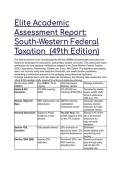
Elite Academic
Assessment Report:
South-Western Federal
Taxation (49th Edition)
The 2026 enactment of the One Big Beautiful Bill Act (OBBBA) fundamentally restructures the
federal tax landscape for corporations, partnerships, estates, and trusts. This assessment report
synthesizes the core statutory modifications mapped to the South-Western Federal Taxation
2026: Corporations, Partnerships, Estates and Trusts, 49th Edition. The legislation permanently
alters cost recovery, entity-level deduction thresholds, and wealth transfer parameters,
demanding a modernized approach to tax pedagogy and professional application.
To bridge academic theory and high-stakes tax compliance, the following table isolates the most
critical 2026 paradigm shifts required for entity and estate tax planning :
Tax Provision (2026 Pre-OBBBA (TCJA 2026 Permanent Strategic Implication
OBBBA) Legacy) Statutory Update
Estate & Gift $13.99M (expiring $15,000,000 per Permanently shields
Exemption 2025) individual ($30M MFJ). legacy wealth; shifts
focus to state-level
cliffs (e.g., NY).
Section 163(j) ATI EBIT (depreciation not EBITDA restored; Increases allowable
Base added back). capitalization business interest
workaround closed. deduction but traps
capitalized interest.
Itemized Deductions Subject to Pease The 2/37 Rule: Tax Shaves 5.4% off the
limitations or fully benefit capped at 35% top of all itemized
allowed. for the 37% bracket. deductions for
high-net-worth
taxpayers.
Section 139L Fully taxable interest. 25% exclusion on Eliminates
Exclusion agricultural loans; 25% double-dipping while
expense disallowance. incentivizing rural
lending.
Section 199A (QBI) Expiring 20% Permanent 20%; new Secures permanent
deduction. $400 minimum pass-through parity
deduction floor. with the flat 21%
corporate rate.
,PART 0: THE NAVIGATOR
● Tier 1: Foundational Syntax & Application (Questions 1–28)
○ Focus: OBBBA 2026 mechanics, Section 139L parameters, Section 351/721 control
tests, QBI baselines, and permanent Estate Tax exemptions.
● Tier 2: Complex Application & Simulation (Questions 29–58)
○ Focus: Interaction between the 2/37 Rule, Section 163(j) EBITDA modifications,
capitalization workarounds, and flow-through phase-ins.
● Tier 3: Grandmaster Synthesis (Questions 59–88)
○ Focus: Multi-variable scenarios involving Section 332 liquidations, S-Corporation
Built-In Gains (BIG) tax, and complex basis adjustments.
PART I: THE PRIMER
Mastering this analytical sequence bridges the gap between academic theory and operational
tax compliance. The rigorous application of these principles separates operational novices from
elite tax strategists capable of navigating the global 2026 tax landscape.
● The OBBBA Estate Axiom: The federal estate and GST tax exemption is permanently
elevated to $15 million per individual effective January 1, 2026.
● The Section 139L Rule: Qualified lenders exclude 25% of interest income from eligible
agricultural loans; Section 265 simultaneously disallows 25% of the associated interest
expense.
● The 2/37 Itemized Haircut: For taxpayers in the 37% bracket, the tax benefit of itemized
deductions is reduced by 2/37ths (capped at 35 cents on the dollar).
● The Section 163(j) Trap: Adjusted Taxable Income (ATI) reverts to EBITDA. However,
electively capitalizing interest (e.g., Section 263A) to avoid the limitation is now
permanently outlawed.
● The QBI Baseline: The 20% deduction is permanent. Phase-in ranges escalate to
$197,300 (Single) and $394,600 (MFJ), coupled with a $400 minimum deduction.
PART II: THE ELITE TEST BANK
Q1: An FDIC-insured bank originates an aquaculture facility loan on August 1, 2025. In 2026, it
generates $400,000 in interest income and incurs $100,000 in associated interest expense.
Based on Section 139L and Section 265, what is the net taxable income from this loan? A)
$300,000 B) $225,000 C) $200,000 D) $275,000
● The Answer: B ($225,000)
● Distractor Analysis:
○ A is incorrect: Calculates raw cash flow without applying the statutory exclusion.
○ C is incorrect: Excludes 25% of income ($100k) but wrongly deducts the full $100k
expense.
○ D is incorrect: Represents a math error in applying the 25% expense disallowance.
The Mentor's Analysis: Section 139L excludes 25% of the income ($100k excluded; $300k
taxable). Section 265 disallows 25% of the expense ($25k disallowed; $75k deductible). $300k -
$75k = $225k. Professional/Academic Intuition: Section 139L shields agricultural income but
forces a symmetrical sacrifice of the associated deduction.
Q2: A married couple dies in 2026 with a $29,000,000 combined gross estate. Neither made
, taxable gifts. Based on 2026 permanent estate tax parameters, what is their federal estate tax
liability? A) $0 B) $5,604,000 C) $400,000 D) $11,600,000
● The Answer: A ($0)
● Distractor Analysis:
○ B is incorrect: Assumes expiration of TCJA limits and reversion to pre-2018
parameters.
○ C is incorrect: Assumes the outdated 2025 $13.99M limits.
○ D is incorrect: Taxes the entire estate, ignoring the exclusion entirely.
The Mentor's Analysis: The 2026 OBBBA raised the exemption to $15 million per individual ($30
million MFJ). The $29M estate is fully shielded. Professional/Academic Intuition: The 2026
permanent exemption provides a $30 million absolute tax shield for married couples.
Q3: A married couple in the 37% bracket claims $100,000 in allowable itemized deductions in
2026. Under the 2/37 Rule, what is the maximum actual tax savings generated by these
deductions? A) $37,000 B) $35,000 C) $100,000 D) $0
● The Answer: B ($35,000)
● Distractor Analysis:
○ A is incorrect: Reflects legacy rules prior to the OBBBA 2/37 haircut.
○ C is incorrect: Confuses deduction face value with tax savings.
○ D is incorrect: The rule limits the benefit; it does not eliminate it.
The Mentor's Analysis: The 2/37 rule artificially caps the tax benefit of itemized deductions for
top-bracket taxpayers at 35 cents on the dollar. Professional/Academic Intuition: The 2/37
haircut permanently shaves the top marginal deduction benefit from 37% down to 35%.
Q4: A taxpayer transfers property (FMV $500,000; Basis $200,000) to a newly formed
C-Corporation for 75% of its stock. No other transfers occur. Under Section 351, what is the
recognized gain? A) $0 B) $150,000 C) $300,000 D) $500,000
● The Answer: C ($300,000)
● Distractor Analysis:
○ A is incorrect: Assumes tax-free treatment, but the 80% control test is failed.
○ B is incorrect: Pro-rata gain recognition is not a valid tax concept here.
○ D is incorrect: Taxes the entire FMV, ignoring the taxpayer's basis.
The Mentor's Analysis: Section 351 demands absolute compliance with the 80% control
requirement. Holding 75% triggers full realization of the $300,000 built-in gain.
Professional/Academic Intuition: Section 351 requires 80% control; falling even 1% short
triggers full taxation on the contributed property.
Q5: Individual A transfers appreciated property (FMV $1,000,000; Basis $200,000) to an LLC
taxed as a partnership for a 40% interest. Under Section 721, what amount of gain is
recognized? A) $800,000 B) $0 C) $400,000 D) $480,000
● The Answer: B ($0)
● Distractor Analysis:
○ A is incorrect: Applies the corporate 80% control failure logic to a partnership.
○ C is incorrect: Pro-rata taxation is invalid.
○ D is incorrect: Taxes gain based on the remaining 60% partner interest.
The Mentor's Analysis: Section 721 has no 80% control requirement. Contributions to
partnerships are universally tax-free regardless of ownership percentage.
Professional/Academic Intuition: Partnership formations bypass the Section 351 control
trap, offering absolute nonrecognition for property contributions.
Q6: In 2026, an individual with an AGI of $1,000,000 donates $10,000 cash to a charity.
Assuming they itemize, what is the deductible amount under OBBBA constraints? A) $10,000 B)
Assessment Report:
South-Western Federal
Taxation (49th Edition)
The 2026 enactment of the One Big Beautiful Bill Act (OBBBA) fundamentally restructures the
federal tax landscape for corporations, partnerships, estates, and trusts. This assessment report
synthesizes the core statutory modifications mapped to the South-Western Federal Taxation
2026: Corporations, Partnerships, Estates and Trusts, 49th Edition. The legislation permanently
alters cost recovery, entity-level deduction thresholds, and wealth transfer parameters,
demanding a modernized approach to tax pedagogy and professional application.
To bridge academic theory and high-stakes tax compliance, the following table isolates the most
critical 2026 paradigm shifts required for entity and estate tax planning :
Tax Provision (2026 Pre-OBBBA (TCJA 2026 Permanent Strategic Implication
OBBBA) Legacy) Statutory Update
Estate & Gift $13.99M (expiring $15,000,000 per Permanently shields
Exemption 2025) individual ($30M MFJ). legacy wealth; shifts
focus to state-level
cliffs (e.g., NY).
Section 163(j) ATI EBIT (depreciation not EBITDA restored; Increases allowable
Base added back). capitalization business interest
workaround closed. deduction but traps
capitalized interest.
Itemized Deductions Subject to Pease The 2/37 Rule: Tax Shaves 5.4% off the
limitations or fully benefit capped at 35% top of all itemized
allowed. for the 37% bracket. deductions for
high-net-worth
taxpayers.
Section 139L Fully taxable interest. 25% exclusion on Eliminates
Exclusion agricultural loans; 25% double-dipping while
expense disallowance. incentivizing rural
lending.
Section 199A (QBI) Expiring 20% Permanent 20%; new Secures permanent
deduction. $400 minimum pass-through parity
deduction floor. with the flat 21%
corporate rate.
,PART 0: THE NAVIGATOR
● Tier 1: Foundational Syntax & Application (Questions 1–28)
○ Focus: OBBBA 2026 mechanics, Section 139L parameters, Section 351/721 control
tests, QBI baselines, and permanent Estate Tax exemptions.
● Tier 2: Complex Application & Simulation (Questions 29–58)
○ Focus: Interaction between the 2/37 Rule, Section 163(j) EBITDA modifications,
capitalization workarounds, and flow-through phase-ins.
● Tier 3: Grandmaster Synthesis (Questions 59–88)
○ Focus: Multi-variable scenarios involving Section 332 liquidations, S-Corporation
Built-In Gains (BIG) tax, and complex basis adjustments.
PART I: THE PRIMER
Mastering this analytical sequence bridges the gap between academic theory and operational
tax compliance. The rigorous application of these principles separates operational novices from
elite tax strategists capable of navigating the global 2026 tax landscape.
● The OBBBA Estate Axiom: The federal estate and GST tax exemption is permanently
elevated to $15 million per individual effective January 1, 2026.
● The Section 139L Rule: Qualified lenders exclude 25% of interest income from eligible
agricultural loans; Section 265 simultaneously disallows 25% of the associated interest
expense.
● The 2/37 Itemized Haircut: For taxpayers in the 37% bracket, the tax benefit of itemized
deductions is reduced by 2/37ths (capped at 35 cents on the dollar).
● The Section 163(j) Trap: Adjusted Taxable Income (ATI) reverts to EBITDA. However,
electively capitalizing interest (e.g., Section 263A) to avoid the limitation is now
permanently outlawed.
● The QBI Baseline: The 20% deduction is permanent. Phase-in ranges escalate to
$197,300 (Single) and $394,600 (MFJ), coupled with a $400 minimum deduction.
PART II: THE ELITE TEST BANK
Q1: An FDIC-insured bank originates an aquaculture facility loan on August 1, 2025. In 2026, it
generates $400,000 in interest income and incurs $100,000 in associated interest expense.
Based on Section 139L and Section 265, what is the net taxable income from this loan? A)
$300,000 B) $225,000 C) $200,000 D) $275,000
● The Answer: B ($225,000)
● Distractor Analysis:
○ A is incorrect: Calculates raw cash flow without applying the statutory exclusion.
○ C is incorrect: Excludes 25% of income ($100k) but wrongly deducts the full $100k
expense.
○ D is incorrect: Represents a math error in applying the 25% expense disallowance.
The Mentor's Analysis: Section 139L excludes 25% of the income ($100k excluded; $300k
taxable). Section 265 disallows 25% of the expense ($25k disallowed; $75k deductible). $300k -
$75k = $225k. Professional/Academic Intuition: Section 139L shields agricultural income but
forces a symmetrical sacrifice of the associated deduction.
Q2: A married couple dies in 2026 with a $29,000,000 combined gross estate. Neither made
, taxable gifts. Based on 2026 permanent estate tax parameters, what is their federal estate tax
liability? A) $0 B) $5,604,000 C) $400,000 D) $11,600,000
● The Answer: A ($0)
● Distractor Analysis:
○ B is incorrect: Assumes expiration of TCJA limits and reversion to pre-2018
parameters.
○ C is incorrect: Assumes the outdated 2025 $13.99M limits.
○ D is incorrect: Taxes the entire estate, ignoring the exclusion entirely.
The Mentor's Analysis: The 2026 OBBBA raised the exemption to $15 million per individual ($30
million MFJ). The $29M estate is fully shielded. Professional/Academic Intuition: The 2026
permanent exemption provides a $30 million absolute tax shield for married couples.
Q3: A married couple in the 37% bracket claims $100,000 in allowable itemized deductions in
2026. Under the 2/37 Rule, what is the maximum actual tax savings generated by these
deductions? A) $37,000 B) $35,000 C) $100,000 D) $0
● The Answer: B ($35,000)
● Distractor Analysis:
○ A is incorrect: Reflects legacy rules prior to the OBBBA 2/37 haircut.
○ C is incorrect: Confuses deduction face value with tax savings.
○ D is incorrect: The rule limits the benefit; it does not eliminate it.
The Mentor's Analysis: The 2/37 rule artificially caps the tax benefit of itemized deductions for
top-bracket taxpayers at 35 cents on the dollar. Professional/Academic Intuition: The 2/37
haircut permanently shaves the top marginal deduction benefit from 37% down to 35%.
Q4: A taxpayer transfers property (FMV $500,000; Basis $200,000) to a newly formed
C-Corporation for 75% of its stock. No other transfers occur. Under Section 351, what is the
recognized gain? A) $0 B) $150,000 C) $300,000 D) $500,000
● The Answer: C ($300,000)
● Distractor Analysis:
○ A is incorrect: Assumes tax-free treatment, but the 80% control test is failed.
○ B is incorrect: Pro-rata gain recognition is not a valid tax concept here.
○ D is incorrect: Taxes the entire FMV, ignoring the taxpayer's basis.
The Mentor's Analysis: Section 351 demands absolute compliance with the 80% control
requirement. Holding 75% triggers full realization of the $300,000 built-in gain.
Professional/Academic Intuition: Section 351 requires 80% control; falling even 1% short
triggers full taxation on the contributed property.
Q5: Individual A transfers appreciated property (FMV $1,000,000; Basis $200,000) to an LLC
taxed as a partnership for a 40% interest. Under Section 721, what amount of gain is
recognized? A) $800,000 B) $0 C) $400,000 D) $480,000
● The Answer: B ($0)
● Distractor Analysis:
○ A is incorrect: Applies the corporate 80% control failure logic to a partnership.
○ C is incorrect: Pro-rata taxation is invalid.
○ D is incorrect: Taxes gain based on the remaining 60% partner interest.
The Mentor's Analysis: Section 721 has no 80% control requirement. Contributions to
partnerships are universally tax-free regardless of ownership percentage.
Professional/Academic Intuition: Partnership formations bypass the Section 351 control
trap, offering absolute nonrecognition for property contributions.
Q6: In 2026, an individual with an AGI of $1,000,000 donates $10,000 cash to a charity.
Assuming they itemize, what is the deductible amount under OBBBA constraints? A) $10,000 B)


