
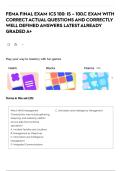
FEMA FINAL EXAM ICS 100: IS – 100.C EXAM WITH
CORRECT ACTUAL QUESTIONS AND CORRECTLY
WELL DEFINED ANSWERS LATEST ALREADY
GRADED A+
Play your way to mastery with fun games
Match Blocks Charms NEW
Terms in this set (25)
Which NIMS Management C. Information and Intelligence Management
Characteristic may include gathering,
analyzing, and assessing weather
service data from technical
specialists?
A. Incident Facilities and Locations
B. Management by Objectives
C. Information and Intelligence
Management
D. Integrated Communications
, The Incident Commander or Unified C. Identifying strategies, tactics, tasks, and activities
Command establishes incident to achieve the objectives.
objectives that include:
A. Delegating functional
responsibilities and specifying
resource types.
B. Establishing a manageable span of
control.
C. Identifying strategies, tactics, tasks,
and activities to achieve the
objectives.
D. Selecting personnel to serve on
the Incident Management Team.
Depending on the incident size and B. Incident Command
complexity, various types of support
facilities may be established by:
A. the Logistics Section
B. Incident Command
C. the Planning Section
D. Local Authorities
In a Unified Command, members C. Situational Awareness
representing multiple jurisdictions
and agencies work together to
establish:
A. Resource Allocations
B. Shared Agency Authority
C. Situational Awareness
D. Incident Objectives
CORRECT ACTUAL QUESTIONS AND CORRECTLY
WELL DEFINED ANSWERS LATEST ALREADY
GRADED A+
Play your way to mastery with fun games
Match Blocks Charms NEW
Terms in this set (25)
Which NIMS Management C. Information and Intelligence Management
Characteristic may include gathering,
analyzing, and assessing weather
service data from technical
specialists?
A. Incident Facilities and Locations
B. Management by Objectives
C. Information and Intelligence
Management
D. Integrated Communications
, The Incident Commander or Unified C. Identifying strategies, tactics, tasks, and activities
Command establishes incident to achieve the objectives.
objectives that include:
A. Delegating functional
responsibilities and specifying
resource types.
B. Establishing a manageable span of
control.
C. Identifying strategies, tactics, tasks,
and activities to achieve the
objectives.
D. Selecting personnel to serve on
the Incident Management Team.
Depending on the incident size and B. Incident Command
complexity, various types of support
facilities may be established by:
A. the Logistics Section
B. Incident Command
C. the Planning Section
D. Local Authorities
In a Unified Command, members C. Situational Awareness
representing multiple jurisdictions
and agencies work together to
establish:
A. Resource Allocations
B. Shared Agency Authority
C. Situational Awareness
D. Incident Objectives


