
Nursing Licensure, Certification, Roles &
Education: High-Yield Practice Questions
& Exam Review
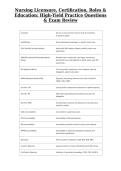
Licensure Ensures a nurse has the minimum level of competency
to practice safely.
Certification Shows specialized knowledge in a specific clinical area.
CNA (Certified Nursing Assistant) Assists with ADLs (bathing, feeding, mobility) under nurse
supervision.
LPN/LVN (Licensed Practical/Vocational Provides basic nursing care, vital signs, wound care,
Nurse) administers some meds (depends on state), works under RN
supervision.
RN (Registered Nurse) Full nursing scope: assessment, clinical judgment, planning,
delegation, patient education.
APRN (Advanced Practice RN) Diagnosis, prescribing, advanced care (roles include NP,
CRNA, CNS, CNM).
Key Point: LPN Cannot perform independent assessment or patient teaching.
Key Point: RN Holds legal responsibility for the patient care plan and
delegation.
Key Point: APRN Has prescriptive authority and advanced clinical autonomy
(varies by state).
CNA Accountability Accountable to supervising nurse.
LPN Accountability Accountable to RN and physician.
RN Accountability Accountable to patients, board of nursing, and employer.
APRN Accountability Accountable to advanced standards of practice and
prescribing regulations.
Education Formal academic preparation (ADN, BSN, MSN, DNP).
Licensure Meaning Legal permission to practice (NCLEX-RN grants RN license).
Certification Meaning Validation of specialized knowledge (CCRN, CPN, FNP-BC).
, Benefits of BSN Preparation Stronger critical thinking & leadership skills, higher quality
patient care & lower mortality, preferred in Magnet hospitals,
required for many management & public health roles,
provides pathway for graduate-level nursing.
Education: High-Yield Practice Questions
& Exam Review
Licensure Ensures a nurse has the minimum level of competency
to practice safely.
Certification Shows specialized knowledge in a specific clinical area.
CNA (Certified Nursing Assistant) Assists with ADLs (bathing, feeding, mobility) under nurse
supervision.
LPN/LVN (Licensed Practical/Vocational Provides basic nursing care, vital signs, wound care,
Nurse) administers some meds (depends on state), works under RN
supervision.
RN (Registered Nurse) Full nursing scope: assessment, clinical judgment, planning,
delegation, patient education.
APRN (Advanced Practice RN) Diagnosis, prescribing, advanced care (roles include NP,
CRNA, CNS, CNM).
Key Point: LPN Cannot perform independent assessment or patient teaching.
Key Point: RN Holds legal responsibility for the patient care plan and
delegation.
Key Point: APRN Has prescriptive authority and advanced clinical autonomy
(varies by state).
CNA Accountability Accountable to supervising nurse.
LPN Accountability Accountable to RN and physician.
RN Accountability Accountable to patients, board of nursing, and employer.
APRN Accountability Accountable to advanced standards of practice and
prescribing regulations.
Education Formal academic preparation (ADN, BSN, MSN, DNP).
Licensure Meaning Legal permission to practice (NCLEX-RN grants RN license).
Certification Meaning Validation of specialized knowledge (CCRN, CPN, FNP-BC).
, Benefits of BSN Preparation Stronger critical thinking & leadership skills, higher quality
patient care & lower mortality, preferred in Magnet hospitals,
required for many management & public health roles,
provides pathway for graduate-level nursing.


