

The pulmonary system:
- Muscles require oxygen: 0.2 - 0.4L/min at rest and 4 - 5L/min during world class marathon running. This can’t be met
through diffusion across the skin (serves upper skin only)
- Pulmonary ventilation: moving and exchanging ambient air with air in the lungs
- Ambient air enters the nose and mouth, moved to ventilatory system, adjusts to body temperature and conditions
before gas exchange occurs
Lungs and alveoli
- The lungs provide a gas exchange surface
- Contain more than 600 million alveoli
- Inspired air enters alveoli and then diffuses into alveolar capillaries
- Part of the pulmonary circulation
- CO2 in alveolar capillaries diffuses into alveoli and is expired
Ventilation:
- Ventilation is dependent on pressure gradients
- When intrapulmonary pressure exceeds atmospheric pressure then gas moves out of ventilatory system
- When atmospheric pressure exceeds intrapulmonary pressure then gas moves into the ventilatory system
- Inspiration: contraction of the diaphragm, reduction of intrapulmonary pressure and pressure gradient favours the
movement into ventilatory system
- Expiration: passive process at rest due to elastic recoil of lung tissue and relaxation of inspiratory muscles and an
increase in intrapulmonary pressure.
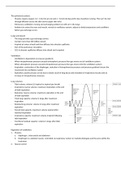
Lung volumes:
- Tidal volume: volume (L) inspired or expired per breath
- Inspiratory reserve volume: maximum inspiration at the end
of tidal inspiration
- Expiratory reserve volume: maximum expiration at the end
of tidal expiration
- Total lung capacity: volume in lungs after maximum
inspiration
- Residual lung volume: volume in lungs after maximum
expiration
- Forced vital capacity: maximum volume expired after
maximal inspiration
- Inspiratory capacity: maximum volume inspired following
tidal expiration
- Functional residual capacity: volume in lungs after tidal
expiration
Regulation of ventilation:
1. Muscles
a. diaphragm , intercostals and abdomen
b. Diaphragm is a skeletal muscle, controlled via respiratory centers in medulla oblongata and the pons within the
brainstem
2. Neural control
- Muscles require oxygen: 0.2 - 0.4L/min at rest and 4 - 5L/min during world class marathon running. This can’t be met
through diffusion across the skin (serves upper skin only)
- Pulmonary ventilation: moving and exchanging ambient air with air in the lungs
- Ambient air enters the nose and mouth, moved to ventilatory system, adjusts to body temperature and conditions
before gas exchange occurs
Lungs and alveoli
- The lungs provide a gas exchange surface
- Contain more than 600 million alveoli
- Inspired air enters alveoli and then diffuses into alveolar capillaries
- Part of the pulmonary circulation
- CO2 in alveolar capillaries diffuses into alveoli and is expired
Ventilation:
- Ventilation is dependent on pressure gradients
- When intrapulmonary pressure exceeds atmospheric pressure then gas moves out of ventilatory system
- When atmospheric pressure exceeds intrapulmonary pressure then gas moves into the ventilatory system
- Inspiration: contraction of the diaphragm, reduction of intrapulmonary pressure and pressure gradient favours the
movement into ventilatory system
- Expiration: passive process at rest due to elastic recoil of lung tissue and relaxation of inspiratory muscles and an
increase in intrapulmonary pressure.
Lung volumes:
- Tidal volume: volume (L) inspired or expired per breath
- Inspiratory reserve volume: maximum inspiration at the end
of tidal inspiration
- Expiratory reserve volume: maximum expiration at the end
of tidal expiration
- Total lung capacity: volume in lungs after maximum
inspiration
- Residual lung volume: volume in lungs after maximum
expiration
- Forced vital capacity: maximum volume expired after
maximal inspiration
- Inspiratory capacity: maximum volume inspired following
tidal expiration
- Functional residual capacity: volume in lungs after tidal
expiration
Regulation of ventilation:
1. Muscles
a. diaphragm , intercostals and abdomen
b. Diaphragm is a skeletal muscle, controlled via respiratory centers in medulla oblongata and the pons within the
brainstem
2. Neural control


