

Stem cells in the body: Development from egg to adult (cell fate): The adult body is
- Stem cells are the body’s natural repair and regeneration formed from a single cell (the oocyte) by:
mechanisms 1. Cell division: symmetric and asymmetric
- Tissues and the blood have their own supplies of resident 2. Differentiation into specific cell types
stem cells (stem cell niche), which help replace and repair 3. Migration to organise into complex structures
cells that are lost ex. Neural stem cells 4. Apoptosis programmed cell death
- Some stem cells are able to migrate from one tissue to
another to effect repair ex. Mesenchymal stem cells
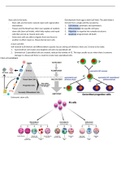
A stem cell (SC):
Self-renewal (cell division) and differentiation capacity (occurs during cell division), there are 2 choice to be made:
1. Asymmetrical: cell creates one daughter cell and one specialised cell
2. Symmetrical: 2 specialised cells are created, reduces the number of SC. This type usually occurs when there is extreme
damage in a tissue and there’s a need to create many specialised cells.
Embryonic stem cells:
, Hematopoietic stem cells (HSC): Mesenchymal stem cells:
Quiescent (asleep) in bone marrow (purely vascularised, low Quiescent (asleep) in bone marrow and body fat:
oxygen): - Hypoxic niche
- Hypoxic niche - Slow self-renewal
- Slow self-renewal - No differentiation
- No differentiation Activation/mobilisation to multiple organs:
Activation/mobilisation to blood: - Migration
- Signals from the blood - chemokines/cytokines - Expansion (symmetrical cell division)
- Migration - Specification (asymmetric cell division)
- Expansion (symmetrical cell division)
- Specification (asymmetric cell division)
Reason for transplanting bone marrow: Huge quantities of
hematopoietic stem cells (help treat diseases)
Stem cells summary:
Stem cell: capacity to self-renew and differentiate
Types: totipotent, pluripotent, multipotent, unipotent
Pluripotent stem cell
- Stem cells are the body’s natural repair and regeneration formed from a single cell (the oocyte) by:
mechanisms 1. Cell division: symmetric and asymmetric
- Tissues and the blood have their own supplies of resident 2. Differentiation into specific cell types
stem cells (stem cell niche), which help replace and repair 3. Migration to organise into complex structures
cells that are lost ex. Neural stem cells 4. Apoptosis programmed cell death
- Some stem cells are able to migrate from one tissue to
another to effect repair ex. Mesenchymal stem cells
A stem cell (SC):
Self-renewal (cell division) and differentiation capacity (occurs during cell division), there are 2 choice to be made:
1. Asymmetrical: cell creates one daughter cell and one specialised cell
2. Symmetrical: 2 specialised cells are created, reduces the number of SC. This type usually occurs when there is extreme
damage in a tissue and there’s a need to create many specialised cells.
Embryonic stem cells:
, Hematopoietic stem cells (HSC): Mesenchymal stem cells:
Quiescent (asleep) in bone marrow (purely vascularised, low Quiescent (asleep) in bone marrow and body fat:
oxygen): - Hypoxic niche
- Hypoxic niche - Slow self-renewal
- Slow self-renewal - No differentiation
- No differentiation Activation/mobilisation to multiple organs:
Activation/mobilisation to blood: - Migration
- Signals from the blood - chemokines/cytokines - Expansion (symmetrical cell division)
- Migration - Specification (asymmetric cell division)
- Expansion (symmetrical cell division)
- Specification (asymmetric cell division)
Reason for transplanting bone marrow: Huge quantities of
hematopoietic stem cells (help treat diseases)
Stem cells summary:
Stem cell: capacity to self-renew and differentiate
Types: totipotent, pluripotent, multipotent, unipotent
Pluripotent stem cell


