
Chapter- 15
Biodiversity and Conservation
• Large and diverse communities of biota occupy distinct climatic zone forming ecosystems.
• The term biodiversity was first coined in 1980 by W.G. Rosen. It is the shortened and combined version of two
words- “biological” and “diversity”.
• Biodiversity or biological diversity can be defined as the vast diversity of species and varieties of all the life forms
existing on earth. They include the species of micro-organisms, algae, fungi, plants, animals, occurring on the
earth in various habitats and the ecological complexes and niches of which they are a part.
• Whether or not a species can survive and colonize an area depends on the environmental conditions of the area
as well as the range of tolerance of the species.
MAGNITUDE OF BIODIVERSITY
• India has approximately 45,000 species of plants and nearly twice as many species of animals. India, therefore, is
one of the 12 mega diversity countries of the world.
• Numerous species that are yet to be identified are believed inhabit tropics and coral reefs.
• The number of species present in tropics can be estimated by comparing species richness between tropics and
temperate areas. Inventories are nearly complete for most groups of organisms in the temperate areas.
• Scientists have in this manner calculated the total number of species in the world to be approximately 5.50
million.
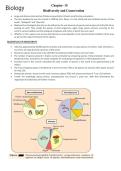
• The most intriguing aspect of biodiversity is that more than 70% of all species are animals while plants account
for only 22%.
• Among the animals, insects are the most numerous (about 70%) with present estimate of 7 out of 10 animals.
• Further the knowledge about protists, archaebacteria and viruses is quite less. With that information the
magnitude of biodiversity will further increase.
, LEVELS OF BIODIVERSITY
1. Genetic diversity
• It is the diversity in the number and type of genes as well as chromosomes present in different species and the
variations in the genes and their alleles in the same species.
• On average a bacteriophage has 100 genes, Drosophila melanogaster 13000 genes and Homo sapiens 30,000 –
40,000 genes.
• Variation in the genes of a species increase with increase in size and environmental parameters of the habitat.
• Genetic diversity is useful in adaptation to changes in environmental conditions.
• It helps in speciation or evolution of new species.
• Lower genetic diversity within a species or variety may be useful for uniformity in yield as well as higher yield.
However it is more susceptible to degradation and prone to mass scale destruction at the hands of fungal or
insect attacks.
2. Species diversity
• It is the diversity and variety in the number and richness of the species of a region.
• The number of species per unit area is called species richness.
• Number of individuals of different species in a given area represents species evenness or species equitability.
• Communities where species are represented by more or less the same number of individuals exhibit evenness.
• Communities where one or more species have more individuals than other, show dominance or unevenness.
• Species diversity is the product of species richness or evenness or equitability.
• Odum et al (1960) calculate species diversity as number of species per thousand individuals while Menhinick
(1964) calculates it as number of species in relation to square root of total number of individuals.
• Diversity index commonly used in ecological studies is Shannon index.
3. Community and Ecosystem diversity
It has three types
(i) Alpha diversity (within community diversity) It is a species diversity. α – diversity is dependent upon species richness
and evenness. There is a lot of competition, adjustments and inter relationships amongst members of the same
community. Variations are limited.
(ii) Beta diversity (Between communities diversity). It is diversity which appears along a gradient of habitat within
geographical area. Due to differences in microhabitat, niches and in environmental condition there could occur change
in communities that could lead to replacement of species.
(iii) Gamma diversity.
• It is diversity present in ranges of communities as represented by diversity of habitats/ ecosystems over a total
landscape geographical area.
• Ecosystem diversity is the variety of forms in the ecosystem due to diversity of niches, trophic levels and
ecological processes like nutrient recycling, food webs, energy flow, role of dominant species and various biotic
interactions.
• Diversity helps in achieving more productive and stable ecosystems which can tolerate various environmental
stresses like prolonged drought
INDIA AS MEGADIVERSITY REGION
• India has attained a unique distinction as it has been assigned the status of mega diversity nation.
• The country has 10 biogeographical regions. They are: Trans Himalaya, Himalaya, Desert, Semi-arid, Western
Ghats, Deccan peninsula, Gangetic Plain, Coasts, North-East and Islands.
Biodiversity and Conservation
• Large and diverse communities of biota occupy distinct climatic zone forming ecosystems.
• The term biodiversity was first coined in 1980 by W.G. Rosen. It is the shortened and combined version of two
words- “biological” and “diversity”.
• Biodiversity or biological diversity can be defined as the vast diversity of species and varieties of all the life forms
existing on earth. They include the species of micro-organisms, algae, fungi, plants, animals, occurring on the
earth in various habitats and the ecological complexes and niches of which they are a part.
• Whether or not a species can survive and colonize an area depends on the environmental conditions of the area
as well as the range of tolerance of the species.
MAGNITUDE OF BIODIVERSITY
• India has approximately 45,000 species of plants and nearly twice as many species of animals. India, therefore, is
one of the 12 mega diversity countries of the world.
• Numerous species that are yet to be identified are believed inhabit tropics and coral reefs.
• The number of species present in tropics can be estimated by comparing species richness between tropics and
temperate areas. Inventories are nearly complete for most groups of organisms in the temperate areas.
• Scientists have in this manner calculated the total number of species in the world to be approximately 5.50
million.
• The most intriguing aspect of biodiversity is that more than 70% of all species are animals while plants account
for only 22%.
• Among the animals, insects are the most numerous (about 70%) with present estimate of 7 out of 10 animals.
• Further the knowledge about protists, archaebacteria and viruses is quite less. With that information the
magnitude of biodiversity will further increase.
, LEVELS OF BIODIVERSITY
1. Genetic diversity
• It is the diversity in the number and type of genes as well as chromosomes present in different species and the
variations in the genes and their alleles in the same species.
• On average a bacteriophage has 100 genes, Drosophila melanogaster 13000 genes and Homo sapiens 30,000 –
40,000 genes.
• Variation in the genes of a species increase with increase in size and environmental parameters of the habitat.
• Genetic diversity is useful in adaptation to changes in environmental conditions.
• It helps in speciation or evolution of new species.
• Lower genetic diversity within a species or variety may be useful for uniformity in yield as well as higher yield.
However it is more susceptible to degradation and prone to mass scale destruction at the hands of fungal or
insect attacks.
2. Species diversity
• It is the diversity and variety in the number and richness of the species of a region.
• The number of species per unit area is called species richness.
• Number of individuals of different species in a given area represents species evenness or species equitability.
• Communities where species are represented by more or less the same number of individuals exhibit evenness.
• Communities where one or more species have more individuals than other, show dominance or unevenness.
• Species diversity is the product of species richness or evenness or equitability.
• Odum et al (1960) calculate species diversity as number of species per thousand individuals while Menhinick
(1964) calculates it as number of species in relation to square root of total number of individuals.
• Diversity index commonly used in ecological studies is Shannon index.
3. Community and Ecosystem diversity
It has three types
(i) Alpha diversity (within community diversity) It is a species diversity. α – diversity is dependent upon species richness
and evenness. There is a lot of competition, adjustments and inter relationships amongst members of the same
community. Variations are limited.
(ii) Beta diversity (Between communities diversity). It is diversity which appears along a gradient of habitat within
geographical area. Due to differences in microhabitat, niches and in environmental condition there could occur change
in communities that could lead to replacement of species.
(iii) Gamma diversity.
• It is diversity present in ranges of communities as represented by diversity of habitats/ ecosystems over a total
landscape geographical area.
• Ecosystem diversity is the variety of forms in the ecosystem due to diversity of niches, trophic levels and
ecological processes like nutrient recycling, food webs, energy flow, role of dominant species and various biotic
interactions.
• Diversity helps in achieving more productive and stable ecosystems which can tolerate various environmental
stresses like prolonged drought
INDIA AS MEGADIVERSITY REGION
• India has attained a unique distinction as it has been assigned the status of mega diversity nation.
• The country has 10 biogeographical regions. They are: Trans Himalaya, Himalaya, Desert, Semi-arid, Western
Ghats, Deccan peninsula, Gangetic Plain, Coasts, North-East and Islands.


