

Unit 8A Musculoskeletal disorders:
Skeletal system:
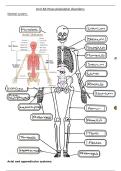
Axial and appendicular systems:
,There are two separate parts in the skeletal system called the axial and appendicular
skeletons. The axial skeleton is built up of 80 bones in the head, neck, back and chest.
Examples of these bones include the cranium, vertebrae, sacrum, sternum and ribs.
This part of the skeletal system’s function is to provide protection for the brain, spinal
cord, heart, lungs as well as other organs residing in that area. In addition, the
muscles in the body responsible for the movement of the head, neck and trunk are
attached to the axial skeleton, and their role is to help with breathing and to steady
areas in the appendicular skeleton.
The appendicular skeleton is built up of 126 bones that are connected to the axial
skeleton, including the shoulders, pelvis, arms, hands, legs and feet. These bones are
all connected by various ligaments, as well as cartilage and tendons. The bones in this
part of the skeletal system also have
areas where the muscles can attach,
called bony prominences and
protuberances.
Types of bones:
There are 5 different types of bones in
the body. Long bones are cylindrical and
hard, containing soft bone marrow, and
they are wider at the end of the bone in
comparison to the middle. An example of
a long bone is the humerus located in
the arms. Short bones have a similar
structure to long bones, though they are
shorter. An example of a short bone are
the carpals found in the wrist. Flat bones
are made up of hard bone with a soft
layer in between the bone, and this can
be protective or work as a place for
muscles to attach. Examples of flat
bones include the cranium and scapula.
Irregular bones can be many different
shapes, some having cavities etc, and an
example of this type of bone are the
vertebrae. Sesamoid bones are very small bones, and these are found in tendons or
surrounded by muscle and places where a lot of pressure is present.
Before the bones are fully developed, they begin as cartilage, and slowly become
ossified, where they become bone. These bones will then grow with hollow middles
which will have bone marrow present to make the bones lighter. However, some
cartilage will stay as such into adulthood.
, Composition of the bone:
Bones are made of the protein, collagen and
the mineral calcium phosphate, this makes
the bone hard and strong. Bones store the
calcium, and they release some of this
calcium into the blood stream when other
parts of the body need it.
Bone tissue consists of two types of
mineralised tissue, cortical bone and
cancellous bone. Other tissues in the bones
include bone marrow, endosteum, periosteum,
nerves, blood vessels and cartilage.
Tendons and ligaments:
Tendons are fibrous tissues, and they are all
around the body connecting muscle to bone.
They are responsible for transferring muscle
generated force to the bone it is attached to,
and this then allows the movement around
the joint to occur.
Ligaments connect bone to bone, and they
are responsible for steadying the joint and to
connect the two ends of the bone to each
other. The ligaments are important as they
ensure that the joint doesn’t twist too much
and so it doesn’t become dislocated. There
are two types of ligaments that are yellow
and white. They are different as white
ligaments are full of collagen fibres, which make them not very flexible. Yellow
ligaments are more flexible as they have more elastic fibres in them.
Tendons and ligaments differ from each other as they both attach to different parts of
the system, tendons being from bone to muscle, and ligaments connecting bone to
bone. As well as this, they both have different characteristics that define them. For
example, ligaments tend to be much more flexible than tendons. Ligaments are found
at joints around the body, whereas tendons join the muscle to the bone.
Skeletal system:
Axial and appendicular systems:
,There are two separate parts in the skeletal system called the axial and appendicular
skeletons. The axial skeleton is built up of 80 bones in the head, neck, back and chest.
Examples of these bones include the cranium, vertebrae, sacrum, sternum and ribs.
This part of the skeletal system’s function is to provide protection for the brain, spinal
cord, heart, lungs as well as other organs residing in that area. In addition, the
muscles in the body responsible for the movement of the head, neck and trunk are
attached to the axial skeleton, and their role is to help with breathing and to steady
areas in the appendicular skeleton.
The appendicular skeleton is built up of 126 bones that are connected to the axial
skeleton, including the shoulders, pelvis, arms, hands, legs and feet. These bones are
all connected by various ligaments, as well as cartilage and tendons. The bones in this
part of the skeletal system also have
areas where the muscles can attach,
called bony prominences and
protuberances.
Types of bones:
There are 5 different types of bones in
the body. Long bones are cylindrical and
hard, containing soft bone marrow, and
they are wider at the end of the bone in
comparison to the middle. An example of
a long bone is the humerus located in
the arms. Short bones have a similar
structure to long bones, though they are
shorter. An example of a short bone are
the carpals found in the wrist. Flat bones
are made up of hard bone with a soft
layer in between the bone, and this can
be protective or work as a place for
muscles to attach. Examples of flat
bones include the cranium and scapula.
Irregular bones can be many different
shapes, some having cavities etc, and an
example of this type of bone are the
vertebrae. Sesamoid bones are very small bones, and these are found in tendons or
surrounded by muscle and places where a lot of pressure is present.
Before the bones are fully developed, they begin as cartilage, and slowly become
ossified, where they become bone. These bones will then grow with hollow middles
which will have bone marrow present to make the bones lighter. However, some
cartilage will stay as such into adulthood.
, Composition of the bone:
Bones are made of the protein, collagen and
the mineral calcium phosphate, this makes
the bone hard and strong. Bones store the
calcium, and they release some of this
calcium into the blood stream when other
parts of the body need it.
Bone tissue consists of two types of
mineralised tissue, cortical bone and
cancellous bone. Other tissues in the bones
include bone marrow, endosteum, periosteum,
nerves, blood vessels and cartilage.
Tendons and ligaments:
Tendons are fibrous tissues, and they are all
around the body connecting muscle to bone.
They are responsible for transferring muscle
generated force to the bone it is attached to,
and this then allows the movement around
the joint to occur.
Ligaments connect bone to bone, and they
are responsible for steadying the joint and to
connect the two ends of the bone to each
other. The ligaments are important as they
ensure that the joint doesn’t twist too much
and so it doesn’t become dislocated. There
are two types of ligaments that are yellow
and white. They are different as white
ligaments are full of collagen fibres, which make them not very flexible. Yellow
ligaments are more flexible as they have more elastic fibres in them.
Tendons and ligaments differ from each other as they both attach to different parts of
the system, tendons being from bone to muscle, and ligaments connecting bone to
bone. As well as this, they both have different characteristics that define them. For
example, ligaments tend to be much more flexible than tendons. Ligaments are found
at joints around the body, whereas tendons join the muscle to the bone.


