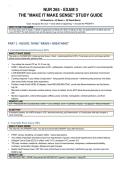
NUR 265 - EXAM 3
THE "MAKE IT MAKE SENSE" STUDY GUIDE
50 Questions = 25 Neuro + 25 Shock/Burns
Goal: recognize the clue -> know what is happening -> choose the PRIORITY.
HOW TO USE THIS GUIDE
For every topic, learn 4 things: (1) What is happening? (2) What will I SEE? (3) What can KILL the patient first? (4) What does the
nurse DO first? The bold memory lines are the pieces to say out loud until they become automatic.
PART 1 - NEURO: THINK "BRAIN + BREATHING"
1. Increased Intracranial Pressure (ICP)
MAKE IT MAKE SENSE
The skull is a CLOSED BOX. Inside are brain tissue + blood + cerebrospinal fluid (CSF). If one takes up too much space and the
others cannot compensate, pressure rises.
• Your slides list normal ICP as 10-15 mm Hg.
• EARLY: altered level of consciousness (LOC), restlessness, headache, confusion. Also watch for recurrent/projectile
vomiting and pupil changes.
• LATE/DANGER: blown pupil, posturing, Cushing response. Decerebrate posturing means brainstem involvement
and is more serious.
• Cushing response in your slides: bradycardia + rising systolic blood pressure + widened pulse pressure; the slides
note some books include slow respirations.
• Position: head of bed (HOB) 30 degrees, head MIDLINE/NEUTRAL, avoid neck flexion/extension and hip flexion,
log roll.
• Mannitol is listed to decrease cerebral edema. Fever is treated, but do NOT allow shivering because it can increase
ICP.
• Monitor oxygenation, arterial blood gases (ABGs), pulse oximetry, hemoglobin, cerebral perfusion, and fluid
balance.
MEMORY LINE
ICP = PRESSURE IN A CLOSED BOX. EARLY = LOC CHANGE. LATE = CUSHING. Position = 30 degrees + HEAD STRAIGHT.
EXAM TRAP
A headache matters, but a NEW change in LOC, abnormal posturing, pupil deterioration, or Cushing-type vital-sign changes is
more concerning.
2. Traumatic Brain Injury (TBI)
MAKE IT MAKE SENSE
The initial hit is the PRIMARY injury. Your job is to prevent SECONDARY injury after the trauma.
• FIRST: airway, breathing, circulation (ABC) + spinal precautions.
• Your slides emphasize secondary injury from hypotension, hypoxia, intracranial hypertension and cerebral edema.
• Glasgow Coma Scale (GCS) in slides: mild 13-15; moderate 9-12; severe 3-8.
• TBI cues: amnesia, headache, dizziness, seizure, loss of consciousness, sleepiness, restlessness/irritability,
confusion, personality changes, diplopia and gait changes.
• Basilar skull fracture clues: CSF from nose (rhinorrhea) or ear (otorrhea), halo/bull's-eye sign, raccoon eyes and
Battle's sign.
MEMORY LINE
TBI: PROTECT ABC + SPINE, then prevent the SECOND HIT: hypoxia + hypotension + rising ICP.
, 3. Craniotomy
• Post-op neuro and dressing checks are listed every hour.
• HOB 30 degrees; head midline/neutral; avoid extreme hip or neck flexion.
• Watch for cerebral edema/increased ICP, hematoma/bleeding, hydrocephalus, meningitis, CSF leak, seizures,
fluid/electrolyte problems and respiratory issues.
MEMORY LINE
After brain surgery: NEURO + DRESSING + ICP + AIRWAY.
4. Meningitis
MAKE IT MAKE SENSE
The meninges are inflamed. Bacterial meningitis is labeled MOST SERIOUS in your slides.
• Think: fever + severe headache + nuchal rigidity + photophobia + LOC change + nausea/vomiting.
• Meningococcal meningitis may cause a petechial rash.
• Bacterial CSF: CLOUDY, pressure UP, glucose DOWN, protein UP, WBC UP.
• Nursing: ABCs, frequent neuro/vital-sign checks, temperature control, seizure precautions, intake/output and daily
weight.
• Bacterial meningitis = DROPLET precautions in your slides.
MEMORY LINE
BACTERIAL = BAD: cloudy CSF, LOW glucose, HIGH protein/WBC + DROPLET.
5. Spinal Cord Injury (SCI)
• Complete injury = complete loss of motor function and sensation below injury. Incomplete = some function remains.
• Thoracic/lumbar injury can cause paraplegia. High cervical injury threatens breathing.
• Your slides emphasize that injury above C4 may be fatal because the patient may not breathe independently;
injuries higher than C5 can paralyze respiratory muscles.
• Do NOT move a suspected spinal injury unless head, neck and spine are properly supported/immobilized.
MEMORY LINE
SCI: THE HIGHER THE INJURY, THE BIGGER THE BREATHING PROBLEM.
6. Spinal Shock vs Autonomic Dysreflexia
SPINAL SHOCK AUTONOMIC DYSREFLEXIA
WHEN Immediately after SCI After spinal shock subsides; injury above T6
Hypotension + bradycardia + paralysis +
BIG CLUES SEVERE hypertension + bradycardia
hypothermia
Bowel/bladder distention; absent sweating
OTHER Trigger often bladder, bowel, or skin pressure
below injury
FIRST MOVE Support ABC/perfusion HOB HIGH Fowler's immediately
Monitor recovery; spasticity/hyperreflexia Find/remove trigger: bladder, impaction,
THEN
signals end wrinkles/pressure
MEMORY LINE
Spinal SHOCK = BP DOWN. Autonomic dysreflexia = BP WAY UP -> SIT THEM UP.
7. GBS vs MG vs ALS - DO NOT MIX THESE UP
GBS MG ALS
WHERE weakness starts LEGS -> ASCENDS HEAD/EYES -> may descend Often arms/legs; asymmetric
Bilateral symmetric weakness, ↓ Ptosis, diplopia, chewing/swallowing Muscle atrophy/twitching; sensory
Classic clues
reflexes, paresthesia weakness pathways INTACT
Big danger Respiratory failure Respiratory failure/aspiration Respiratory failure/aspiration
Pyridostigmine; steroids; Riluzole, edaravone,
Treatment in slides IVIG + plasmapheresis
IVIG/plasmapheresis supportive/QOL care
Exam priority AIRWAY + vital capacity AIRWAY in crisis Respiratory + aspiration prevention
MEMORY TRICK
GBS = GROUND UP. MG = MY EYES/face get weak. ALS = ACTION (motor) is lost but SENSATION stays.
THE "MAKE IT MAKE SENSE" STUDY GUIDE
50 Questions = 25 Neuro + 25 Shock/Burns
Goal: recognize the clue -> know what is happening -> choose the PRIORITY.
HOW TO USE THIS GUIDE
For every topic, learn 4 things: (1) What is happening? (2) What will I SEE? (3) What can KILL the patient first? (4) What does the
nurse DO first? The bold memory lines are the pieces to say out loud until they become automatic.
PART 1 - NEURO: THINK "BRAIN + BREATHING"
1. Increased Intracranial Pressure (ICP)
MAKE IT MAKE SENSE
The skull is a CLOSED BOX. Inside are brain tissue + blood + cerebrospinal fluid (CSF). If one takes up too much space and the
others cannot compensate, pressure rises.
• Your slides list normal ICP as 10-15 mm Hg.
• EARLY: altered level of consciousness (LOC), restlessness, headache, confusion. Also watch for recurrent/projectile
vomiting and pupil changes.
• LATE/DANGER: blown pupil, posturing, Cushing response. Decerebrate posturing means brainstem involvement
and is more serious.
• Cushing response in your slides: bradycardia + rising systolic blood pressure + widened pulse pressure; the slides
note some books include slow respirations.
• Position: head of bed (HOB) 30 degrees, head MIDLINE/NEUTRAL, avoid neck flexion/extension and hip flexion,
log roll.
• Mannitol is listed to decrease cerebral edema. Fever is treated, but do NOT allow shivering because it can increase
ICP.
• Monitor oxygenation, arterial blood gases (ABGs), pulse oximetry, hemoglobin, cerebral perfusion, and fluid
balance.
MEMORY LINE
ICP = PRESSURE IN A CLOSED BOX. EARLY = LOC CHANGE. LATE = CUSHING. Position = 30 degrees + HEAD STRAIGHT.
EXAM TRAP
A headache matters, but a NEW change in LOC, abnormal posturing, pupil deterioration, or Cushing-type vital-sign changes is
more concerning.
2. Traumatic Brain Injury (TBI)
MAKE IT MAKE SENSE
The initial hit is the PRIMARY injury. Your job is to prevent SECONDARY injury after the trauma.
• FIRST: airway, breathing, circulation (ABC) + spinal precautions.
• Your slides emphasize secondary injury from hypotension, hypoxia, intracranial hypertension and cerebral edema.
• Glasgow Coma Scale (GCS) in slides: mild 13-15; moderate 9-12; severe 3-8.
• TBI cues: amnesia, headache, dizziness, seizure, loss of consciousness, sleepiness, restlessness/irritability,
confusion, personality changes, diplopia and gait changes.
• Basilar skull fracture clues: CSF from nose (rhinorrhea) or ear (otorrhea), halo/bull's-eye sign, raccoon eyes and
Battle's sign.
MEMORY LINE
TBI: PROTECT ABC + SPINE, then prevent the SECOND HIT: hypoxia + hypotension + rising ICP.
, 3. Craniotomy
• Post-op neuro and dressing checks are listed every hour.
• HOB 30 degrees; head midline/neutral; avoid extreme hip or neck flexion.
• Watch for cerebral edema/increased ICP, hematoma/bleeding, hydrocephalus, meningitis, CSF leak, seizures,
fluid/electrolyte problems and respiratory issues.
MEMORY LINE
After brain surgery: NEURO + DRESSING + ICP + AIRWAY.
4. Meningitis
MAKE IT MAKE SENSE
The meninges are inflamed. Bacterial meningitis is labeled MOST SERIOUS in your slides.
• Think: fever + severe headache + nuchal rigidity + photophobia + LOC change + nausea/vomiting.
• Meningococcal meningitis may cause a petechial rash.
• Bacterial CSF: CLOUDY, pressure UP, glucose DOWN, protein UP, WBC UP.
• Nursing: ABCs, frequent neuro/vital-sign checks, temperature control, seizure precautions, intake/output and daily
weight.
• Bacterial meningitis = DROPLET precautions in your slides.
MEMORY LINE
BACTERIAL = BAD: cloudy CSF, LOW glucose, HIGH protein/WBC + DROPLET.
5. Spinal Cord Injury (SCI)
• Complete injury = complete loss of motor function and sensation below injury. Incomplete = some function remains.
• Thoracic/lumbar injury can cause paraplegia. High cervical injury threatens breathing.
• Your slides emphasize that injury above C4 may be fatal because the patient may not breathe independently;
injuries higher than C5 can paralyze respiratory muscles.
• Do NOT move a suspected spinal injury unless head, neck and spine are properly supported/immobilized.
MEMORY LINE
SCI: THE HIGHER THE INJURY, THE BIGGER THE BREATHING PROBLEM.
6. Spinal Shock vs Autonomic Dysreflexia
SPINAL SHOCK AUTONOMIC DYSREFLEXIA
WHEN Immediately after SCI After spinal shock subsides; injury above T6
Hypotension + bradycardia + paralysis +
BIG CLUES SEVERE hypertension + bradycardia
hypothermia
Bowel/bladder distention; absent sweating
OTHER Trigger often bladder, bowel, or skin pressure
below injury
FIRST MOVE Support ABC/perfusion HOB HIGH Fowler's immediately
Monitor recovery; spasticity/hyperreflexia Find/remove trigger: bladder, impaction,
THEN
signals end wrinkles/pressure
MEMORY LINE
Spinal SHOCK = BP DOWN. Autonomic dysreflexia = BP WAY UP -> SIT THEM UP.
7. GBS vs MG vs ALS - DO NOT MIX THESE UP
GBS MG ALS
WHERE weakness starts LEGS -> ASCENDS HEAD/EYES -> may descend Often arms/legs; asymmetric
Bilateral symmetric weakness, ↓ Ptosis, diplopia, chewing/swallowing Muscle atrophy/twitching; sensory
Classic clues
reflexes, paresthesia weakness pathways INTACT
Big danger Respiratory failure Respiratory failure/aspiration Respiratory failure/aspiration
Pyridostigmine; steroids; Riluzole, edaravone,
Treatment in slides IVIG + plasmapheresis
IVIG/plasmapheresis supportive/QOL care
Exam priority AIRWAY + vital capacity AIRWAY in crisis Respiratory + aspiration prevention
MEMORY TRICK
GBS = GROUND UP. MG = MY EYES/face get weak. ALS = ACTION (motor) is lost but SENSATION stays.