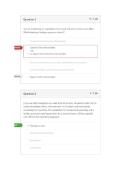
Question 1 0/1pts
You are performing an examination of 2 3-year-old who is new to your office.
Which finding o findings requiresa referral?
D[ soeecnis sotundenindane
and
An equal A-P and transverse chest diameter.
fseg Speech s 50% understandable.
Question 2 1/1pts
A 16-year-old is brought in as a walk-in by his parents. His parents state that he
acutely developed a fever, chills and rash. He has been confused and not
answering their questions. On examination he is toxically ill appearing, and is
febrile, tachycardic and hypotensive. He is noted to have a diffuse petechial
rash. What is the most likely diagnosis?
ZHD - venincococcem
, Question 3 1/1pts
A 7-month-old female was brought by her mother to an outpatient clinical
because of a 2-day history of fever, copious nasal secretions, and wheezing. The
mother volunteered that the baby has been healthy and has not had these
symptoms in the past. The infant’s temperature is noted to be 100.7°F, her
respiratory rate is 50 breaths/min, and her pulse oximetry is 95% on room air.
Physical examination reveals no signsof dehydration, but wheezing is hear on
lung auscultation. The infant shows no improvement after three treatments with
nebulized albuterol. Which of the following is recommended treatment?
Supportive care with hydration and huidified oxygen
You are performing an examination of 2 3-year-old who is new to your office.
Which finding o findings requiresa referral?
D[ soeecnis sotundenindane
and
An equal A-P and transverse chest diameter.
fseg Speech s 50% understandable.
Question 2 1/1pts
A 16-year-old is brought in as a walk-in by his parents. His parents state that he
acutely developed a fever, chills and rash. He has been confused and not
answering their questions. On examination he is toxically ill appearing, and is
febrile, tachycardic and hypotensive. He is noted to have a diffuse petechial
rash. What is the most likely diagnosis?
ZHD - venincococcem
, Question 3 1/1pts
A 7-month-old female was brought by her mother to an outpatient clinical
because of a 2-day history of fever, copious nasal secretions, and wheezing. The
mother volunteered that the baby has been healthy and has not had these
symptoms in the past. The infant’s temperature is noted to be 100.7°F, her
respiratory rate is 50 breaths/min, and her pulse oximetry is 95% on room air.
Physical examination reveals no signsof dehydration, but wheezing is hear on
lung auscultation. The infant shows no improvement after three treatments with
nebulized albuterol. Which of the following is recommended treatment?
Supportive care with hydration and huidified oxygen