
• Wrong document? Swap it for free
  • Written by students who passed
  • Immediately available after payment
  • Read online or as PDF
Sell
Where do you study
Your language
Document preview thumbnail
Preview 3 out of 26 pages
Exam (elaborations)

NR 509 Midterm Exam 2026/2027 – 60+ Questions & Correct Answers | Physical Assessment, HEENT, Neuro, Cardiac, Respiratory, Skin & Musculoskeletal | Chamberlain University

Document preview thumbnail
Preview 3 out of 26 pages

This NR 509 Midterm Exam 2026/2027 resource is a 26-page collection of 60+ exam-style questions and correct answers centered on advanced physical assessment and clinical reasoning. The document uses detailed patient presentations to test recognition of abnormal findings, selection of likely diagnoses, interpretation of examination techniques, and organization of the comprehensive health history. Major areas include HEENT assessment, neurological examination, cardiovascular and respiratory assessment, dermatology, musculoskeletal examination, cranial nerves, interviewing, review of systems, mental status, and clinical documentation. A substantial portion addresses skin and dermatologic assessment through clinical presentations and image-based questions. Conditions represented include pityriasis rosea, tinea versicolor, psoriasis, vitiligo-associated assessment, melanoma risk factors, and other skin findings. For example, the opening question describes the characteristic Christmas-tree distribution of pityriasis rosea, while another scenario associates sharply bordered, finely scaling patches of the upper trunk and arms with tinea versicolor. Additional questions require students to interpret visual skin findings and connect physical examination observations with appropriate clinical evaluation. The neurological and cranial-nerve assessment material is especially detailed. Students review clonus, corticospinal tract dysfunction, asterixis associated with metabolic problems, absence seizures, levels of consciousness, muscle-strength grading, mental-status abnormalities, and neurological manifestations of increased intracranial pressure. Cranial-nerve questions address the olfactory nerve, CN VI, CN X and CN XI, while clinical scenarios include pupillary findings in opioid intoxication, uvular deviation, and assessment techniques for neurological dysfunction. The document also tests interpretation of findings such as papilledema, altered consciousness, and abnormal motor responses. The HEENT and eye assessment questions cover visual acuity, ophthalmoscopy, red reflexes, glaucoma, hypertensive retinopathy, cotton-wool patches, subconjunctival hemorrhage, optic neuritis, nystagmus, otitis externa, epistaxis, lymph-node assessment, and Weber testing. Students practice interpreting Snellen results such as 20/100 vision, recognizing an increased cup-to-disc ratio associated with glaucoma, differentiating causes of acute visual symptoms, and identifying common ear and eye abnormalities from examination findings. The final page specifically asks students to recognize the Weber test, reinforcing practical examination technique alongside diagnostic reasoning. Cardiovascular and respiratory content integrates heart sounds, murmurs, blood pressure measurement, chest symptoms, and pulmonary examination findings. Topics include mitral stenosis assessment in the left lateral decubitus position, inspiratory splitting of S2, angina, orthopnea, heart failure, crackles, asthma, wheezing, respiratory distress, hemoptysis, and tension pneumothorax landmarks. Clinical cases require students to connect physical findings with likely pathology—for example, expiratory wheezing and decreased air movement with asthma and newly developed late inspiratory crackles with heart failure. The resource also gives strong coverage to musculoskeletal assessment and differential diagnosis. Questions examine the straight-leg raise for suspected herniated disc, muscle-strength grading, cartilaginous joints of vertebral bodies, lateral epicondylitis, rotator-cuff tendinitis or tear, degenerative neck pain, Lyme disease-associated joint symptoms, and rheumatoid arthritis. These scenarios emphasize connecting the patient's history, mechanism of injury, distribution of symptoms, physical examination maneuvers, and abnormal findings to the most likely clinical explanation. Another important component is patient interviewing and comprehensive health-history documentation. The material tests comprehensive versus focused histories, the seven attributes of symptoms, adaptive questioning, interpreter positioning, establishing an interview agenda, rapport, subjective versus objective information, and classification of information under past medical history, surgeries, adult illnesses, personal and social history, and review of systems. Students also encounter therapeutic communication scenarios that require recognizing nonverbal behavior and responding appropriately rather than simply memorizing diagnostic facts. Relevant students: This document is most relevant for Chamberlain University NR 509 students, advanced physical assessment students, nurse practitioner students, MSN students, graduate nursing students, FNP and other APRN-track learners, and students preparing for physical examination and health-assessment midterms. It is particularly useful for learners reviewing dermatology, HEENT, cardiovascular and pulmonary assessment, neurological examination, cranial nerves, musculoskeletal assessment, health-history interviewing, review of systems, mental status, symptom analysis, and differential diagnosis. Keywords: NR 509 Midterm Exam 2026, NR 509 Midterm Exam 2027, NR 509 exam questions and answers, NR 509 midterm questions, NR509 Midterm Chamberlain, NR 509 Advanced Physical Assessment, advanced physical assessment exam, physical assessment questions and answers, health assessment midterm, nurse practitioner physical assessment, FNP assessment exam, APRN physical assessment, comprehensive health history, patient interview questions, review of systems nursing, seven attributes of symptoms, subjective objective data, HEENT assessment questions, eye assessment nursing, visual acuity assessment, glaucoma assessment, hypertensive retinopathy, cotton wool patches, cranial nerve assessment, neurological assessment questions, clonus assessment, corticospinal tract, mental status examination, cardiovascular assessment questions, heart sounds assessment, mitral stenosis assessment, respiratory assessment questions, asthma physical assessment, heart failure crackles, musculoskeletal assessment questions, straight leg raise test, rotator cuff assessment, lateral epicondylitis, dermatology assessment questions, pityriasis rosea, tinea versicolor, psoriasis assessment, melanoma risk factors, Weber test, otitis externa, Chamberlain NR 509 study guide, Chamberlain University nursing exam

Content preview

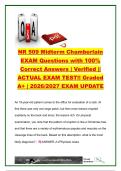
NR 509 Midterm Chamberlain
EXAM Questions with 100%
Correct Answers | Verified ||
ACTUAL EXAM TEST!! Graded
A+ | 2026/2027 EXAM UPDATE

An 18-year-old patient comes to the office for evaluation of a rash. At

first there was only one large patch, but then more lesions erupted

suddenly on the back and torso; the lesions itch. On physical

examination, you note that the pattern of eruption is like a Christmas tree

and that there are a variety of erythematous papules and macules on the

cleavage lines of the back. Based on this description, what is the most

likely diagnosis? - ANSWER ✔✔Pityriasis rosea

,A 19-year-old construction worker presents for evaluation of a rash. He

notes that it started on his back with a multitude of spots and is also on

his arms, chest, and neck. It itches a lot. He does sweat more than

before because being outdoors is part of his job. On physical

examination, you note dark tan patches with a reddish cast that has

sharp borders and fine scales, scattered more prominently around the

upper back, chest, neck, and upper arms as well as under the arms.

Based on this description, what is your most likely diagnosis? -

ANSWER ✔✔Tinea versicolor


You are examining a child with severe cerebral palsy. When you

suddenly move his foot dorsally, a sustained "beating" of the foot against

your hand ensues. What does this represent? - ANSWER ✔✔Clonus


A patient presents with a daily headache which has worsened over the

past several months. On funduscopic examination, you notice that the

disk edge is indistinct and the veins do not pulsate. Which is most likely?

- ANSWER ✔✔Increased intracranial pressure


A patient complains of epistaxis. Which other cause should be

considered? - ANSWER ✔✔Hematemesis


A patient complains of shortness of breath for the past few days. On

examination, you note late inspiratory crackles in the lower third of the

, chest that were not present a week ago. What is the most likely

explanation for these? - ANSWER ✔✔Heart failure


You are excited about a positive test finding you have just noticed on

physical

examination of your patient. You go on to do more examination,

laboratory work, and

diagnostic tests, only to find that there is no sign of the disease you

thought would

correlate with the finding. This same experience happens several times.

What should


you conclude? - ANSWER ✔✔Continue using the test, perhaps doing

less laboratory work and diagnostics.

A 50-year-old woman presents with a new complaint of headache. The

patient states,

"this is worst headache of my life". Her concurrent conditions includes

hypertension. Her

history includes habitual ER visits for various complaints and panic

attacks. Her most


COPYRIGHT©PROFFKERRYMARTIN 2026/2027. YEAR PUBLISHED 2026. COMPANY REGISTRATION NUMBER: 619652435. TERMS OF USE.
PRIVACY STATEMENT. ALL RIGHTS RESERVED


Document information

Uploaded on
September 10, 2026
Number of pages
26
Written in
2026/2027
Type
Exam (elaborations)
Contains
Questions & answers
$21.99

Wrong document? Swap it for free Within 14 days of purchase and before downloading, you can choose a different document. You can simply spend the amount again.
Written by students who passed
Immediately available after payment
Read online or as PDF

Seller avatar
Reputation scores are based on the amount of documents a seller has sold for a fee and the reviews they have received for those documents. There are three levels: Bronze, Silver and Gold. The better the reputation, the more your can rely on the quality of the sellers work.
PROFFKERRYMARTIN
3.4
(67)
Sold
318
Followers
9
Items
11563
Last sold
7 hours ago


Why students choose Stuvia

Created by fellow students, verified by reviews

Quality you can trust: written by students who passed their tests and reviewed by others who've used these notes.

Didn't get what you expected? Choose another document

No worries! You can instantly pick a different document that better fits what you're looking for.

Pay as you like, start learning right away

No subscription, no commitments. Pay the way you're used to via credit card and download your PDF document instantly.

Student with book image

“Bought, downloaded, and aced it. It really can be that simple.”

Alisha Student

Working on your references?

Create accurate citations in APA, MLA and Harvard with our free citation generator.

Working on your references?

Frequently asked questions
