

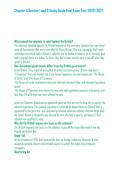
Chapter 4 Section 1 and 2 Study Guide.Final Exam Test 2026\2027.
What caused the colonists to rebel against the British?
The colonists rebelled against the British because of the excessive taxation that was levied
upon all the colonies that were controlled by Great Britain. This was caused by the French
and Indian war which lead to Britain's debt for war to double in amount, so in reaction, they
had to pay off these war debts. To do so, they had to pass certain acts to pay off what they
spent in the war.
How did colonial governments differ from the British government?
Great Britain: They acquired a king that inherited executive power. Britain also had a
"Parliament" that was divided into a two-house legislature; the two houses are "The House
of Lords" and "The House of Commons".
-The House of Lords contained aristocrats that had inherited titles, and inherited legislative
power
-The House of Commons was elected by men who held significant amounts of property, and
less than 1/4 of British men were allowed to vote
American Colonies: Contained an appointed governor that serves the king, but is paid by the
colonial legislature. The Colonial Legislature contained an Upper House or Council that is
appointed by the governor, and contained prominent colonists without inherited titles. Also,
the Lower House or Assembly was elected by men who held property, and about 2/3 of
colonial men qualified to vote.
Why did the British impose new taxes on the colonies?
The British imposed new taxes on the colonies to pay off the large debt made from the
French and Indian War.
Sugar Act
An act proposed in 1764, that lowered the duty on foreign molasses. However, it also
assigned customs officers and created courts to collect the duties and prosecute
smugglers.
Quartering Act
What caused the colonists to rebel against the British?
The colonists rebelled against the British because of the excessive taxation that was levied
upon all the colonies that were controlled by Great Britain. This was caused by the French
and Indian war which lead to Britain's debt for war to double in amount, so in reaction, they
had to pay off these war debts. To do so, they had to pass certain acts to pay off what they
spent in the war.
How did colonial governments differ from the British government?
Great Britain: They acquired a king that inherited executive power. Britain also had a
"Parliament" that was divided into a two-house legislature; the two houses are "The House
of Lords" and "The House of Commons".
-The House of Lords contained aristocrats that had inherited titles, and inherited legislative
power
-The House of Commons was elected by men who held significant amounts of property, and
less than 1/4 of British men were allowed to vote
American Colonies: Contained an appointed governor that serves the king, but is paid by the
colonial legislature. The Colonial Legislature contained an Upper House or Council that is
appointed by the governor, and contained prominent colonists without inherited titles. Also,
the Lower House or Assembly was elected by men who held property, and about 2/3 of
colonial men qualified to vote.
Why did the British impose new taxes on the colonies?
The British imposed new taxes on the colonies to pay off the large debt made from the
French and Indian War.
Sugar Act
An act proposed in 1764, that lowered the duty on foreign molasses. However, it also
assigned customs officers and created courts to collect the duties and prosecute
smugglers.
Quartering Act


