
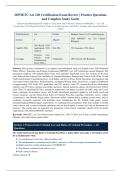
MPOETC Act 120 Certification Exam Review | Practice Questions
and Complete Study Guide
Pennsylvania Municipal Police Officers’ Education and Training Commission (MPOETC) — Act 120
Certification: PA Criminal & Vehicle Codes, Constitutional Law, and Police Academy Operational Standards
(2026)
Total Questions: 100 Format: Multiple Choice (A-D) with Rationales
2026 MPOETC Act 120 Content
Sections: 5 Aligned:
Blueprint
30% Recall / 50%
Cognitive Mix: Application / 20% Item Mix: 75% Scenario / 25% Direct
Analysis
Criminal Law,
Vehicle Code,
Coverage: Verification: 100% Keyed with Rationales
Constitutional,
Patrol, Ethics
Abstract. This practice examination is an original, non-confidential study aid aligned to the 2026 Municipal
Police Officers’ Education and Training Commission (MPOETC) Act 120 Certification content blueprint. The
instrument comprises 100 multiple-choice items with rationales distributed across five sections of 20 items
each: Pennsylvania Criminal Law and Rules of Criminal Procedure; Pennsylvania Vehicle Code (Title 75) and
Traffic Enforcement; Constitutional Law, Civil Rights, and Use of Force; Patrol Operations, Investigations, and
Crisis Intervention; and Ethics, Professionalism, and Report Writing. Items are keyed to a cognitive distribution
of approximately 30% recall, 50% application, and 20% analysis, with 75% scenario-based law enforcement
vignettes and 25% direct statutory knowledge questions. Special inclusions address the Pennsylvania Vehicle
Code (Title 75) including DUI tiers, mandatory suspensions, and proper execution of traffic stops; the Use of
Force continuum, de-escalation tactics, and Fourth Amendment principles applied to real-world search and
seizure situations; and the Pennsylvania Rules of Criminal Procedure regarding warrantless arrests, exigent
circumstances, and Miranda trigger points. Distractors reflect common police academy recruit errors, such as
confusing reasonable suspicion with probable cause, misapplying the PA Vehicle Code points system,
misunderstanding Miranda trigger requirements, or escalating force prematurely. Each item includes a verified
correct answer and a concise rationale explaining why the keyed option is correct and why the distractors are
incorrect. This artifact does not reproduce any proprietary exam content; candidates should verify all current
requirements with official MPOETC materials.
Keywords: MPOETC; Act 120; Pennsylvania criminal law; Title 75; DUI; use of force; Fourth Amendment;
Miranda; crisis intervention; police ethics
Section 1: Pennsylvania Criminal Law and Rules of Criminal Procedure — 20
Questions
Q1: Under the Pennsylvania Rules of Criminal Procedure, a police officer may make a warrantless arrest
for a misdemeanor when:
A. Any misdemeanor at any time without probable cause
B. The misdemeanor is committed in the officer's presence, or there are exigent circumstances and
probable cause for certain misdemeanors *[CORRECT]*
C. Only felonies committed in the officer's view
D. Only summary offenses
Correct Answer: B
,Rationale: PA rules allow warrantless misdemeanor arrest when committed in presence or under exigent
circumstances with probable cause; any-misdemeanor-anytime, only-felonies, and summary-only are incorrect.
Q2: A Pennsylvania officer develops probable cause to arrest a suspect for theft (an misdemeanor not
committed in the officer's presence) and there is no exigency. The proper procedure is to:
A. Arrest immediately without a warrant
B. Wait outside the suspect's home indefinitely
C. Obtain an arrest warrant from the appropriate authority rather than making a warrantless arrest
*[CORRECT]*
D. Ignore the probable cause
Correct Answer: C
Rationale: Without exigency and outside presence, a misdemeanor arrest requires a warrant; immediate warrantless
arrest, indefinite waiting, or ignoring PC are incorrect.
Q3: Which situation qualifies as exigent circumstances justifying a warrantless entry under PA law?
A. A routine follow-up interview at the suspect's home
B. A convenient time for the officer
C. The officer's personal curiosity
D. Imminent destruction of evidence, hot pursuit of a suspect, or imminent threat to life/safety
*[CORRECT]*
Correct Answer: D
Rationale: Exigent circumstances include imminent evidence destruction, hot pursuit, or imminent threat; routine
interviews, convenience, and curiosity are not exigency.
Q4: For a search incident to arrest under PA and Fourth Amendment law, the search must be:
A. Limited to the area within the arrestee's immediate control and contemporaneous with the arrest
*[CORRECT]*
B. The entire house at any time after arrest
C. Any vehicle the suspect once owned
D. All containers anywhere
Correct Answer: A
Rationale: Search incident to arrest is limited to the area within immediate control and contemporaneous;
entire-house, any-vehicle, and all-containers are overbroad.
Q5: The Miranda trigger is activated when a suspect is under:
A. Merely being a suspect
B. Custodial interrogation (both custody and interrogation must be present) *[CORRECT]*
C. Voluntary interview at home
D. Any contact with police
Correct Answer: B
Rationale: Miranda requires both custody and interrogation; suspect status alone, voluntary home interviews, and
any contact do not trigger Miranda.
Q6: An officer questions a suspect who is not in custody at a coffee shop. Miranda warnings are:
A. Always required regardless of custody
B. Required because the suspect is a suspect
C. Not required because the suspect is not in custody, but the interview is voluntary *[CORRECT]*
D. Required only if the suspect is silent
Correct Answer: C
, Rationale: Miranda is not required for non-custodial voluntary interviews; always-required, suspect-status-required,
and silence-required are incorrect.
Q7: Under PA Rule 203, an arrest warrant must be supported by:
A. The officer's personal belief alone
B. A phone call from a citizen
C. The suspect's criminal history
D. A probable cause affidavit or verified complaint *[CORRECT]*
Correct Answer: D
Rationale: An arrest warrant requires a probable cause affidavit or verified complaint; personal belief, a phone call,
or criminal history alone are insufficient.
Q8: The Pennsylvania offense of Theft by Unlawful Taking (18 Pa.C.S. 3922) requires the prosecution to
prove that the actor:
A. Unlawfully took, or exercised unlawful control over, movable property of another with intent to deprive
*[CORRECT]*
B. Permanently damaged the property only
C. Borrowed with intent to return
D. Found abandoned property
Correct Answer: A
Rationale: Theft requires unlawful taking/control with intent to deprive; damage-only, borrow-with-return, and
found-abandoned do not satisfy the elements.
Q9: Theft by deception (18 Pa.C.S. 3923) differs from theft by unlawful taking in that the actor:
A. Uses force or threat
B. Acquires property through deception (creating or reinforcing a false impression) *[CORRECT]*
C. Takes openly with no deception
D. Receives as a gift without knowledge
Correct Answer: B
Rationale: Theft by deception uses false impression; force, open-taking, and unknowing-gift describe other offenses
or no theft.
Q10: The offense of Receiving Stolen Property (18 Pa.C.S. 3925) requires that the receiver:
A. Had no idea about the property's status
B. Purchased at full retail value necessarily
C. Knew or had reason to know the property was stolen *[CORRECT]*
D. Found it discarded
Correct Answer: C
Rationale: Receiving stolen property requires knowledge or reason to know; no-idea, full-retail (not dispositive), and
discarded-found do not satisfy the element.
Q11: The offense of Robbery (18 Pa.C.S. 3701) differs from theft because robbery requires:
A. The value exceeds $2,000
B. The victim is a business
C. The taking occurs at night
D. The use of force or threat of serious bodily injury during the taking *[CORRECT]*
Correct Answer: D
Rationale: Robbery requires force or threat during the taking; value, victim type, and time do not define robbery.
and Complete Study Guide
Pennsylvania Municipal Police Officers’ Education and Training Commission (MPOETC) — Act 120
Certification: PA Criminal & Vehicle Codes, Constitutional Law, and Police Academy Operational Standards
(2026)
Total Questions: 100 Format: Multiple Choice (A-D) with Rationales
2026 MPOETC Act 120 Content
Sections: 5 Aligned:
Blueprint
30% Recall / 50%
Cognitive Mix: Application / 20% Item Mix: 75% Scenario / 25% Direct
Analysis
Criminal Law,
Vehicle Code,
Coverage: Verification: 100% Keyed with Rationales
Constitutional,
Patrol, Ethics
Abstract. This practice examination is an original, non-confidential study aid aligned to the 2026 Municipal
Police Officers’ Education and Training Commission (MPOETC) Act 120 Certification content blueprint. The
instrument comprises 100 multiple-choice items with rationales distributed across five sections of 20 items
each: Pennsylvania Criminal Law and Rules of Criminal Procedure; Pennsylvania Vehicle Code (Title 75) and
Traffic Enforcement; Constitutional Law, Civil Rights, and Use of Force; Patrol Operations, Investigations, and
Crisis Intervention; and Ethics, Professionalism, and Report Writing. Items are keyed to a cognitive distribution
of approximately 30% recall, 50% application, and 20% analysis, with 75% scenario-based law enforcement
vignettes and 25% direct statutory knowledge questions. Special inclusions address the Pennsylvania Vehicle
Code (Title 75) including DUI tiers, mandatory suspensions, and proper execution of traffic stops; the Use of
Force continuum, de-escalation tactics, and Fourth Amendment principles applied to real-world search and
seizure situations; and the Pennsylvania Rules of Criminal Procedure regarding warrantless arrests, exigent
circumstances, and Miranda trigger points. Distractors reflect common police academy recruit errors, such as
confusing reasonable suspicion with probable cause, misapplying the PA Vehicle Code points system,
misunderstanding Miranda trigger requirements, or escalating force prematurely. Each item includes a verified
correct answer and a concise rationale explaining why the keyed option is correct and why the distractors are
incorrect. This artifact does not reproduce any proprietary exam content; candidates should verify all current
requirements with official MPOETC materials.
Keywords: MPOETC; Act 120; Pennsylvania criminal law; Title 75; DUI; use of force; Fourth Amendment;
Miranda; crisis intervention; police ethics
Section 1: Pennsylvania Criminal Law and Rules of Criminal Procedure — 20
Questions
Q1: Under the Pennsylvania Rules of Criminal Procedure, a police officer may make a warrantless arrest
for a misdemeanor when:
A. Any misdemeanor at any time without probable cause
B. The misdemeanor is committed in the officer's presence, or there are exigent circumstances and
probable cause for certain misdemeanors *[CORRECT]*
C. Only felonies committed in the officer's view
D. Only summary offenses
Correct Answer: B
,Rationale: PA rules allow warrantless misdemeanor arrest when committed in presence or under exigent
circumstances with probable cause; any-misdemeanor-anytime, only-felonies, and summary-only are incorrect.
Q2: A Pennsylvania officer develops probable cause to arrest a suspect for theft (an misdemeanor not
committed in the officer's presence) and there is no exigency. The proper procedure is to:
A. Arrest immediately without a warrant
B. Wait outside the suspect's home indefinitely
C. Obtain an arrest warrant from the appropriate authority rather than making a warrantless arrest
*[CORRECT]*
D. Ignore the probable cause
Correct Answer: C
Rationale: Without exigency and outside presence, a misdemeanor arrest requires a warrant; immediate warrantless
arrest, indefinite waiting, or ignoring PC are incorrect.
Q3: Which situation qualifies as exigent circumstances justifying a warrantless entry under PA law?
A. A routine follow-up interview at the suspect's home
B. A convenient time for the officer
C. The officer's personal curiosity
D. Imminent destruction of evidence, hot pursuit of a suspect, or imminent threat to life/safety
*[CORRECT]*
Correct Answer: D
Rationale: Exigent circumstances include imminent evidence destruction, hot pursuit, or imminent threat; routine
interviews, convenience, and curiosity are not exigency.
Q4: For a search incident to arrest under PA and Fourth Amendment law, the search must be:
A. Limited to the area within the arrestee's immediate control and contemporaneous with the arrest
*[CORRECT]*
B. The entire house at any time after arrest
C. Any vehicle the suspect once owned
D. All containers anywhere
Correct Answer: A
Rationale: Search incident to arrest is limited to the area within immediate control and contemporaneous;
entire-house, any-vehicle, and all-containers are overbroad.
Q5: The Miranda trigger is activated when a suspect is under:
A. Merely being a suspect
B. Custodial interrogation (both custody and interrogation must be present) *[CORRECT]*
C. Voluntary interview at home
D. Any contact with police
Correct Answer: B
Rationale: Miranda requires both custody and interrogation; suspect status alone, voluntary home interviews, and
any contact do not trigger Miranda.
Q6: An officer questions a suspect who is not in custody at a coffee shop. Miranda warnings are:
A. Always required regardless of custody
B. Required because the suspect is a suspect
C. Not required because the suspect is not in custody, but the interview is voluntary *[CORRECT]*
D. Required only if the suspect is silent
Correct Answer: C
, Rationale: Miranda is not required for non-custodial voluntary interviews; always-required, suspect-status-required,
and silence-required are incorrect.
Q7: Under PA Rule 203, an arrest warrant must be supported by:
A. The officer's personal belief alone
B. A phone call from a citizen
C. The suspect's criminal history
D. A probable cause affidavit or verified complaint *[CORRECT]*
Correct Answer: D
Rationale: An arrest warrant requires a probable cause affidavit or verified complaint; personal belief, a phone call,
or criminal history alone are insufficient.
Q8: The Pennsylvania offense of Theft by Unlawful Taking (18 Pa.C.S. 3922) requires the prosecution to
prove that the actor:
A. Unlawfully took, or exercised unlawful control over, movable property of another with intent to deprive
*[CORRECT]*
B. Permanently damaged the property only
C. Borrowed with intent to return
D. Found abandoned property
Correct Answer: A
Rationale: Theft requires unlawful taking/control with intent to deprive; damage-only, borrow-with-return, and
found-abandoned do not satisfy the elements.
Q9: Theft by deception (18 Pa.C.S. 3923) differs from theft by unlawful taking in that the actor:
A. Uses force or threat
B. Acquires property through deception (creating or reinforcing a false impression) *[CORRECT]*
C. Takes openly with no deception
D. Receives as a gift without knowledge
Correct Answer: B
Rationale: Theft by deception uses false impression; force, open-taking, and unknowing-gift describe other offenses
or no theft.
Q10: The offense of Receiving Stolen Property (18 Pa.C.S. 3925) requires that the receiver:
A. Had no idea about the property's status
B. Purchased at full retail value necessarily
C. Knew or had reason to know the property was stolen *[CORRECT]*
D. Found it discarded
Correct Answer: C
Rationale: Receiving stolen property requires knowledge or reason to know; no-idea, full-retail (not dispositive), and
discarded-found do not satisfy the element.
Q11: The offense of Robbery (18 Pa.C.S. 3701) differs from theft because robbery requires:
A. The value exceeds $2,000
B. The victim is a business
C. The taking occurs at night
D. The use of force or threat of serious bodily injury during the taking *[CORRECT]*
Correct Answer: D
Rationale: Robbery requires force or threat during the taking; value, victim type, and time do not define robbery.


