
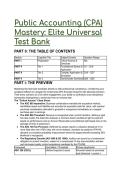
Public Accounting (CPA)
Mastery: Elite Universal
Test Bank
PART 0: THE TABLE OF CONTENTS
Section Cognitive Tier Subject Domain Question Range
PART I Preparation Critical Axioms & N/A
Directives
PART II Tier 1 Foundational Syntax & Q1 – Q18
Application
PART II Tier 2 Complex Application & Q19 – Q37
Simulation
PART II Tier 3 Grandmaster Synthesis Q38 – Q55
PART I: THE PREVIEW
Mastering this test bank translates directly to elite professional competence, conditioning your
analytical reflexes to navigate the modernized CPA Evolution blueprint with absolute precision.
Treat every scenario as a live client engagement; your ability to synthesize cross-disciplinary
frameworks distinguishes a technician from an industry titan.
The "Critical Axioms" Cheat Sheet:
● The ASC 805 Imperative: Business combinations mandate the acquisition method;
identifiable assets and liabilities are recorded at acquisition-date fair value, with residual
purchase consideration allocated to goodwill or recognized immediately as a bargain
purchase gain in earnings.
● The ASC 606 Threshold: Revenue is recognized when control transfers, utilizing a rigid
five-step model; the distinction between a Contract Asset (conditional right to payment
based on performance) and an Account Receivable (unconditional right based only on the
passage of time) is paramount.
● The ASC 740 Tax Provision: Deferred tax assets require a valuation allowance if it is
more likely than not (>50%) they will not be realized; uncertain tax positions (FIN 48)
demand a cumulative probability measurement where the largest benefit exceeding 50%
likelihood is recognized.
● The Regulatory Gauntlet (AS 1000 & QC 1000): Auditors are bound by a fundamental
obligation to protect investors, subject to a compressed 14-day documentation window
and risk-based quality control evaluations mandated by the PCAOB.
Framework Core Metric / Threshold Primary Application
ASC 326 (CECL) Lifetime Expected Losses Financial assets at amortized
cost (historical + current +
,Framework Core Metric / Threshold Primary Application
forecast)
IRC § 179 (2026) $2,560,000 Max / $4,090,000 Immediate expensing of
Phase-out qualifying business property
IRC § 163(j) Business Interest Income + Limitation on business interest
30% ATI expense deductions
PCAOB AS 2201 Reasonable Possibility of Differentiating Material
Material Misstatement Weaknesses from Significant
Deficiencies
PART II: THE ELITE TEST BANK
Tier 1: Foundational Syntax & Application
Q1: An entity enters into a contract to construct a specialized asset. The entity determines that it
has a right to payment for performance completed to date, but the final billing is contingent upon
passing a final safety inspection. Based on the principles of ASC 606, which classification is the
MOST APPROPRIATE for the unbilled accumulated costs and recognized margin? A) Account
Receivable B) Unearned Revenue C) Contract Asset D) Capitalized Work-in-Progress
● Answer: C (Contract Asset)
● Distractor Analysis:
○ A is incorrect: An account receivable requires an unconditional right to payment,
requiring only the passage of time. The pending safety inspection represents a
condition beyond mere time.
○ B is incorrect: Unearned revenue (Contract Liability) represents an obligation where
consideration has been received before the performance obligation is satisfied,
which contradicts the prompt's premise of unbilled earned margin.
○ D is incorrect: ASC 606 dictates revenue recognition models, overriding standard
inventory capitalization once a contract exists and revenue is recognized over time.
The Mentor's Analysis: Under ASC 606, when revenue is recognized but the right to payment
remains conditional on something other than the passage of time (like an inspection or
milestone), it must be classified as a contract asset. By utilizing conditional right logic, you
bypass the common trap of prematurely recognizing accounts receivable. Professional Intuition:
If payment requires a milestone beyond mere time, it is a Contract Asset, not an Account
Receivable.
Q2: A private company acquired a subsidiary and is consolidating the financial statements. The
purchase price was $15 million, and the fair value of the identifiable net assets acquired was
$18 million. Based on the principles of ASC 805, which accounting treatment is REQUIRED? A)
Recognize $3 million as Goodwill and amortize over 10 years. B) Recognize a $3 million
Bargain Purchase Gain in current earnings. C) Record the net assets at $15 million to match the
consideration transferred. D) Recognize $3 million in Accumulated Other Comprehensive
Income (AOCI).
● Answer: B (Recognize a $3 million Bargain Purchase Gain in current earnings.)
● Distractor Analysis:
○ A is incorrect: Goodwill only arises when consideration exceeds the fair value of net
assets, not the inverse.
○ C is incorrect: The acquisition method requires measuring identifiable assets and
liabilities at their acquisition-date fair values, explicitly forbidding adjustments to
, match the purchase price.
○ D is incorrect: Bargain purchase gains flow directly to the income statement on Day
1, not to equity or OCI.
The Mentor's Analysis: When the fair value of net assets exceeds the purchase consideration,
the acquirer has executed a bargain purchase. ASC 805 requires the resulting gain to be
recognized immediately in earnings. By utilizing fair value primacy, you bypass the common trap
of forcing assets to match the purchase price via negative goodwill. Professional Intuition:
Bargain purchase gains are Day 1 income statement victories; they never touch the
balance sheet as negative goodwill.
Q3: A state government levies a property tax for its General Fund. By year-end, $1,000,000 is
billed, $800,000 is collected, and an additional $150,000 is expected to be collected 90 days
after year-end. Based on the principles of Governmental Accounting, which amount is the
CORRECT revenue recognition for the current period? A) $1,000,000 B) $950,000 C) $800,000
D) $0
● Answer: C ($800,000)
● Distractor Analysis:
○ A is incorrect: This applies commercial full accrual logic, ignoring the modified
accrual "available" criteria necessary for governmental funds.
○ B is incorrect: While $150,000 is expected, it falls outside the standard 60-day
availability period required to pay current liabilities, thus becoming a deferred inflow
of resources.
○ D is incorrect: The $800,000 collected during the period is unequivocally both
measurable and available.
The Mentor's Analysis: Governmental funds use the modified accrual basis, recognizing
revenue only when it is "measurable and available" (typically collected within 60 days of
year-end to service current liabilities). By utilizing the 60-day availability rule, you bypass the
common trap of applying commercial full-accrual standards to municipal funds. Professional
Intuition: In the General Fund, if the cash doesn't arrive in time to pay this year's bills, it
isn't this year's revenue.
Q4: An entity has a deferred tax asset of $500,000 arising from net operating loss
carryforwards. Management assesses that there is a 60% probability the entity will not generate
sufficient future taxable income. Based on the principles of ASC 740, which action is
REQUIRED? A) Write down the deferred tax asset directly to $200,000. B) Establish a valuation
allowance of $500,000. C) Establish a valuation allowance of $300,000. D) Disclose the
uncertainty in the footnotes without adjusting the balance sheet.
● Answer: B (Establish a valuation allowance of $500,000.)
● Distractor Analysis:
○ A is incorrect: Deferred tax assets are recorded gross; they are not written down
directly but offset by a contra-asset valuation allowance.
○ C is incorrect: The valuation allowance is not probability-weighted on a sliding
scale. Because the 50% threshold is breached (it is more likely than not that the
entire asset won't be realized), a full allowance is needed against the unrealizable
portion.
○ D is incorrect: ASC 740 mandates actual balance sheet recognition of a valuation
allowance, not mere footnote disclosure.
The Mentor's Analysis: ASC 740 requires a valuation allowance to reduce a deferred tax asset if
it is "more likely than not" (greater than 50% chance) that some or all of the asset will not be
realized. By utilizing the binary >50% threshold assessment, you bypass the common trap of
Mastery: Elite Universal
Test Bank
PART 0: THE TABLE OF CONTENTS
Section Cognitive Tier Subject Domain Question Range
PART I Preparation Critical Axioms & N/A
Directives
PART II Tier 1 Foundational Syntax & Q1 – Q18
Application
PART II Tier 2 Complex Application & Q19 – Q37
Simulation
PART II Tier 3 Grandmaster Synthesis Q38 – Q55
PART I: THE PREVIEW
Mastering this test bank translates directly to elite professional competence, conditioning your
analytical reflexes to navigate the modernized CPA Evolution blueprint with absolute precision.
Treat every scenario as a live client engagement; your ability to synthesize cross-disciplinary
frameworks distinguishes a technician from an industry titan.
The "Critical Axioms" Cheat Sheet:
● The ASC 805 Imperative: Business combinations mandate the acquisition method;
identifiable assets and liabilities are recorded at acquisition-date fair value, with residual
purchase consideration allocated to goodwill or recognized immediately as a bargain
purchase gain in earnings.
● The ASC 606 Threshold: Revenue is recognized when control transfers, utilizing a rigid
five-step model; the distinction between a Contract Asset (conditional right to payment
based on performance) and an Account Receivable (unconditional right based only on the
passage of time) is paramount.
● The ASC 740 Tax Provision: Deferred tax assets require a valuation allowance if it is
more likely than not (>50%) they will not be realized; uncertain tax positions (FIN 48)
demand a cumulative probability measurement where the largest benefit exceeding 50%
likelihood is recognized.
● The Regulatory Gauntlet (AS 1000 & QC 1000): Auditors are bound by a fundamental
obligation to protect investors, subject to a compressed 14-day documentation window
and risk-based quality control evaluations mandated by the PCAOB.
Framework Core Metric / Threshold Primary Application
ASC 326 (CECL) Lifetime Expected Losses Financial assets at amortized
cost (historical + current +
,Framework Core Metric / Threshold Primary Application
forecast)
IRC § 179 (2026) $2,560,000 Max / $4,090,000 Immediate expensing of
Phase-out qualifying business property
IRC § 163(j) Business Interest Income + Limitation on business interest
30% ATI expense deductions
PCAOB AS 2201 Reasonable Possibility of Differentiating Material
Material Misstatement Weaknesses from Significant
Deficiencies
PART II: THE ELITE TEST BANK
Tier 1: Foundational Syntax & Application
Q1: An entity enters into a contract to construct a specialized asset. The entity determines that it
has a right to payment for performance completed to date, but the final billing is contingent upon
passing a final safety inspection. Based on the principles of ASC 606, which classification is the
MOST APPROPRIATE for the unbilled accumulated costs and recognized margin? A) Account
Receivable B) Unearned Revenue C) Contract Asset D) Capitalized Work-in-Progress
● Answer: C (Contract Asset)
● Distractor Analysis:
○ A is incorrect: An account receivable requires an unconditional right to payment,
requiring only the passage of time. The pending safety inspection represents a
condition beyond mere time.
○ B is incorrect: Unearned revenue (Contract Liability) represents an obligation where
consideration has been received before the performance obligation is satisfied,
which contradicts the prompt's premise of unbilled earned margin.
○ D is incorrect: ASC 606 dictates revenue recognition models, overriding standard
inventory capitalization once a contract exists and revenue is recognized over time.
The Mentor's Analysis: Under ASC 606, when revenue is recognized but the right to payment
remains conditional on something other than the passage of time (like an inspection or
milestone), it must be classified as a contract asset. By utilizing conditional right logic, you
bypass the common trap of prematurely recognizing accounts receivable. Professional Intuition:
If payment requires a milestone beyond mere time, it is a Contract Asset, not an Account
Receivable.
Q2: A private company acquired a subsidiary and is consolidating the financial statements. The
purchase price was $15 million, and the fair value of the identifiable net assets acquired was
$18 million. Based on the principles of ASC 805, which accounting treatment is REQUIRED? A)
Recognize $3 million as Goodwill and amortize over 10 years. B) Recognize a $3 million
Bargain Purchase Gain in current earnings. C) Record the net assets at $15 million to match the
consideration transferred. D) Recognize $3 million in Accumulated Other Comprehensive
Income (AOCI).
● Answer: B (Recognize a $3 million Bargain Purchase Gain in current earnings.)
● Distractor Analysis:
○ A is incorrect: Goodwill only arises when consideration exceeds the fair value of net
assets, not the inverse.
○ C is incorrect: The acquisition method requires measuring identifiable assets and
liabilities at their acquisition-date fair values, explicitly forbidding adjustments to
, match the purchase price.
○ D is incorrect: Bargain purchase gains flow directly to the income statement on Day
1, not to equity or OCI.
The Mentor's Analysis: When the fair value of net assets exceeds the purchase consideration,
the acquirer has executed a bargain purchase. ASC 805 requires the resulting gain to be
recognized immediately in earnings. By utilizing fair value primacy, you bypass the common trap
of forcing assets to match the purchase price via negative goodwill. Professional Intuition:
Bargain purchase gains are Day 1 income statement victories; they never touch the
balance sheet as negative goodwill.
Q3: A state government levies a property tax for its General Fund. By year-end, $1,000,000 is
billed, $800,000 is collected, and an additional $150,000 is expected to be collected 90 days
after year-end. Based on the principles of Governmental Accounting, which amount is the
CORRECT revenue recognition for the current period? A) $1,000,000 B) $950,000 C) $800,000
D) $0
● Answer: C ($800,000)
● Distractor Analysis:
○ A is incorrect: This applies commercial full accrual logic, ignoring the modified
accrual "available" criteria necessary for governmental funds.
○ B is incorrect: While $150,000 is expected, it falls outside the standard 60-day
availability period required to pay current liabilities, thus becoming a deferred inflow
of resources.
○ D is incorrect: The $800,000 collected during the period is unequivocally both
measurable and available.
The Mentor's Analysis: Governmental funds use the modified accrual basis, recognizing
revenue only when it is "measurable and available" (typically collected within 60 days of
year-end to service current liabilities). By utilizing the 60-day availability rule, you bypass the
common trap of applying commercial full-accrual standards to municipal funds. Professional
Intuition: In the General Fund, if the cash doesn't arrive in time to pay this year's bills, it
isn't this year's revenue.
Q4: An entity has a deferred tax asset of $500,000 arising from net operating loss
carryforwards. Management assesses that there is a 60% probability the entity will not generate
sufficient future taxable income. Based on the principles of ASC 740, which action is
REQUIRED? A) Write down the deferred tax asset directly to $200,000. B) Establish a valuation
allowance of $500,000. C) Establish a valuation allowance of $300,000. D) Disclose the
uncertainty in the footnotes without adjusting the balance sheet.
● Answer: B (Establish a valuation allowance of $500,000.)
● Distractor Analysis:
○ A is incorrect: Deferred tax assets are recorded gross; they are not written down
directly but offset by a contra-asset valuation allowance.
○ C is incorrect: The valuation allowance is not probability-weighted on a sliding
scale. Because the 50% threshold is breached (it is more likely than not that the
entire asset won't be realized), a full allowance is needed against the unrealizable
portion.
○ D is incorrect: ASC 740 mandates actual balance sheet recognition of a valuation
allowance, not mere footnote disclosure.
The Mentor's Analysis: ASC 740 requires a valuation allowance to reduce a deferred tax asset if
it is "more likely than not" (greater than 50% chance) that some or all of the asset will not be
realized. By utilizing the binary >50% threshold assessment, you bypass the common trap of


