
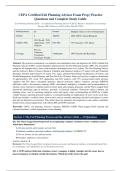
CEPA Certified Exit Planning Advisor Exam Prep | Practice
Questions and Complete Study Guide
Exit Planning Institute (EPI) — Certified Exit Planning Advisor (CEPA): Business Valuation, Exit Strategy
Design, M&A Advisory, and Post-Exit Wealth (2026)
Total Questions: 60 Format: Multiple Choice (A-D) with Rationales
Sections: 5 Aligned: 2026 CEPA Content Blueprint
30% Recall / 50%
Cognitive Mix: Application / 20% Item Mix: 75% Scenario / 25% Direct
Analysis
Process,
Valuation,
Coverage: Verification: 100% Keyed with Rationales
Transitions,
Tax/Legal, Wealth
Abstract. This practice examination is an original, non-confidential study aid aligned to the 2026 Certified Exit
Planning Advisor (CEPA) content blueprint administered by the Exit Planning Institute (EPI). The instrument
comprises 60 multiple-choice items with rationales distributed across five sections: The Exit Planning Process
and the Advisor’s Role (10 items); Business Valuation and Financial Analysis (15 items); Exit and Transition
Strategies (Internal and External) (15 items); Tax, Legal, and Deal Structuring Considerations (10 items); and
Wealth Management, Estate Planning, and Post-Exit Life (10 items). Items are keyed to a cognitive distribution
of approximately 30% recall, 50% application, and 20% analysis, with 75% scenario-based client advisory
vignettes and 25% direct conceptual questions. Special inclusions address valuation concepts (EBITDA
add-backs, seller’s discretionary earnings (SDE), and industry multiples), evaluation and recommendation of
internal versus external exit options based on owner goals and company financials, and the Three-Legged Stool
framework identifying gaps in business, personal, or financial readiness. Distractors reflect common exit
planning errors, such as confusing enterprise value with equity value, recommending an ESOP for a highly
volatile business, ignoring personal readiness, or misunderstanding tax implications of asset versus stock sales.
Each item includes a verified correct answer and a concise rationale explaining why the keyed option is correct
and why the distractors are incorrect. This artifact does not reproduce any proprietary exam content; candidates
should verify current requirements with official EPI and CEPA materials.
Keywords: CEPA; exit planning; business valuation; EBITDA; ESOP; Three-Legged Stool; internal and
external transitions; wealth management; estate planning
Section 1: The Exit Planning Process and the Advisor’s Role — 10 Questions
Q1: The Three-Legged Stool framework in exit planning evaluates a business owner's readiness across
which three dimensions?
A. Revenue growth, profit margin, and cash flow
B. Business readiness, personal readiness, and financial readiness *[CORRECT]*
C. Pre-tax income, tax rate, and net income
D. Founders, employees, and customers
Correct Answer: B
Rationale: The Three-Legged Stool comprises business, personal, and financial readiness; revenue/profit/cash flow,
tax components, and stakeholders are not the framework's legs.
Q2: A CEPA advisor finds that a business owner's company is highly valuable, but the owner has no
post-exit purpose or identity outside the business. Which leg of the stool is the gap?
, A. Business readiness
B. Financial readiness
C. Personal readiness *[CORRECT]*
D. Tax readiness
Correct Answer: C
Rationale: Lack of post-exit purpose and identity is a personal readiness gap; business, financial, and tax readiness
are different legs.
Q3: An owner's business has strong financials but no management team capable of running it without the
owner, and the owner's personal financial plan depends entirely on the sale proceeds. Which legs have
gaps?
A. Only the business leg
B. Only the personal leg
C. Only the financial leg
D. Business readiness (no successor management) and personal/financial readiness (dependence on
proceeds without a plan) *[CORRECT]*
Correct Answer: D
Rationale: Two legs are weak: business (no successor management) and personal/financial (dependence on proceeds
without a plan); it is not single-leg.
Q4: Value acceleration in exit planning is best described as:
A. Increasing business value and transferability through deliberate improvements across value drivers
before exit, not merely waiting for a higher offer *[CORRECT]*
B. Selling the business as quickly as possible
C. Reducing the sale price to attract buyers
D. Avoiding all pre-sale improvements to save cost
Correct Answer: A
Rationale: Value acceleration deliberately improves value drivers before exit to raise value and transferability; quick
selling, price cuts, or skipping improvements are not value acceleration.
Q5: The primary role of the CEPA is to:
A. Replace the owner's CPA and attorney
B. Lead and coordinate a multi-disciplinary team (CPA, attorney, wealth, personal) to design and execute
a comprehensive exit plan aligned with owner goals *[CORRECT]*
C. Sell the business as a broker only
D. Provide legal tax advice directly
Correct Answer: B
Rationale: The CEPA coordinates a multidisciplinary team aligned with owner goals; replacing CPAs/attorneys,
broker-only work, or providing legal tax advice are not the CEPA role.
Q6: A key benefit of starting exit planning 3-5 years before a planned transition is to:
A. Maximize the immediate sale price with no preparation
B. Avoid paying any taxes
C. Allow time to build management depth, optimize financials, implement tax strategies, and improve
personal and financial readiness *[CORRECT]*
D. Eliminate the need for advisors
Correct Answer: C
Rationale: Early planning allows building management, optimizing financials, tax planning, and readiness;
immediate sale, tax avoidance, or eliminating advisors are not benefits of early planning.
Questions and Complete Study Guide
Exit Planning Institute (EPI) — Certified Exit Planning Advisor (CEPA): Business Valuation, Exit Strategy
Design, M&A Advisory, and Post-Exit Wealth (2026)
Total Questions: 60 Format: Multiple Choice (A-D) with Rationales
Sections: 5 Aligned: 2026 CEPA Content Blueprint
30% Recall / 50%
Cognitive Mix: Application / 20% Item Mix: 75% Scenario / 25% Direct
Analysis
Process,
Valuation,
Coverage: Verification: 100% Keyed with Rationales
Transitions,
Tax/Legal, Wealth
Abstract. This practice examination is an original, non-confidential study aid aligned to the 2026 Certified Exit
Planning Advisor (CEPA) content blueprint administered by the Exit Planning Institute (EPI). The instrument
comprises 60 multiple-choice items with rationales distributed across five sections: The Exit Planning Process
and the Advisor’s Role (10 items); Business Valuation and Financial Analysis (15 items); Exit and Transition
Strategies (Internal and External) (15 items); Tax, Legal, and Deal Structuring Considerations (10 items); and
Wealth Management, Estate Planning, and Post-Exit Life (10 items). Items are keyed to a cognitive distribution
of approximately 30% recall, 50% application, and 20% analysis, with 75% scenario-based client advisory
vignettes and 25% direct conceptual questions. Special inclusions address valuation concepts (EBITDA
add-backs, seller’s discretionary earnings (SDE), and industry multiples), evaluation and recommendation of
internal versus external exit options based on owner goals and company financials, and the Three-Legged Stool
framework identifying gaps in business, personal, or financial readiness. Distractors reflect common exit
planning errors, such as confusing enterprise value with equity value, recommending an ESOP for a highly
volatile business, ignoring personal readiness, or misunderstanding tax implications of asset versus stock sales.
Each item includes a verified correct answer and a concise rationale explaining why the keyed option is correct
and why the distractors are incorrect. This artifact does not reproduce any proprietary exam content; candidates
should verify current requirements with official EPI and CEPA materials.
Keywords: CEPA; exit planning; business valuation; EBITDA; ESOP; Three-Legged Stool; internal and
external transitions; wealth management; estate planning
Section 1: The Exit Planning Process and the Advisor’s Role — 10 Questions
Q1: The Three-Legged Stool framework in exit planning evaluates a business owner's readiness across
which three dimensions?
A. Revenue growth, profit margin, and cash flow
B. Business readiness, personal readiness, and financial readiness *[CORRECT]*
C. Pre-tax income, tax rate, and net income
D. Founders, employees, and customers
Correct Answer: B
Rationale: The Three-Legged Stool comprises business, personal, and financial readiness; revenue/profit/cash flow,
tax components, and stakeholders are not the framework's legs.
Q2: A CEPA advisor finds that a business owner's company is highly valuable, but the owner has no
post-exit purpose or identity outside the business. Which leg of the stool is the gap?
, A. Business readiness
B. Financial readiness
C. Personal readiness *[CORRECT]*
D. Tax readiness
Correct Answer: C
Rationale: Lack of post-exit purpose and identity is a personal readiness gap; business, financial, and tax readiness
are different legs.
Q3: An owner's business has strong financials but no management team capable of running it without the
owner, and the owner's personal financial plan depends entirely on the sale proceeds. Which legs have
gaps?
A. Only the business leg
B. Only the personal leg
C. Only the financial leg
D. Business readiness (no successor management) and personal/financial readiness (dependence on
proceeds without a plan) *[CORRECT]*
Correct Answer: D
Rationale: Two legs are weak: business (no successor management) and personal/financial (dependence on proceeds
without a plan); it is not single-leg.
Q4: Value acceleration in exit planning is best described as:
A. Increasing business value and transferability through deliberate improvements across value drivers
before exit, not merely waiting for a higher offer *[CORRECT]*
B. Selling the business as quickly as possible
C. Reducing the sale price to attract buyers
D. Avoiding all pre-sale improvements to save cost
Correct Answer: A
Rationale: Value acceleration deliberately improves value drivers before exit to raise value and transferability; quick
selling, price cuts, or skipping improvements are not value acceleration.
Q5: The primary role of the CEPA is to:
A. Replace the owner's CPA and attorney
B. Lead and coordinate a multi-disciplinary team (CPA, attorney, wealth, personal) to design and execute
a comprehensive exit plan aligned with owner goals *[CORRECT]*
C. Sell the business as a broker only
D. Provide legal tax advice directly
Correct Answer: B
Rationale: The CEPA coordinates a multidisciplinary team aligned with owner goals; replacing CPAs/attorneys,
broker-only work, or providing legal tax advice are not the CEPA role.
Q6: A key benefit of starting exit planning 3-5 years before a planned transition is to:
A. Maximize the immediate sale price with no preparation
B. Avoid paying any taxes
C. Allow time to build management depth, optimize financials, implement tax strategies, and improve
personal and financial readiness *[CORRECT]*
D. Eliminate the need for advisors
Correct Answer: C
Rationale: Early planning allows building management, optimizing financials, tax planning, and readiness;
immediate sale, tax avoidance, or eliminating advisors are not benefits of early planning.


