
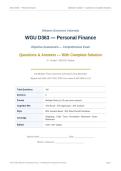
WGU D363 — Personal Finance 2026/2027 Update — Questions & Complete Solutions
Western Governors University
WGU D363 — Personal Finance
Objective Assessment — Comprehensive Exam
Questions & Answers — With Complete Solution
A+ Graded · 2026/2027 Update
100 Multiple-Choice Questions with Step-by-Step Rationales
Aligned with 2026–2027 WGU D363 Curriculum & SECURE Act 2.0
Total Questions 100
Sections 6
Format Multiple Choice (A–D, one correct answer)
Cognitive Mix 25% Recall · 55% Application · 20% Analysis
Style 80% Scenario-Based · 20% Direct Recall/Calculation
Budgeting · Credit · Taxes · Investments · Retirement · Estate ·
Coverage
Behavioral
Edition Update
Student Name: __________________________ Date: __________________
Mentor / Instructor: __________________________
WGU D363 Objective Assessment Prep | 100-Question Comprehensive Exam Page 1
,WGU D363 — Personal Finance 2026/2027 Update — Questions & Complete Solutions
Examination Overview & Section Map
This comprehensive examination assesses WGU D363 Personal Finance competencies across six core domains: financial
planning and budgeting, credit and debt management, income and taxes, savings and investment, retirement and estate
planning, and behavioral finance. Each question includes a verified answer with a step-by-step rationale explaining why the
correct option is right and why the distractors represent common WGU D363 exam pitfalls. The exam aligns with
2026–2027 WGU curriculum standards, current IRS contribution limits, SECURE Act 2.0 provisions, and updated tax
brackets. Use this resource both as a self-assessment tool and as a study guide for the objective assessment.
Question
# Section Title
Range
1 Financial Planning and Budgeting Q1–Q20
2 Credit, Debt, and Consumer Protection Q21–Q38
3 Income, Taxes, and Employment Q39–Q50
4 Savings, Investment, and Risk Management Q51–Q72
5 Retirement and Estate Planning Q73–Q88
6 Behavioral Finance and Advanced Topics Q89–Q100
Cognitive Level Distribution
• Recall (~25%) — direct identification of FICO factors, IRS contribution limits, FCRA reporting periods, and
consumer-protection statutes.
• Application (~55%) — calculating liquidity, DTI, and asset-to-debt ratios; selecting debt repayment strategies;
comparing insurance plans; choosing Traditional vs. Roth contributions.
• Analysis (~20%) — comparing sequence-of-returns risk, evaluating tax-rate arbitrage, identifying behavioral biases, and
integrating estate-planning tools.
WGU D363 Objective Assessment Prep | 100-Question Comprehensive Exam Page 2
,WGU D363 — Personal Finance 2026/2027 Update — Questions & Complete Solutions
Section 1: Financial Planning and Budgeting
Financial Statements, Budgeting Strategies, Goal Setting, & Cash Flow Management — Questions 1–20
1. A client presents the following data for the month: $6,200 salary, $1,800 rent, $450 groceries, $320 auto loan,
$180 utilities, $260 dining, $200 to savings, and $290 discretionary. The cash-flow statement will show:
A. A deficit of $300 because savings is treated as an expense that exceeds available income
B. A surplus of $1,400, calculated as income minus all expenses including the savings contribution
C. A surplus of $1,400, with savings reclassified as an asset transfer rather than an expense [CORRECT]
D. Break-even because savings offsets the discretionary spending exactly
Correct Answer: C — A surplus of $1,400, with savings reclassified as an asset transfer rather than an
expense
Rationale: On a cash-flow statement, income ($6,200) minus expenses ($1,800 + $450 + $320 + $180 + $260 + $290 = $3,300)
yields a surplus of $2,900. The $200 contributed to savings is an asset transfer (balance sheet movement), not an expense;
including it as an expense would understate surplus by $200. Therefore surplus = $2,900 and $200 of it flows to savings, leaving
$2,700 of unallocated cash. Option A inverts the calculation; Option B double-counts savings as an expense; Option D is
mathematically incorrect.
2. Which statement correctly distinguishes a balance sheet (net worth statement) from a cash-flow statement?
A. The balance sheet covers a defined period; the cash-flow statement is a snapshot at a point in time
B. The balance sheet is a point-in-time snapshot of assets minus liabilities; the cash-flow statement reports
income and expenses over a defined period [CORRECT]
C. Both are point-in-time statements; only the categories differ
D. Both cover a defined period; only the format differs
Correct Answer: B — The balance sheet is a point-in-time snapshot of assets minus liabilities; the
cash-flow statement reports income and expenses over a defined period
Rationale: A balance sheet (net worth statement) is a snapshot at a single point in time showing assets, liabilities, and net worth
(assets − liabilities). A cash-flow statement covers a defined period (month, year) and reports income versus expenses to derive a
surplus or deficit. Options A, C, and D all misstate the temporal nature of these statements.
3. Using the 50/30/20 rule, a household with gross monthly income of $5,400 should allocate approximately:
A. $2,700 to needs, $1,620 to wants, $1,080 to savings and debt repayment [CORRECT]
B. $2,700 to needs, $1,080 to wants, $1,620 to savings and debt repayment
C. $1,800 to needs, $1,800 to wants, $1,800 to savings
D. $3,000 to needs, $1,400 to wants, $1,000 to savings
Correct Answer: A — $2,700 to needs, $1,620 to wants, $1,080 to savings and debt repayment
Rationale: The 50/30/20 rule allocates 50% to needs ($5,400 × 0.50 = $2,700), 30% to wants ($5,400 × 0.30 = $1,620), and 20%
to savings and debt repayment ($5,400 × 0.20 = $1,080). Option B swaps wants and savings allocations; Option C equally
divides the income (not the 50/30/20 framework); Option D uses arbitrary numbers.
WGU D363 Objective Assessment Prep | 100-Question Comprehensive Exam Page 3
, WGU D363 — Personal Finance 2026/2027 Update — Questions & Complete Solutions
4. Zero-based budgeting is BEST described as:
A. A budget that begins with no prior baseline and must justify every expense
B. A budget in which income minus assigned expenses equals zero, assigning every dollar a purpose
[CORRECT]
C. A budget that ignores fixed expenses and focuses only on variable spending
D. A budget based on zero-based expense categories without income allocation
Correct Answer: B — A budget in which income minus assigned expenses equals zero, assigning every
dollar a purpose
Rationale: In personal finance, zero-based budgeting means income minus expenses (including savings, debt repayment, and
discretionary spending) equals zero — every dollar is intentionally assigned a purpose. This differs from corporate zero-based
budgeting (Option A) which justifies every expense from scratch. Options C and D mischaracterize the technique.
5. A client has $14,500 in checking/savings, $8,200 in a money market account, and monthly expenses of $4,100.
What is their liquidity ratio and is it within the recommended range?
A. 3.5 months — within the recommended 3–6 month range
B. 5.5 months — exceeds the recommended range and suggests under-investment
C. 5.5 months — within the recommended 3–6 month range [CORRECT]
D. 2.5 months — below the recommended range
Correct Answer: C — 5.5 months — within the recommended 3–6 month range
Rationale: Liquid assets = $14,500 + $8,200 = $22,700. Liquidity ratio = liquid assets ÷ monthly expenses = $22,700 ÷ $4,100 =
5.54 months, which falls within the recommended 3–6 month range. Option A miscalculates by using only checking/savings;
Option B misapplies the target range; Option D uses only part of the liquid assets or an incorrect denominator.
6. A borrower has a gross monthly income of $6,000, a mortgage payment of $1,500, a car loan of $400, student
loans of $350, and minimum credit card payments of $250. Their debt-to-income (DTI) ratio is:
A. 25%, well below the recommended ceiling
B. 33%, at the upper end of acceptable for conventional mortgages
C. 42%, which exceeds typical mortgage qualification thresholds [CORRECT]
D. 50%, disqualifying them from any mortgage product
Correct Answer: C — 42%, which exceeds typical mortgage qualification thresholds
Rationale: Total monthly debt = $1,500 + $400 + $350 + $250 = $2,500. DTI = $2,500 ÷ $6,000 = 41.7% ≈ 42%. Conventional
mortgage guidelines typically cap DTI at 43% (some lenders prefer ≤36% overall, with up to 28% for housing). Option A only
counts the mortgage; Option B understates total debt; Option D overstates the result.
WGU D363 Objective Assessment Prep | 100-Question Comprehensive Exam Page 4
Western Governors University
WGU D363 — Personal Finance
Objective Assessment — Comprehensive Exam
Questions & Answers — With Complete Solution
A+ Graded · 2026/2027 Update
100 Multiple-Choice Questions with Step-by-Step Rationales
Aligned with 2026–2027 WGU D363 Curriculum & SECURE Act 2.0
Total Questions 100
Sections 6
Format Multiple Choice (A–D, one correct answer)
Cognitive Mix 25% Recall · 55% Application · 20% Analysis
Style 80% Scenario-Based · 20% Direct Recall/Calculation
Budgeting · Credit · Taxes · Investments · Retirement · Estate ·
Coverage
Behavioral
Edition Update
Student Name: __________________________ Date: __________________
Mentor / Instructor: __________________________
WGU D363 Objective Assessment Prep | 100-Question Comprehensive Exam Page 1
,WGU D363 — Personal Finance 2026/2027 Update — Questions & Complete Solutions
Examination Overview & Section Map
This comprehensive examination assesses WGU D363 Personal Finance competencies across six core domains: financial
planning and budgeting, credit and debt management, income and taxes, savings and investment, retirement and estate
planning, and behavioral finance. Each question includes a verified answer with a step-by-step rationale explaining why the
correct option is right and why the distractors represent common WGU D363 exam pitfalls. The exam aligns with
2026–2027 WGU curriculum standards, current IRS contribution limits, SECURE Act 2.0 provisions, and updated tax
brackets. Use this resource both as a self-assessment tool and as a study guide for the objective assessment.
Question
# Section Title
Range
1 Financial Planning and Budgeting Q1–Q20
2 Credit, Debt, and Consumer Protection Q21–Q38
3 Income, Taxes, and Employment Q39–Q50
4 Savings, Investment, and Risk Management Q51–Q72
5 Retirement and Estate Planning Q73–Q88
6 Behavioral Finance and Advanced Topics Q89–Q100
Cognitive Level Distribution
• Recall (~25%) — direct identification of FICO factors, IRS contribution limits, FCRA reporting periods, and
consumer-protection statutes.
• Application (~55%) — calculating liquidity, DTI, and asset-to-debt ratios; selecting debt repayment strategies;
comparing insurance plans; choosing Traditional vs. Roth contributions.
• Analysis (~20%) — comparing sequence-of-returns risk, evaluating tax-rate arbitrage, identifying behavioral biases, and
integrating estate-planning tools.
WGU D363 Objective Assessment Prep | 100-Question Comprehensive Exam Page 2
,WGU D363 — Personal Finance 2026/2027 Update — Questions & Complete Solutions
Section 1: Financial Planning and Budgeting
Financial Statements, Budgeting Strategies, Goal Setting, & Cash Flow Management — Questions 1–20
1. A client presents the following data for the month: $6,200 salary, $1,800 rent, $450 groceries, $320 auto loan,
$180 utilities, $260 dining, $200 to savings, and $290 discretionary. The cash-flow statement will show:
A. A deficit of $300 because savings is treated as an expense that exceeds available income
B. A surplus of $1,400, calculated as income minus all expenses including the savings contribution
C. A surplus of $1,400, with savings reclassified as an asset transfer rather than an expense [CORRECT]
D. Break-even because savings offsets the discretionary spending exactly
Correct Answer: C — A surplus of $1,400, with savings reclassified as an asset transfer rather than an
expense
Rationale: On a cash-flow statement, income ($6,200) minus expenses ($1,800 + $450 + $320 + $180 + $260 + $290 = $3,300)
yields a surplus of $2,900. The $200 contributed to savings is an asset transfer (balance sheet movement), not an expense;
including it as an expense would understate surplus by $200. Therefore surplus = $2,900 and $200 of it flows to savings, leaving
$2,700 of unallocated cash. Option A inverts the calculation; Option B double-counts savings as an expense; Option D is
mathematically incorrect.
2. Which statement correctly distinguishes a balance sheet (net worth statement) from a cash-flow statement?
A. The balance sheet covers a defined period; the cash-flow statement is a snapshot at a point in time
B. The balance sheet is a point-in-time snapshot of assets minus liabilities; the cash-flow statement reports
income and expenses over a defined period [CORRECT]
C. Both are point-in-time statements; only the categories differ
D. Both cover a defined period; only the format differs
Correct Answer: B — The balance sheet is a point-in-time snapshot of assets minus liabilities; the
cash-flow statement reports income and expenses over a defined period
Rationale: A balance sheet (net worth statement) is a snapshot at a single point in time showing assets, liabilities, and net worth
(assets − liabilities). A cash-flow statement covers a defined period (month, year) and reports income versus expenses to derive a
surplus or deficit. Options A, C, and D all misstate the temporal nature of these statements.
3. Using the 50/30/20 rule, a household with gross monthly income of $5,400 should allocate approximately:
A. $2,700 to needs, $1,620 to wants, $1,080 to savings and debt repayment [CORRECT]
B. $2,700 to needs, $1,080 to wants, $1,620 to savings and debt repayment
C. $1,800 to needs, $1,800 to wants, $1,800 to savings
D. $3,000 to needs, $1,400 to wants, $1,000 to savings
Correct Answer: A — $2,700 to needs, $1,620 to wants, $1,080 to savings and debt repayment
Rationale: The 50/30/20 rule allocates 50% to needs ($5,400 × 0.50 = $2,700), 30% to wants ($5,400 × 0.30 = $1,620), and 20%
to savings and debt repayment ($5,400 × 0.20 = $1,080). Option B swaps wants and savings allocations; Option C equally
divides the income (not the 50/30/20 framework); Option D uses arbitrary numbers.
WGU D363 Objective Assessment Prep | 100-Question Comprehensive Exam Page 3
, WGU D363 — Personal Finance 2026/2027 Update — Questions & Complete Solutions
4. Zero-based budgeting is BEST described as:
A. A budget that begins with no prior baseline and must justify every expense
B. A budget in which income minus assigned expenses equals zero, assigning every dollar a purpose
[CORRECT]
C. A budget that ignores fixed expenses and focuses only on variable spending
D. A budget based on zero-based expense categories without income allocation
Correct Answer: B — A budget in which income minus assigned expenses equals zero, assigning every
dollar a purpose
Rationale: In personal finance, zero-based budgeting means income minus expenses (including savings, debt repayment, and
discretionary spending) equals zero — every dollar is intentionally assigned a purpose. This differs from corporate zero-based
budgeting (Option A) which justifies every expense from scratch. Options C and D mischaracterize the technique.
5. A client has $14,500 in checking/savings, $8,200 in a money market account, and monthly expenses of $4,100.
What is their liquidity ratio and is it within the recommended range?
A. 3.5 months — within the recommended 3–6 month range
B. 5.5 months — exceeds the recommended range and suggests under-investment
C. 5.5 months — within the recommended 3–6 month range [CORRECT]
D. 2.5 months — below the recommended range
Correct Answer: C — 5.5 months — within the recommended 3–6 month range
Rationale: Liquid assets = $14,500 + $8,200 = $22,700. Liquidity ratio = liquid assets ÷ monthly expenses = $22,700 ÷ $4,100 =
5.54 months, which falls within the recommended 3–6 month range. Option A miscalculates by using only checking/savings;
Option B misapplies the target range; Option D uses only part of the liquid assets or an incorrect denominator.
6. A borrower has a gross monthly income of $6,000, a mortgage payment of $1,500, a car loan of $400, student
loans of $350, and minimum credit card payments of $250. Their debt-to-income (DTI) ratio is:
A. 25%, well below the recommended ceiling
B. 33%, at the upper end of acceptable for conventional mortgages
C. 42%, which exceeds typical mortgage qualification thresholds [CORRECT]
D. 50%, disqualifying them from any mortgage product
Correct Answer: C — 42%, which exceeds typical mortgage qualification thresholds
Rationale: Total monthly debt = $1,500 + $400 + $350 + $250 = $2,500. DTI = $2,500 ÷ $6,000 = 41.7% ≈ 42%. Conventional
mortgage guidelines typically cap DTI at 43% (some lenders prefer ≤36% overall, with up to 28% for housing). Option A only
counts the mortgage; Option B understates total debt; Option D overstates the result.
WGU D363 Objective Assessment Prep | 100-Question Comprehensive Exam Page 4


