
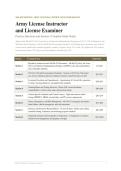
2026-2027 EDITION | ARMY LICENSING CERTIFICATION PREPARATION
Army License Instructor
and License Examiner
Practice Questions and Answers | Complete Study Guide
Aligned with AR 600-55 (The Army Driver and Operator Standardization Program) and TC 21-305-20 (Manual for the
Wheeled Vehicle Operator), with DA PAM 600-55 procedural standards. 100 multiple-choice questions, each with the
correct answer marked and a detailed regulatory rationale. Cognitive levels: 25% recall, 50% application, 25% analysis.
Scenario-based items: 75%; direct recall and regulatory identification: 25%.
Section Content Focus Questions
Regulatory Framework and AR 600-55 Governance - AR 600-55 policy, the Army
Section 1 Driver and Operator Standardization Program (ADOSP), roles and responsibilities, Q1-Q20
and commander authority
DA Form 348 and Documentation Standards - Sections of DA Form 348, proper
Section 2 Q21-Q35
use, license validation, physical evaluation measures, and performance records
Licensing Procedures and Appointments - Appointment of LIs and LEs, separation
Section 3 Q36-Q45
of duties, licensing pathways, and qualification standards
Training Phases and Testing Protocols - Phases I-III, License Examiner
Section 4 Q46-Q60
responsibilities, control course setup, and practical testing
Vehicle-Specific Standards and Control Courses - Light and medium vehicle
Section 5 Q61-Q70
testing, HMMWV, MRAP, tractor/trailer, and PLS course requirements
Safety, Emergencies, and Risk Management - AR 385-10, emergency procedures,
Section 6 Q71-Q80
brake failure, vehicle emergencies, and risk assessment
Instructor and Examiner Responsibilities - LI and LE duties, liability and conduct,
Section 7 Q81-Q90
remedial training, evaluation, and sustaining program standards
Integrated Scenarios and Command-Level Questions - Comprehensive scenarios,
Section 8 Q91-Q100
battalion-level management, and program oversight
2026-2027 Edition | For Training and Study Use 1
,Army License Instructor and License Examiner | Complete Study Guide AR 600-55 | TC 21-305-20
SECTION 1 Questions Q1-Q20
Regulatory Framework and AR 600-55 Governance
Focus: AR 600-55 policy, the Army Driver and Operator Standardization Program (ADOSP), roles and responsibilities, and
commander authority
Q1. Which statement best describes the primary purpose of Army Regulation 600-55?
A. Establishes the physical readiness training standards and body composition program for
all Soldiers
B. Prescribes the Army Maintenance Management System used to schedule and record
operator-level maintenance
C. Prescribes policy, procedural guidance, and responsibilities for the Army Driver and
Operator Standardization Program (ADOSP), governing selection, training, testing, and
licensing of vehicle and equipment operators [CORRECT]
D. Directs the Army Substance Abuse Program testing requirements for personnel in
safety-sensitive positions
Correct Answer: C
Rationale: AR 600-55 is the governing regulation for the ADOSP: it standardizes the selection, training,
testing, and licensing of every Soldier or civilian who operates an Army motor vehicle or equipment,
with DA PAM 600-55 providing the detailed how-to procedures. The distractors describe programs
governed elsewhere: physical readiness under AR 350-1 and FM 7-22, maintenance management under
AR 750-1 and DA PAM 750-8, and drug testing under AR 600-85. LI/LE candidates must instantly
associate ADOSP with AR 600-55 because every licensing decision traces back to that regulation's
authority.
2026-2027 Edition | For Training and Study Use 2
,Army License Instructor and License Examiner | Complete Study Guide AR 600-55 | TC 21-305-20
Q2. A newly assigned company commander assumes command of a transportation
platoon-equipped unit that conducts daily licensing operations. Under AR 600-55, what is this
commander's core responsibility regarding the ADOSP within the unit?
A. The commander holds ultimate responsibility for the unit ADOSP, to include
appointing qualified License Instructors and License Examiners, ensuring only licensed
and qualified personnel operate unit vehicles, and maintaining an effective licensing
program [CORRECT]
B. The commander may delegate the entire licensing program to the unit motor sergeant,
retaining responsibility only for countersigning DA Form 348 documents prepared by
maintenance personnel
C. The commander is only responsible for funding the program, while the installation
Master Driver assumes the commander's licensing responsibilities
D. Responsibility belongs to the battalion logistics officer, who administers licensing as a
staff function independent of the company
Correct Answer: A
Rationale: AR 600-55 places ultimate responsibility for the ADOSP squarely on the unit commander;
delegation of administrative tasks never relieves the commander of that accountability. The commander
personally ensures trained, tested, and licensed operators are the only personnel who operate unit
vehicles and appoints the LIs and LEs who execute the program. The Master Driver and motor sergeant
advise and administer, but they do not assume the commander's ultimate responsibility, and licensing is a
command function, not a logistics staff function.
2026-2027 Edition | For Training and Study Use 3
, Army License Instructor and License Examiner | Complete Study Guide AR 600-55 | TC 21-305-20
Q3. An NCO studying for the LI/LE board asks how AR 600-55 differs from DA PAM
600-55. Which explanation is correct?
A. AR 600-55 contains the practical course layouts and score sheets, while DA PAM
600-55 contains the enforceable policy
B. AR 600-55 prescribes the enforceable policy, responsibilities, and minimum
requirements, while DA PAM 600-55 provides the procedural guidance that explains how
to implement those requirements in detail [CORRECT]
C. DA PAM 600-55 is the newer publication that replaced AR 600-55 for all licensing
actions beginning with the 2026-2027 training cycle
D. The two publications are interchangeable; either may be cited as the authority for
licensing, testing, or enforcement actions
Correct Answer: B
Rationale: The regulation (AR 600-55) states what the standardization program requires and assigns
command responsibility, while the pamphlet (DA PAM 600-55) explains how to execute it, including
training conduct, testing procedures, and documentation techniques. This policy-versus-procedure
division is a classic LI/LE exam trap: an enforcement action is cited to the AR, never to the pamphlet.
DA PAM 600-55 has not replaced the regulation, and the two are never interchangeable because a
pamphlet cannot establish enforceable policy.
Q4. During a scheduled review, the battalion commander learns that an operator assigned to a
subordinate company has repeatedly committed preventable traffic violations in Army vehicles.
Who has the authority to suspend that operator's license under AR 600-55?
A. Only the Installation Management Command director, because license suspensions are
an installation-level action
B. The unit License Examiner, because the examiner scored the operator's original road
test
C. Any master sergeant in the operator's chain of command, because NCOs enforce
discipline daily
D. The unit commander or the commander's designated representative, acting under the
authority granted by AR 600-55 [CORRECT]
Correct Answer: D
Rationale: AR 600-55 grants suspension and revocation authority to the unit commander or a
designated representative, ensuring that licensing decisions remain a command action tied to discipline
and safety. License Examiners score tests and make recommendations, but they hold no independent
suspension authority; testing authority and disciplinary authority are deliberately separated. NCOs
recommend action through the chain of command, and installation-level agencies do not own unit license
suspension decisions, which makes the commander (or designated representative) the only correct
answer.
2026-2027 Edition | For Training and Study Use 4
Army License Instructor
and License Examiner
Practice Questions and Answers | Complete Study Guide
Aligned with AR 600-55 (The Army Driver and Operator Standardization Program) and TC 21-305-20 (Manual for the
Wheeled Vehicle Operator), with DA PAM 600-55 procedural standards. 100 multiple-choice questions, each with the
correct answer marked and a detailed regulatory rationale. Cognitive levels: 25% recall, 50% application, 25% analysis.
Scenario-based items: 75%; direct recall and regulatory identification: 25%.
Section Content Focus Questions
Regulatory Framework and AR 600-55 Governance - AR 600-55 policy, the Army
Section 1 Driver and Operator Standardization Program (ADOSP), roles and responsibilities, Q1-Q20
and commander authority
DA Form 348 and Documentation Standards - Sections of DA Form 348, proper
Section 2 Q21-Q35
use, license validation, physical evaluation measures, and performance records
Licensing Procedures and Appointments - Appointment of LIs and LEs, separation
Section 3 Q36-Q45
of duties, licensing pathways, and qualification standards
Training Phases and Testing Protocols - Phases I-III, License Examiner
Section 4 Q46-Q60
responsibilities, control course setup, and practical testing
Vehicle-Specific Standards and Control Courses - Light and medium vehicle
Section 5 Q61-Q70
testing, HMMWV, MRAP, tractor/trailer, and PLS course requirements
Safety, Emergencies, and Risk Management - AR 385-10, emergency procedures,
Section 6 Q71-Q80
brake failure, vehicle emergencies, and risk assessment
Instructor and Examiner Responsibilities - LI and LE duties, liability and conduct,
Section 7 Q81-Q90
remedial training, evaluation, and sustaining program standards
Integrated Scenarios and Command-Level Questions - Comprehensive scenarios,
Section 8 Q91-Q100
battalion-level management, and program oversight
2026-2027 Edition | For Training and Study Use 1
,Army License Instructor and License Examiner | Complete Study Guide AR 600-55 | TC 21-305-20
SECTION 1 Questions Q1-Q20
Regulatory Framework and AR 600-55 Governance
Focus: AR 600-55 policy, the Army Driver and Operator Standardization Program (ADOSP), roles and responsibilities, and
commander authority
Q1. Which statement best describes the primary purpose of Army Regulation 600-55?
A. Establishes the physical readiness training standards and body composition program for
all Soldiers
B. Prescribes the Army Maintenance Management System used to schedule and record
operator-level maintenance
C. Prescribes policy, procedural guidance, and responsibilities for the Army Driver and
Operator Standardization Program (ADOSP), governing selection, training, testing, and
licensing of vehicle and equipment operators [CORRECT]
D. Directs the Army Substance Abuse Program testing requirements for personnel in
safety-sensitive positions
Correct Answer: C
Rationale: AR 600-55 is the governing regulation for the ADOSP: it standardizes the selection, training,
testing, and licensing of every Soldier or civilian who operates an Army motor vehicle or equipment,
with DA PAM 600-55 providing the detailed how-to procedures. The distractors describe programs
governed elsewhere: physical readiness under AR 350-1 and FM 7-22, maintenance management under
AR 750-1 and DA PAM 750-8, and drug testing under AR 600-85. LI/LE candidates must instantly
associate ADOSP with AR 600-55 because every licensing decision traces back to that regulation's
authority.
2026-2027 Edition | For Training and Study Use 2
,Army License Instructor and License Examiner | Complete Study Guide AR 600-55 | TC 21-305-20
Q2. A newly assigned company commander assumes command of a transportation
platoon-equipped unit that conducts daily licensing operations. Under AR 600-55, what is this
commander's core responsibility regarding the ADOSP within the unit?
A. The commander holds ultimate responsibility for the unit ADOSP, to include
appointing qualified License Instructors and License Examiners, ensuring only licensed
and qualified personnel operate unit vehicles, and maintaining an effective licensing
program [CORRECT]
B. The commander may delegate the entire licensing program to the unit motor sergeant,
retaining responsibility only for countersigning DA Form 348 documents prepared by
maintenance personnel
C. The commander is only responsible for funding the program, while the installation
Master Driver assumes the commander's licensing responsibilities
D. Responsibility belongs to the battalion logistics officer, who administers licensing as a
staff function independent of the company
Correct Answer: A
Rationale: AR 600-55 places ultimate responsibility for the ADOSP squarely on the unit commander;
delegation of administrative tasks never relieves the commander of that accountability. The commander
personally ensures trained, tested, and licensed operators are the only personnel who operate unit
vehicles and appoints the LIs and LEs who execute the program. The Master Driver and motor sergeant
advise and administer, but they do not assume the commander's ultimate responsibility, and licensing is a
command function, not a logistics staff function.
2026-2027 Edition | For Training and Study Use 3
, Army License Instructor and License Examiner | Complete Study Guide AR 600-55 | TC 21-305-20
Q3. An NCO studying for the LI/LE board asks how AR 600-55 differs from DA PAM
600-55. Which explanation is correct?
A. AR 600-55 contains the practical course layouts and score sheets, while DA PAM
600-55 contains the enforceable policy
B. AR 600-55 prescribes the enforceable policy, responsibilities, and minimum
requirements, while DA PAM 600-55 provides the procedural guidance that explains how
to implement those requirements in detail [CORRECT]
C. DA PAM 600-55 is the newer publication that replaced AR 600-55 for all licensing
actions beginning with the 2026-2027 training cycle
D. The two publications are interchangeable; either may be cited as the authority for
licensing, testing, or enforcement actions
Correct Answer: B
Rationale: The regulation (AR 600-55) states what the standardization program requires and assigns
command responsibility, while the pamphlet (DA PAM 600-55) explains how to execute it, including
training conduct, testing procedures, and documentation techniques. This policy-versus-procedure
division is a classic LI/LE exam trap: an enforcement action is cited to the AR, never to the pamphlet.
DA PAM 600-55 has not replaced the regulation, and the two are never interchangeable because a
pamphlet cannot establish enforceable policy.
Q4. During a scheduled review, the battalion commander learns that an operator assigned to a
subordinate company has repeatedly committed preventable traffic violations in Army vehicles.
Who has the authority to suspend that operator's license under AR 600-55?
A. Only the Installation Management Command director, because license suspensions are
an installation-level action
B. The unit License Examiner, because the examiner scored the operator's original road
test
C. Any master sergeant in the operator's chain of command, because NCOs enforce
discipline daily
D. The unit commander or the commander's designated representative, acting under the
authority granted by AR 600-55 [CORRECT]
Correct Answer: D
Rationale: AR 600-55 grants suspension and revocation authority to the unit commander or a
designated representative, ensuring that licensing decisions remain a command action tied to discipline
and safety. License Examiners score tests and make recommendations, but they hold no independent
suspension authority; testing authority and disciplinary authority are deliberately separated. NCOs
recommend action through the chain of command, and installation-level agencies do not own unit license
suspension decisions, which makes the commander (or designated representative) the only correct
answer.
2026-2027 Edition | For Training and Study Use 4


