
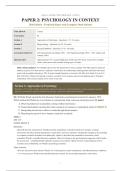
AQA A-LEVEL PSYCHOLOGY (7182/2)
PAPER 2: PSYCHOLOGY IN CONTEXT
2026 Edition - Predicted Paper with Complete Mark Scheme
Time allowed 2 hours
Total marks 96
Section A Approaches in Psychology - Questions 1-15 - 24 marks
Section B Biopsychology - Questions 16-30 - 24 marks
Section C Research Methods - Questions 31-45 - 48 marks
Assessment objectives AO1 Demonstrate knowledge (30%) - AO2 Apply knowledge (40%) - AO3 Analyse and
evaluate (30%)
Question style Approximately 75% scenario/application (AO2) and 25% direct recall (AO1); multiple
choice, short answer and extended writing up to 16 marks
Mark scheme guidance. For multiple choice items the keyed answer and a rationale with AQA-specific distractor
analysis are given. For short answers, indicative content lists the creditworthy marking points (allocation shown per
point) with acceptable alternatives. The 16-mark extended question is assessed with AQA level bands (Levels 0-4)
split AO1/AO3, followed by indicative content, a model Level 4 response and an essay planning sheet. Examiner
commentary with common student errors closes every item.
Section A: Approaches in Psychology
Questions 1-15 | 24 marks | Origins of psychology, behaviourist approach, social learning theory, cognitive approach, biological
approach, psychodynamic approach, humanistic psychology, comparison of approaches and debates
Q1: Wilhelm Wundt opened the first laboratory dedicated to psychological research in Leipzig in 1879.
Which method did Wundt use in an attempt to systematically study conscious mental processes? [1 mark]
A. Observing behaviour in naturalistic settings without interference
B. Trained participants reporting their inner sensations in response to standardised stimuli [CORRECT]
C. Interpreting unconscious conflicts revealed through dream analysis
D. Measuring the speed of nerve impulse conduction in animals
Marks: 1
AO: AO1
Correct Answer: B
Rationale:
Option B describes introspection: Wundt presented standardised, controlled stimuli (for example, a ticking
metronome) and asked trained participants to report their conscious sensations, marking the emergence of psychology
as a separate scientific discipline from philosophy. Option A describes later naturalistic observation, which
contradicts Wundt's controlled laboratory emphasis. Option C belongs to the psychodynamic approach, which studies
the unconscious - something Wundt explicitly rejected as unscientific. Option D refers to physiological work of
scientists such as Helmholtz, not Wundt's psychological method.
Mark Scheme:
• B is the only answer that matches Wundt's use of introspection under standardised, controlled laboratory conditions.
• A is wrong because Wundt used controlled laboratory stimuli, not uncontrolled naturalistic observation.
1
,AQA A-LEVEL PSYCHOLOGY (7182/2) Paper 2: Psychology in Context - 2026 Edition
• C is wrong because dream analysis and the unconscious are psychodynamic (Freud), not Wundt's scientific method.
• D is wrong because measuring nerve conduction is physiology, not the study of conscious experience.
Examiner commentary: Common error: students associate Wundt with 'the first psychologist' but credit Freud's methods
to him. Anchor the 1879 Leipzig laboratory to introspection and the emergence of psychology as a science.
Q2: Explain what is meant by the term 'introspection' in psychology. [2 marks]
Marks: 2
AO: AO1
Correct Answer: Introspection is the process by which a person examines and reports their own conscious inner
experience - their thoughts, sensations and feelings - typically in response to standardised stimuli presented under
controlled conditions.
Mark Scheme:
• 1 mark: the person examines/reports their OWN conscious mental states (thoughts, sensations, feelings).
• 1 mark: reference to presentation of stimuli under standardised/controlled conditions and systematic recording of
the experience (e.g., Wundt's metronome); accept 'the first systematic/experimental attempt to study the mind'.
• Acceptable alternative: describing introspection as structured self-observation used to build general theories about
mental processes.
Examiner commentary: Students often write 'thinking about thinking', which gains no credit unless tied to conscious
experience reported under controlled conditions. Do not credit references to unconscious processes - that is the
psychodynamic approach.
Q3: Before chemotherapy, hospital patients are given a strongly flavoured drink (flavour X) together with the
anti-cancer drug. The drug itself causes nausea. On later visits, flavour X alone triggers nausea. In this
example, the chemotherapy drug is the: [1 mark]
A. Conditioned stimulus (CS)
B. Unconditioned stimulus (UCS) [CORRECT]
C. Conditioned response (CR)
D. Neutral stimulus (NS)
Marks: 1
AO: AO2
Correct Answer: B
Rationale:
The drug causes nausea without any learning, so it is the unconditioned stimulus producing the unconditioned response
(nausea). Flavour X is initially the neutral stimulus and, through repeated pairing with the drug, becomes the
conditioned stimulus that elicits the conditioned response of nausea. Option A and Option C describe learned
elements of the association, and the drug's effect is unlearned. Option D is incorrect because it is the flavour, not the
drug, that starts as the neutral stimulus.
Mark Scheme:
• B: UCS produces the UCR (nausea) directly, before and without conditioning - the drug fits this definition.
• A is wrong: the CS is flavour X after pairing, not the drug.
• C is wrong: the CR is nausea to flavour X; the drug produces the UCR, not a CR.
• D is wrong: flavour X is the NS before pairing; the drug always had the capacity to cause nausea.
Examiner commentary: The most common classical-conditioning error is swapping UCS and CS because the drug is
'medical'. Test each element with one question: was the effect learned or unlearned?
2
, AQA A-LEVEL PSYCHOLOGY (7182/2) Paper 2: Psychology in Context - 2026 Edition
Q4: Outline one difference between classical conditioning and operant conditioning. [2 marks]
Marks: 2
AO: AO1
Correct Answer: Classical conditioning explains learning through association between two stimuli, producing an
automatic, reflexive response, whereas operant conditioning explains learning through the consequences of voluntary
behaviour - reinforcement strengthens behaviour and punishment weakens it.
Mark Scheme:
• 1 mark: classical = learning by association between stimuli (neutral stimulus paired with unconditioned stimulus);
response is reflexive/involuntary (e.g., Pavlov's dogs).
• 1 mark: operant = learning through consequences of active, voluntary behaviour - positive/negative reinforcement
increases likelihood; punishment decreases it (e.g., Skinner's rats/pigeons).
• Both elements must contrast for full marks; two descriptions of the same mechanism score a maximum of 1 mark.
Examiner commentary: Writing 'classical = Pavlov, operant = Skinner' with dogs and rats earns nothing without the
mechanism (association vs consequences). The contrast word - association OR consequence - is the creditworthy core.
Q5: A 16-year-old begins using the same slang and wearing the same brands as an online creator whom they
admire and wish to be like. According to social learning theory, this behaviour is best explained by: [1 mark]
A. Internalisation
B. Negative reinforcement
C. Deindividuation
D. Identification [CORRECT]
Marks: 1
AO: AO2
Correct Answer: D
Rationale:
Identification occurs when an individual imitates a model with whom they feel a connection and whom they wish to
be like; perceived similarity and admiration make imitation more likely, exactly as in the scenario. Internalisation
involves deeper private acceptance of beliefs, not merely copying surface behaviour. Negative reinforcement requires
the removal of an unpleasant consequence, which is absent here. Deindividuation refers to loss of personal identity in
crowds and is irrelevant to imitation of an admired model.
Mark Scheme:
• D: wanting to be like the model = identification; imitation is more likely when there is perceived similarity/attraction
to the model.
• A is wrong: internalisation is public and private acceptance of a viewpoint - deeper than surface imitation.
• B is wrong: no unpleasant stimulus is removed in the scenario.
• C is wrong: deindividuation concerns anonymity in groups, not modelling.
Examiner commentary: Do not credit vicarious reinforcement here - nothing is observed being rewarded. The cue is
'wish to be like', the classic identification trigger in Bandura's account.
Q6: In a classroom, a pupil watches a classmate receive praise from the teacher for tidying away equipment.
The pupil then begins tidying their own equipment. Referring to social learning theory, explain the pupil's
behaviour. [2 marks]
Marks: 2
AO: AO2
Correct Answer: The pupil observed the model's behaviour being rewarded (praise), which is vicarious reinforcement;
seeing the behaviour reinforced makes the pupil more likely to imitate the tidying behaviour, even though the pupil
received no direct reinforcement.
3
PAPER 2: PSYCHOLOGY IN CONTEXT
2026 Edition - Predicted Paper with Complete Mark Scheme
Time allowed 2 hours
Total marks 96
Section A Approaches in Psychology - Questions 1-15 - 24 marks
Section B Biopsychology - Questions 16-30 - 24 marks
Section C Research Methods - Questions 31-45 - 48 marks
Assessment objectives AO1 Demonstrate knowledge (30%) - AO2 Apply knowledge (40%) - AO3 Analyse and
evaluate (30%)
Question style Approximately 75% scenario/application (AO2) and 25% direct recall (AO1); multiple
choice, short answer and extended writing up to 16 marks
Mark scheme guidance. For multiple choice items the keyed answer and a rationale with AQA-specific distractor
analysis are given. For short answers, indicative content lists the creditworthy marking points (allocation shown per
point) with acceptable alternatives. The 16-mark extended question is assessed with AQA level bands (Levels 0-4)
split AO1/AO3, followed by indicative content, a model Level 4 response and an essay planning sheet. Examiner
commentary with common student errors closes every item.
Section A: Approaches in Psychology
Questions 1-15 | 24 marks | Origins of psychology, behaviourist approach, social learning theory, cognitive approach, biological
approach, psychodynamic approach, humanistic psychology, comparison of approaches and debates
Q1: Wilhelm Wundt opened the first laboratory dedicated to psychological research in Leipzig in 1879.
Which method did Wundt use in an attempt to systematically study conscious mental processes? [1 mark]
A. Observing behaviour in naturalistic settings without interference
B. Trained participants reporting their inner sensations in response to standardised stimuli [CORRECT]
C. Interpreting unconscious conflicts revealed through dream analysis
D. Measuring the speed of nerve impulse conduction in animals
Marks: 1
AO: AO1
Correct Answer: B
Rationale:
Option B describes introspection: Wundt presented standardised, controlled stimuli (for example, a ticking
metronome) and asked trained participants to report their conscious sensations, marking the emergence of psychology
as a separate scientific discipline from philosophy. Option A describes later naturalistic observation, which
contradicts Wundt's controlled laboratory emphasis. Option C belongs to the psychodynamic approach, which studies
the unconscious - something Wundt explicitly rejected as unscientific. Option D refers to physiological work of
scientists such as Helmholtz, not Wundt's psychological method.
Mark Scheme:
• B is the only answer that matches Wundt's use of introspection under standardised, controlled laboratory conditions.
• A is wrong because Wundt used controlled laboratory stimuli, not uncontrolled naturalistic observation.
1
,AQA A-LEVEL PSYCHOLOGY (7182/2) Paper 2: Psychology in Context - 2026 Edition
• C is wrong because dream analysis and the unconscious are psychodynamic (Freud), not Wundt's scientific method.
• D is wrong because measuring nerve conduction is physiology, not the study of conscious experience.
Examiner commentary: Common error: students associate Wundt with 'the first psychologist' but credit Freud's methods
to him. Anchor the 1879 Leipzig laboratory to introspection and the emergence of psychology as a science.
Q2: Explain what is meant by the term 'introspection' in psychology. [2 marks]
Marks: 2
AO: AO1
Correct Answer: Introspection is the process by which a person examines and reports their own conscious inner
experience - their thoughts, sensations and feelings - typically in response to standardised stimuli presented under
controlled conditions.
Mark Scheme:
• 1 mark: the person examines/reports their OWN conscious mental states (thoughts, sensations, feelings).
• 1 mark: reference to presentation of stimuli under standardised/controlled conditions and systematic recording of
the experience (e.g., Wundt's metronome); accept 'the first systematic/experimental attempt to study the mind'.
• Acceptable alternative: describing introspection as structured self-observation used to build general theories about
mental processes.
Examiner commentary: Students often write 'thinking about thinking', which gains no credit unless tied to conscious
experience reported under controlled conditions. Do not credit references to unconscious processes - that is the
psychodynamic approach.
Q3: Before chemotherapy, hospital patients are given a strongly flavoured drink (flavour X) together with the
anti-cancer drug. The drug itself causes nausea. On later visits, flavour X alone triggers nausea. In this
example, the chemotherapy drug is the: [1 mark]
A. Conditioned stimulus (CS)
B. Unconditioned stimulus (UCS) [CORRECT]
C. Conditioned response (CR)
D. Neutral stimulus (NS)
Marks: 1
AO: AO2
Correct Answer: B
Rationale:
The drug causes nausea without any learning, so it is the unconditioned stimulus producing the unconditioned response
(nausea). Flavour X is initially the neutral stimulus and, through repeated pairing with the drug, becomes the
conditioned stimulus that elicits the conditioned response of nausea. Option A and Option C describe learned
elements of the association, and the drug's effect is unlearned. Option D is incorrect because it is the flavour, not the
drug, that starts as the neutral stimulus.
Mark Scheme:
• B: UCS produces the UCR (nausea) directly, before and without conditioning - the drug fits this definition.
• A is wrong: the CS is flavour X after pairing, not the drug.
• C is wrong: the CR is nausea to flavour X; the drug produces the UCR, not a CR.
• D is wrong: flavour X is the NS before pairing; the drug always had the capacity to cause nausea.
Examiner commentary: The most common classical-conditioning error is swapping UCS and CS because the drug is
'medical'. Test each element with one question: was the effect learned or unlearned?
2
, AQA A-LEVEL PSYCHOLOGY (7182/2) Paper 2: Psychology in Context - 2026 Edition
Q4: Outline one difference between classical conditioning and operant conditioning. [2 marks]
Marks: 2
AO: AO1
Correct Answer: Classical conditioning explains learning through association between two stimuli, producing an
automatic, reflexive response, whereas operant conditioning explains learning through the consequences of voluntary
behaviour - reinforcement strengthens behaviour and punishment weakens it.
Mark Scheme:
• 1 mark: classical = learning by association between stimuli (neutral stimulus paired with unconditioned stimulus);
response is reflexive/involuntary (e.g., Pavlov's dogs).
• 1 mark: operant = learning through consequences of active, voluntary behaviour - positive/negative reinforcement
increases likelihood; punishment decreases it (e.g., Skinner's rats/pigeons).
• Both elements must contrast for full marks; two descriptions of the same mechanism score a maximum of 1 mark.
Examiner commentary: Writing 'classical = Pavlov, operant = Skinner' with dogs and rats earns nothing without the
mechanism (association vs consequences). The contrast word - association OR consequence - is the creditworthy core.
Q5: A 16-year-old begins using the same slang and wearing the same brands as an online creator whom they
admire and wish to be like. According to social learning theory, this behaviour is best explained by: [1 mark]
A. Internalisation
B. Negative reinforcement
C. Deindividuation
D. Identification [CORRECT]
Marks: 1
AO: AO2
Correct Answer: D
Rationale:
Identification occurs when an individual imitates a model with whom they feel a connection and whom they wish to
be like; perceived similarity and admiration make imitation more likely, exactly as in the scenario. Internalisation
involves deeper private acceptance of beliefs, not merely copying surface behaviour. Negative reinforcement requires
the removal of an unpleasant consequence, which is absent here. Deindividuation refers to loss of personal identity in
crowds and is irrelevant to imitation of an admired model.
Mark Scheme:
• D: wanting to be like the model = identification; imitation is more likely when there is perceived similarity/attraction
to the model.
• A is wrong: internalisation is public and private acceptance of a viewpoint - deeper than surface imitation.
• B is wrong: no unpleasant stimulus is removed in the scenario.
• C is wrong: deindividuation concerns anonymity in groups, not modelling.
Examiner commentary: Do not credit vicarious reinforcement here - nothing is observed being rewarded. The cue is
'wish to be like', the classic identification trigger in Bandura's account.
Q6: In a classroom, a pupil watches a classmate receive praise from the teacher for tidying away equipment.
The pupil then begins tidying their own equipment. Referring to social learning theory, explain the pupil's
behaviour. [2 marks]
Marks: 2
AO: AO2
Correct Answer: The pupil observed the model's behaviour being rewarded (praise), which is vicarious reinforcement;
seeing the behaviour reinforced makes the pupil more likely to imitate the tidying behaviour, even though the pupil
received no direct reinforcement.
3


