
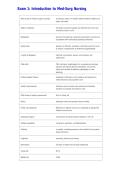
Exam 1: Introduction to Med-Surg Nursing
What is goal of medical surgical nursing? to promote, restore, or maintain optimal health for patients 18
years and older
Safety in healthcare the ability to keep the patient and staff free from harm and
minimize errors in care
Delegation process of transferring a selected nursing task or activity to a
competent UAP (unlicensed assistive personnel)
Supervision guidance or direction, evaluation, and follow-up by the nurse
to ensure a task/activity is performed appropriately
5 rights of delegation right task, circumstance, person, communication, and
supervision
CNA skills CPR, vital signs, height/weight, i/o, recognizes normal body
functions and reports abnormal deviations, ensures the
safety and comfort of patients, participates in care
planning
Evidence-Based Practice integration of the best current evidence and practices to
make decisions about patient care
Quality Improvement indicators used to monitor care outcomes and develop
solutions to change and improve care
PDSA model of quality improvement Plan, Do, Study, Act
Ethics addresses issues and questions about morality
Health care disparities differences in patient access to or availability of appropriate
health care services
Acid-base balance maintenance of arterial blood pH between 7.35-7.45
Cellular regulation cell growth, replication, and differentiation
Clotting a complex, multistep process by which blood forms a protein
based structure
Cognition reasoning, learning and memory
Elimination excretion of waste from the body (GI/Urinary)
Young old 65-74
Middle old 75-84
What is goal of medical surgical nursing? to promote, restore, or maintain optimal health for patients 18
years and older
Safety in healthcare the ability to keep the patient and staff free from harm and
minimize errors in care
Delegation process of transferring a selected nursing task or activity to a
competent UAP (unlicensed assistive personnel)
Supervision guidance or direction, evaluation, and follow-up by the nurse
to ensure a task/activity is performed appropriately
5 rights of delegation right task, circumstance, person, communication, and
supervision
CNA skills CPR, vital signs, height/weight, i/o, recognizes normal body
functions and reports abnormal deviations, ensures the
safety and comfort of patients, participates in care
planning
Evidence-Based Practice integration of the best current evidence and practices to
make decisions about patient care
Quality Improvement indicators used to monitor care outcomes and develop
solutions to change and improve care
PDSA model of quality improvement Plan, Do, Study, Act
Ethics addresses issues and questions about morality
Health care disparities differences in patient access to or availability of appropriate
health care services
Acid-base balance maintenance of arterial blood pH between 7.35-7.45
Cellular regulation cell growth, replication, and differentiation
Clotting a complex, multistep process by which blood forms a protein
based structure
Cognition reasoning, learning and memory
Elimination excretion of waste from the body (GI/Urinary)
Young old 65-74
Middle old 75-84


