
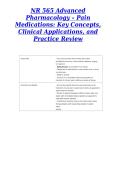
NR 565 Advanced
Pharmacology – Pain
Medications: Key Concepts,
Clinical Applications, and
Practice Review
Acute Pain - Occurs for less than three months and is often
precipitated by trauma, acute medical conditions, surgery,
or treatment.
- Subacute pain has a duration of 1-3 months.
- Categorized as referred pain, acute somatic pain, or acute
visceral pain.
- Rated by severity.
- The focus is on immediate relief and prevention of
transition to chronic pain, utilizing a variety of drugs.
Acute Pain and Opioids - Short-acting opioids should be used exclusively as the
treatment of acute pain in opioid-naive clients (as opposed to
opioid-tolerant clients).
- Titration to optimal therapeutic effects is faster, safer, and
easier with immediate-release opioids (as opposed to
extended-release opioids).
- Unintentional overdose may be more likely when opioid
therapy begins with long-acting opioids in opioid-
naive
clients.
,Chronic Pain - Persists beyond three months or the expected time of
healing.
- Treatment aims to alleviate pain and improve function and
quality of life over the long term.
- Agents used to manage chronic pain are often the
same ones used to manage acute pain. However, due
to the
extended duration of use and increased potential for serious
risks, including misuse and abuse, addiction, overdose, and
death, these agents must be used judiciously to avoid harm.
- Chronic pain is ideally treated without opioids.
Nonpharmacological Treatments Examples: physical therapy, complementary therapies like
acupuncture, rest, ice, heat, etc.
- Crucial in a holistic pain management plan.
Essential Considerations for Safe Pain 1. Opioids are not first-line therapy
Management 2. Establish goals for pain and function
3. Discuss risks and benefits
4. Use immediate-release opioids when starting
5. Use the lowest effective dose
6.Prescribe short durations for acute pain
7.Evaluate benefits and harms frequently
8.Use strategies to mitigate risk
9.Review PDMP data
10. Use urine drug testing
11. Avoid concurrent opioid and benzodiazepine
prescribing
12. Offer treatment for opioid disorder
Management of Pain with Non-Opioids The CDC clinical practice guideline (CPG) for prescribing
non-opioids strongly recommends considering non-opioid
medications and nonpharmacologic treatments for pain
management before prescribing opioids. This approach
prioritizes the prescription of non-opioid medications that can
effectively manage pain with a lower risk of addiction and side
effects. Non-opioid treatments encompass a wide range of
pharmacologic options (including acetaminophen and non-
steroidal anti-inflammatory drugs (NSAIDs) and
nonpharmacologic options (including physical therapy,
exercise, and cognitive behavioral strategies) to address pain
comprehensively.
Acetaminophen (Tylenol): Category, Primary Category: Cyclooxygenase Inhibitors (Drugs that Lack Anti-
Function, Unique Features inflammatory Actions)
Primary Function: Acetaminophen reduces prostaglandin
synthesis in the CNS to reduce pain and fever.
Unique Features: Acetaminophen is used more than any other
analgesic.
, Acetaminophen (Tylenol): MOA Acetaminophen reduces prostaglandin synthesis in the CNS to
reduce pain and fever. While acetaminophen is mostly
transformed into safe metabolites after metabolism, liver
enzymes convert a small part into a harmful substance.
Normally, this dangerous byproduct is quickly neutralized, but
in cases of overdose, it accumulates and can severely
damage the liver due to the depletion of protective
glutathione.
Acetaminophen (Tylenol): Indications and - Pain Relief: Acetaminophen is used when mild pain relief is
Therapeutic Uses needed across a range of indications.
- Fever: Acetaminophen can be used to reduce fever.
Acetaminophen (Tylenol): Side Effects and - Hypertension
Adverse Reactions - Hepatotoxicity
- Rash: Stevens-Johnson Syndrome (SJS), acute generalized
exanthematous pustulosis (AGEP), or toxic epidermal
necrolysis (TEN)
Acetaminophen (Tylenol): Precautions, Precautions
Contraindications, Black Box Warning - Monitor for hepatic dysfunction.
- Caution with clients who consume three or more alcoholic
drinks daily.
- Administering acetylcysteine (Mucomyst) for overdose can
reduce liver injury.
Contraindications
- Contraindicated in clients with hepatic impairment.
- Contraindicated in clients who consume high amounts of
alcohol.
Black Box Warning
- Serious liver injury can result from acetaminophen.
Acetaminophen (Tylenol): Drug Interactions - Alcohol consumption
- Warfarin
- Vaccines (blunt response)
Acetaminophen (Tylenol): Dosing - Dosing varies based on the condition, severity, and
client response.
- Check drug dosing guidelines for individualized dosing.
- Oral (tablet or solution) or rectal dosing.
- Do not use in clients with liver impairment due to the risk
for hepatotoxicity.
- Monitor daily dose of acetaminophen as many other
products (cold and flu medications, other pain medication
combination drugs, etc.) also contain acetaminophen.
The maximum daily dose is 3900mg/day.
- Administering acetylcysteine (Mucomyst) for overdose can
reduce liver injury.
Pharmacology – Pain
Medications: Key Concepts,
Clinical Applications, and
Practice Review
Acute Pain - Occurs for less than three months and is often
precipitated by trauma, acute medical conditions, surgery,
or treatment.
- Subacute pain has a duration of 1-3 months.
- Categorized as referred pain, acute somatic pain, or acute
visceral pain.
- Rated by severity.
- The focus is on immediate relief and prevention of
transition to chronic pain, utilizing a variety of drugs.
Acute Pain and Opioids - Short-acting opioids should be used exclusively as the
treatment of acute pain in opioid-naive clients (as opposed to
opioid-tolerant clients).
- Titration to optimal therapeutic effects is faster, safer, and
easier with immediate-release opioids (as opposed to
extended-release opioids).
- Unintentional overdose may be more likely when opioid
therapy begins with long-acting opioids in opioid-
naive
clients.
,Chronic Pain - Persists beyond three months or the expected time of
healing.
- Treatment aims to alleviate pain and improve function and
quality of life over the long term.
- Agents used to manage chronic pain are often the
same ones used to manage acute pain. However, due
to the
extended duration of use and increased potential for serious
risks, including misuse and abuse, addiction, overdose, and
death, these agents must be used judiciously to avoid harm.
- Chronic pain is ideally treated without opioids.
Nonpharmacological Treatments Examples: physical therapy, complementary therapies like
acupuncture, rest, ice, heat, etc.
- Crucial in a holistic pain management plan.
Essential Considerations for Safe Pain 1. Opioids are not first-line therapy
Management 2. Establish goals for pain and function
3. Discuss risks and benefits
4. Use immediate-release opioids when starting
5. Use the lowest effective dose
6.Prescribe short durations for acute pain
7.Evaluate benefits and harms frequently
8.Use strategies to mitigate risk
9.Review PDMP data
10. Use urine drug testing
11. Avoid concurrent opioid and benzodiazepine
prescribing
12. Offer treatment for opioid disorder
Management of Pain with Non-Opioids The CDC clinical practice guideline (CPG) for prescribing
non-opioids strongly recommends considering non-opioid
medications and nonpharmacologic treatments for pain
management before prescribing opioids. This approach
prioritizes the prescription of non-opioid medications that can
effectively manage pain with a lower risk of addiction and side
effects. Non-opioid treatments encompass a wide range of
pharmacologic options (including acetaminophen and non-
steroidal anti-inflammatory drugs (NSAIDs) and
nonpharmacologic options (including physical therapy,
exercise, and cognitive behavioral strategies) to address pain
comprehensively.
Acetaminophen (Tylenol): Category, Primary Category: Cyclooxygenase Inhibitors (Drugs that Lack Anti-
Function, Unique Features inflammatory Actions)
Primary Function: Acetaminophen reduces prostaglandin
synthesis in the CNS to reduce pain and fever.
Unique Features: Acetaminophen is used more than any other
analgesic.
, Acetaminophen (Tylenol): MOA Acetaminophen reduces prostaglandin synthesis in the CNS to
reduce pain and fever. While acetaminophen is mostly
transformed into safe metabolites after metabolism, liver
enzymes convert a small part into a harmful substance.
Normally, this dangerous byproduct is quickly neutralized, but
in cases of overdose, it accumulates and can severely
damage the liver due to the depletion of protective
glutathione.
Acetaminophen (Tylenol): Indications and - Pain Relief: Acetaminophen is used when mild pain relief is
Therapeutic Uses needed across a range of indications.
- Fever: Acetaminophen can be used to reduce fever.
Acetaminophen (Tylenol): Side Effects and - Hypertension
Adverse Reactions - Hepatotoxicity
- Rash: Stevens-Johnson Syndrome (SJS), acute generalized
exanthematous pustulosis (AGEP), or toxic epidermal
necrolysis (TEN)
Acetaminophen (Tylenol): Precautions, Precautions
Contraindications, Black Box Warning - Monitor for hepatic dysfunction.
- Caution with clients who consume three or more alcoholic
drinks daily.
- Administering acetylcysteine (Mucomyst) for overdose can
reduce liver injury.
Contraindications
- Contraindicated in clients with hepatic impairment.
- Contraindicated in clients who consume high amounts of
alcohol.
Black Box Warning
- Serious liver injury can result from acetaminophen.
Acetaminophen (Tylenol): Drug Interactions - Alcohol consumption
- Warfarin
- Vaccines (blunt response)
Acetaminophen (Tylenol): Dosing - Dosing varies based on the condition, severity, and
client response.
- Check drug dosing guidelines for individualized dosing.
- Oral (tablet or solution) or rectal dosing.
- Do not use in clients with liver impairment due to the risk
for hepatotoxicity.
- Monitor daily dose of acetaminophen as many other
products (cold and flu medications, other pain medication
combination drugs, etc.) also contain acetaminophen.
The maximum daily dose is 3900mg/day.
- Administering acetylcysteine (Mucomyst) for overdose can
reduce liver injury.


