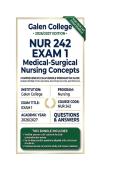
,NUR 242 EXAM 1 Medical-Surgical Nursing Concepts Questions And
Answers 2026/2027 Galen College
Q1. Which intervention is an example of primary prevention?
A) An influenza vaccination
B) A mammogram after symptoms develop
C) Cardiac rehabilitation after myocardial infarction
D) Physical therapy after a stroke
Correct Answer: A) An influenza vaccination
Rationale: Primary prevention occurs before disease or injury develops and
includes measures such as immunization, risk reduction, and health-
promoting behaviors.
Q2. Which activity is an example of secondary prevention?
A) Teaching safe lifting techniques
B) Screening for colorectal cancer
C) Providing rehabilitation after a stroke
D) Managing complications of established heart failure
Correct Answer: B) Screening for colorectal cancer
Rationale: Secondary prevention focuses on early detection of disease
through screening and prompt intervention.
Q3. Which intervention represents tertiary prevention?
A) Smoking-cessation education before disease develops
B) Childhood immunization
C) Cardiac rehabilitation after myocardial infarction
D) Blood-pressure screening
Correct Answer: C) Cardiac rehabilitation after myocardial infarction
Rationale: Tertiary prevention reduces disability, complications, and
functional loss after a disease or injury has occurred.
Q4. Which statement best describes patient-centered care?
A) The nurse selects treatment without patient input.
B) Care is organized around the patient's values, preferences, needs, and
participation.
C) Family preferences always replace patient preferences.
D) Standardized care eliminates the need for individualization.
,Correct Answer: B) Care is organized around the patient's values,
preferences, needs, and participation.
Rationale: Patient-centered care respects the individual's preferences,
values, needs, communication, comfort, and participation in decisions.
Q5. Which action best supports a safe transition from hospital to
home?
A) Give discharge instructions only after the patient leaves.
B) Assume the caregiver understands the plan.
C) Coordinate follow-up, medications, education, and communication with
the receiving setting.
D) Provide written information without assessing understanding.
Correct Answer: C) Coordinate follow-up, medications, education, and
communication with the receiving setting.
Rationale: Safe transitions require coordinated communication, medication
reconciliation, education, follow-up, and attention to caregiver needs.
Q6. Which patient is at greatest risk for complications related to
prolonged immobility?
A) A patient walking independently three times daily
B) A patient on prolonged bed rest with limited ability to reposition
C) A patient performing active range-of-motion exercises
D) A patient independently transferring to a chair
Correct Answer: B) A patient on prolonged bed rest with limited ability to
reposition
Rationale: Immobility increases the risk of venous stasis, atelectasis,
constipation, urinary stasis, muscle loss, contractures, and pressure injury.
Q7. Which respiratory complication is associated with prolonged
immobility?
A) Atelectasis
B) Hyperthyroidism
C) Hematuria
D) Polycythemia
Correct Answer: A) Atelectasis
, Rationale: Limited movement and shallow breathing can reduce alveolar
expansion and promote atelectasis.
Q8. Which intervention helps prevent pulmonary complications in an
immobile patient?
A) Maintain a flat position continuously.
B) Encourage coughing, deep breathing, and incentive-spirometer use as
appropriate.
C) Restrict oral fluids in every patient.
D) Avoid repositioning.
Correct Answer: B) Encourage coughing, deep breathing, and incentive-
spirometer use as appropriate.
Rationale: Lung expansion exercises, repositioning, mobility, and
appropriate hydration help prevent retained secretions and atelectasis.
Q9. Which complication of immobility results from venous stasis?
A) Deep vein thrombosis
B) Cellulitis
C) Cataracts
D) Gastritis
Correct Answer: A) Deep vein thrombosis
Rationale: Prolonged immobility slows venous return and promotes venous
stasis, increasing the risk of thrombus formation.
Q10. Which intervention best reduces venous-stasis complications
in an appropriately stable postoperative patient?
A) Prolonged bed rest
B) Early ambulation and prescribed leg exercises
C) Routine calf massage
D) Keeping the legs dependent continuously
Correct Answer: B) Early ambulation and prescribed leg exercises
Rationale: Early mobility promotes venous return and reduces the risk of
venous thromboembolism.
Q11. Which action should the nurse avoid when a patient is
suspected of having a deep-vein thrombosis?
Answers 2026/2027 Galen College
Q1. Which intervention is an example of primary prevention?
A) An influenza vaccination
B) A mammogram after symptoms develop
C) Cardiac rehabilitation after myocardial infarction
D) Physical therapy after a stroke
Correct Answer: A) An influenza vaccination
Rationale: Primary prevention occurs before disease or injury develops and
includes measures such as immunization, risk reduction, and health-
promoting behaviors.
Q2. Which activity is an example of secondary prevention?
A) Teaching safe lifting techniques
B) Screening for colorectal cancer
C) Providing rehabilitation after a stroke
D) Managing complications of established heart failure
Correct Answer: B) Screening for colorectal cancer
Rationale: Secondary prevention focuses on early detection of disease
through screening and prompt intervention.
Q3. Which intervention represents tertiary prevention?
A) Smoking-cessation education before disease develops
B) Childhood immunization
C) Cardiac rehabilitation after myocardial infarction
D) Blood-pressure screening
Correct Answer: C) Cardiac rehabilitation after myocardial infarction
Rationale: Tertiary prevention reduces disability, complications, and
functional loss after a disease or injury has occurred.
Q4. Which statement best describes patient-centered care?
A) The nurse selects treatment without patient input.
B) Care is organized around the patient's values, preferences, needs, and
participation.
C) Family preferences always replace patient preferences.
D) Standardized care eliminates the need for individualization.
,Correct Answer: B) Care is organized around the patient's values,
preferences, needs, and participation.
Rationale: Patient-centered care respects the individual's preferences,
values, needs, communication, comfort, and participation in decisions.
Q5. Which action best supports a safe transition from hospital to
home?
A) Give discharge instructions only after the patient leaves.
B) Assume the caregiver understands the plan.
C) Coordinate follow-up, medications, education, and communication with
the receiving setting.
D) Provide written information without assessing understanding.
Correct Answer: C) Coordinate follow-up, medications, education, and
communication with the receiving setting.
Rationale: Safe transitions require coordinated communication, medication
reconciliation, education, follow-up, and attention to caregiver needs.
Q6. Which patient is at greatest risk for complications related to
prolonged immobility?
A) A patient walking independently three times daily
B) A patient on prolonged bed rest with limited ability to reposition
C) A patient performing active range-of-motion exercises
D) A patient independently transferring to a chair
Correct Answer: B) A patient on prolonged bed rest with limited ability to
reposition
Rationale: Immobility increases the risk of venous stasis, atelectasis,
constipation, urinary stasis, muscle loss, contractures, and pressure injury.
Q7. Which respiratory complication is associated with prolonged
immobility?
A) Atelectasis
B) Hyperthyroidism
C) Hematuria
D) Polycythemia
Correct Answer: A) Atelectasis
, Rationale: Limited movement and shallow breathing can reduce alveolar
expansion and promote atelectasis.
Q8. Which intervention helps prevent pulmonary complications in an
immobile patient?
A) Maintain a flat position continuously.
B) Encourage coughing, deep breathing, and incentive-spirometer use as
appropriate.
C) Restrict oral fluids in every patient.
D) Avoid repositioning.
Correct Answer: B) Encourage coughing, deep breathing, and incentive-
spirometer use as appropriate.
Rationale: Lung expansion exercises, repositioning, mobility, and
appropriate hydration help prevent retained secretions and atelectasis.
Q9. Which complication of immobility results from venous stasis?
A) Deep vein thrombosis
B) Cellulitis
C) Cataracts
D) Gastritis
Correct Answer: A) Deep vein thrombosis
Rationale: Prolonged immobility slows venous return and promotes venous
stasis, increasing the risk of thrombus formation.
Q10. Which intervention best reduces venous-stasis complications
in an appropriately stable postoperative patient?
A) Prolonged bed rest
B) Early ambulation and prescribed leg exercises
C) Routine calf massage
D) Keeping the legs dependent continuously
Correct Answer: B) Early ambulation and prescribed leg exercises
Rationale: Early mobility promotes venous return and reduces the risk of
venous thromboembolism.
Q11. Which action should the nurse avoid when a patient is
suspected of having a deep-vein thrombosis?