

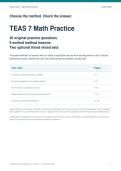
TEAS 7 MATH / METHOD PRACTICE START HERE
Choose the method. Check the answer.
TEAS 7 Math Practice
30 original practice questions
6 worked method lessons
Two optional timed mixed sets
A focused workbook for learners who can follow a calculation but lose time deciding where to start. Practice
identifying the base, labeling the units and checking what the question actually asks.
Your route Pages
Choose your method and learn six patterns 2-5
Six-question diagnostic, then targeted practice 6-8
Two mixed sets: six questions per set 9-10
Worked answers and error notes for all 30 questions 11-16
Error log, reuse plan and references 17-18
Scope: fractions, percentages, ratios/rates, simple linear relationships, unit conversions and basic data interpretation. This is a targeted
skills supplement, not a full TEAS math course or a replica of the exam. Geometry, probability and other topics require additional study.
Independently created with AI assistance and executable arithmetic checks. Not an ATI product, not endorsed by ATI, and contains no
actual exam questions. No score or admission outcome is promised.
Independent study supplement | Version 1.0 - September 2026 1
,TEAS 7 MATH / METHOD PRACTICE METHOD MAP
A 20-second setup habit
First write the target and unit. Then choose the relationship. The time is a practice prompt, not a tested performance claim.
Code / clue First move Reasonableness check
F / part or pieces Choose add/subtract, multiply, or divide. More complete pieces need enough material.
P / percent or change Identify what counts as 100%. A discount lowers the starting price.
R / per, ratio, scale Label the parts or find a unit rate. Keep both quantities in the same order.
A / fixed fee plus rate Write total = fixed + rate x quantity. Substitute into the original equation.
U / change of units Arrange the factor so old units cancel. Smaller units usually need a larger count.
D / average, middle, share Identify the requested summary and total. A mean lies between minimum and maximum.
Three passes through a practice question
Set up: underline the requested quantity; jot down the unit and operation.
Calculate: keep an exact fraction or enough decimal places until the last step.
Check: compare the size with an estimate, verify units and answer the requested quantity.
How to use the diagnostic
Try questions 1-6 without the solutions. Record an answer and a method code. For each error, visit the
matching lesson on pages 3-5, then practice the paired questions on pages 7-8. An answer obtained by
guessing needs review even when correct.
Independent study supplement | Version 1.0 - September 2026 2
, TEAS 7 MATH / METHOD PRACTICE WORKED METHODS
Fractions and percentages
F Fractions: identify the operation
Ask whether the task combines parts, takes part of an amount, or counts how many pieces fit. Addition and
subtraction need common denominators. Multiplication scales an amount. Division counts groups. Check
whether the final answer must be a whole count.
Worked example. A banner is 5/6 m long. After trimming 1/4 m, how much remains?
Subtract equal-sized parts: 5/6 - 1/4 = 10/12 - 3/12 = 7/12 m. Since 1/4 m is removed, the result must be
smaller than 5/6 m.
Wrong turn: (5 - 1)/(6 - 4) = 2. This would make the banner longer after trimming.
P Percent: name the base first
Translate the rate into a decimal and identify the quantity that represents 100%. For an increase or decrease,
calculate the change relative to the original amount. When the final amount is known, reverse the multiplier by
dividing.
Worked example. A membership rises from $48 to $54. Find the percentage increase.
Increase = 54 - 48 = $6. Original base = $48. Relative change = 6/48 = 0.125, so the increase is 12.5%. Check:
48 x 1.125 = 54.
Wrong turn: 6/54 uses the new price as the base. A percentage change is measured against the starting price.
Independent study supplement | Version 1.0 - September 2026 3
Choose the method. Check the answer.
TEAS 7 Math Practice
30 original practice questions
6 worked method lessons
Two optional timed mixed sets
A focused workbook for learners who can follow a calculation but lose time deciding where to start. Practice
identifying the base, labeling the units and checking what the question actually asks.
Your route Pages
Choose your method and learn six patterns 2-5
Six-question diagnostic, then targeted practice 6-8
Two mixed sets: six questions per set 9-10
Worked answers and error notes for all 30 questions 11-16
Error log, reuse plan and references 17-18
Scope: fractions, percentages, ratios/rates, simple linear relationships, unit conversions and basic data interpretation. This is a targeted
skills supplement, not a full TEAS math course or a replica of the exam. Geometry, probability and other topics require additional study.
Independently created with AI assistance and executable arithmetic checks. Not an ATI product, not endorsed by ATI, and contains no
actual exam questions. No score or admission outcome is promised.
Independent study supplement | Version 1.0 - September 2026 1
,TEAS 7 MATH / METHOD PRACTICE METHOD MAP
A 20-second setup habit
First write the target and unit. Then choose the relationship. The time is a practice prompt, not a tested performance claim.
Code / clue First move Reasonableness check
F / part or pieces Choose add/subtract, multiply, or divide. More complete pieces need enough material.
P / percent or change Identify what counts as 100%. A discount lowers the starting price.
R / per, ratio, scale Label the parts or find a unit rate. Keep both quantities in the same order.
A / fixed fee plus rate Write total = fixed + rate x quantity. Substitute into the original equation.
U / change of units Arrange the factor so old units cancel. Smaller units usually need a larger count.
D / average, middle, share Identify the requested summary and total. A mean lies between minimum and maximum.
Three passes through a practice question
Set up: underline the requested quantity; jot down the unit and operation.
Calculate: keep an exact fraction or enough decimal places until the last step.
Check: compare the size with an estimate, verify units and answer the requested quantity.
How to use the diagnostic
Try questions 1-6 without the solutions. Record an answer and a method code. For each error, visit the
matching lesson on pages 3-5, then practice the paired questions on pages 7-8. An answer obtained by
guessing needs review even when correct.
Independent study supplement | Version 1.0 - September 2026 2
, TEAS 7 MATH / METHOD PRACTICE WORKED METHODS
Fractions and percentages
F Fractions: identify the operation
Ask whether the task combines parts, takes part of an amount, or counts how many pieces fit. Addition and
subtraction need common denominators. Multiplication scales an amount. Division counts groups. Check
whether the final answer must be a whole count.
Worked example. A banner is 5/6 m long. After trimming 1/4 m, how much remains?
Subtract equal-sized parts: 5/6 - 1/4 = 10/12 - 3/12 = 7/12 m. Since 1/4 m is removed, the result must be
smaller than 5/6 m.
Wrong turn: (5 - 1)/(6 - 4) = 2. This would make the banner longer after trimming.
P Percent: name the base first
Translate the rate into a decimal and identify the quantity that represents 100%. For an increase or decrease,
calculate the change relative to the original amount. When the final amount is known, reverse the multiplier by
dividing.
Worked example. A membership rises from $48 to $54. Find the percentage increase.
Increase = 54 - 48 = $6. Original base = $48. Relative change = 6/48 = 0.125, so the increase is 12.5%. Check:
48 x 1.125 = 54.
Wrong turn: 6/54 uses the new price as the base. A percentage change is measured against the starting price.
Independent study supplement | Version 1.0 - September 2026 3


