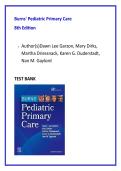
Burns' Pediatric Primary Care
8th Edition
• Author(s)Dawn Lee Garzon, Mary Dirks,
Martha Driessnack, Karen G. Duderstadt,
Nan M. Gaylord
TEST BANK
,
,Question 1
Question 1
Question:
A 4-year-old child is brought to the pediatric primary care clinic for a
routine health supervision visit. The child has no current symptoms.
Which action best reflects the primary purpose of pediatric primary care?
A. Treat only conditions that are causing symptoms today
B. Focus primarily on prescribing medications for common childhood
illnesses
C. Combine health supervision, prevention, screening, development
assessment, and anticipatory guidance
D. Refer every healthy child to a pediatric subspecialist for
comprehensive evaluation
Correct Answer: C. Combine health supervision, prevention, screening,
development assessment, and anticipatory guidance
Rationale:
Pediatric primary care is broader than episodic treatment of illness. It
includes health supervision, prevention, health promotion,
developmental monitoring, age-appropriate screening, anticipatory
guidance, and management of acute and chronic conditions. The AAP
describes pediatric primary health care as continuous, comprehensive,
coordinated, and family-centered.
, Why the Other Options Are Incorrect:
A. This describes a narrow sick-care model and omits preventive and
developmental services that are central to pediatric primary care.
B. Medication management is only one component of primary care and
is not the primary focus of routine pediatric health supervision.
D. Most healthy children can receive comprehensive care in primary care
without routine subspecialty referral.
Question 2
Question:
A nurse practitioner explains the difference between primary care and
primary prevention to a group of nursing students. Which statement by
a student demonstrates correct understanding?
A. “Primary care and primary prevention are interchangeable terms.”
B. “Primary care is a broad healthcare delivery function, whereas primary
prevention focuses on preventing disease before it occurs.”
C. “Primary prevention begins only after a child develops symptoms.”
D. “Primary care is limited to immunizations and health screenings.”
Correct Answer: B. “Primary care is a broad healthcare delivery
function, whereas primary prevention focuses on preventing disease
before it occurs.”
Rationale:
Primary care encompasses first-contact, continuous, comprehensive, and
coordinated healthcare. Primary prevention is a preventive strategy
directed toward reducing the occurrence of disease or injury before it
develops; in pediatrics, examples include immunization, injury
8th Edition
• Author(s)Dawn Lee Garzon, Mary Dirks,
Martha Driessnack, Karen G. Duderstadt,
Nan M. Gaylord
TEST BANK
,
,Question 1
Question 1
Question:
A 4-year-old child is brought to the pediatric primary care clinic for a
routine health supervision visit. The child has no current symptoms.
Which action best reflects the primary purpose of pediatric primary care?
A. Treat only conditions that are causing symptoms today
B. Focus primarily on prescribing medications for common childhood
illnesses
C. Combine health supervision, prevention, screening, development
assessment, and anticipatory guidance
D. Refer every healthy child to a pediatric subspecialist for
comprehensive evaluation
Correct Answer: C. Combine health supervision, prevention, screening,
development assessment, and anticipatory guidance
Rationale:
Pediatric primary care is broader than episodic treatment of illness. It
includes health supervision, prevention, health promotion,
developmental monitoring, age-appropriate screening, anticipatory
guidance, and management of acute and chronic conditions. The AAP
describes pediatric primary health care as continuous, comprehensive,
coordinated, and family-centered.
, Why the Other Options Are Incorrect:
A. This describes a narrow sick-care model and omits preventive and
developmental services that are central to pediatric primary care.
B. Medication management is only one component of primary care and
is not the primary focus of routine pediatric health supervision.
D. Most healthy children can receive comprehensive care in primary care
without routine subspecialty referral.
Question 2
Question:
A nurse practitioner explains the difference between primary care and
primary prevention to a group of nursing students. Which statement by
a student demonstrates correct understanding?
A. “Primary care and primary prevention are interchangeable terms.”
B. “Primary care is a broad healthcare delivery function, whereas primary
prevention focuses on preventing disease before it occurs.”
C. “Primary prevention begins only after a child develops symptoms.”
D. “Primary care is limited to immunizations and health screenings.”
Correct Answer: B. “Primary care is a broad healthcare delivery
function, whereas primary prevention focuses on preventing disease
before it occurs.”
Rationale:
Primary care encompasses first-contact, continuous, comprehensive, and
coordinated healthcare. Primary prevention is a preventive strategy
directed toward reducing the occurrence of disease or injury before it
develops; in pediatrics, examples include immunization, injury