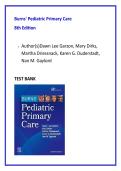
Burns' Pediatric Primary Care
8th Edition
• Author(s)Dawn Lee Garzon, Mary Dirks,
Martha Driessnack, Karen G. Duderstadt,
Nan M. Gaylord
TEST BANK
,
,Question 1
Burns' Pediatric Primary Care, 8th Edition
Chapter 1: Pediatric Primary Care
Original NCLEX-Style Mixed MCQ Question Bank — 20 Questions
Scope: Pediatric Primary Care • Primary Care Versus Primary Prevention
• Pediatric Primary Care Providers • Unique Issues in Pediatrics
Question 1
Question: A 5-year-old is seen in a pediatric clinic for a scheduled health-
supervision visit. The parent says, "She is not sick, so I do not understand
why she needs primary care." Which response best distinguishes
pediatric primary care from a single primary-prevention intervention?
A. A. Primary care is limited to diagnosing illnesses, whereas prevention
is provided by public health agencies.
B. B. Primary care provides ongoing, comprehensive care that includes
prevention, health promotion, assessment, treatment, and coordination
as needed.
C. C. Primary care is only necessary for children with chronic conditions,
while prevention is for healthy children.
D. D. Primary care and primary prevention are interchangeable terms for
services delivered at well-child visits.
, Correct Answer: B. B. Primary care provides ongoing, comprehensive
care that includes prevention, health promotion, assessment, treatment,
and coordination as needed.
Rationale: Pediatric primary care is a longitudinal model of care. It
includes first-contact assessment, health supervision, prevention,
diagnosis and treatment, coordination, and referral when needed.
Primary prevention is narrower: it refers to actions intended to reduce
the risk of a disease or injury before it occurs, such as immunization or
safety counseling. A well-child visit can contain both primary care
functions and primary-prevention interventions.[1][2][3]
Why the Other Options Are Incorrect:
A. Primary care is broader than diagnosis and is not confined to illness
treatment. Prevention also occurs within primary care and in public-
health settings.
C. Healthy children are an important population for primary care because
preventive care, surveillance, and anticipatory guidance are central
functions.
D. The concepts overlap but are not synonymous; primary prevention
describes a preventive strategy, while primary care describes an
organized pattern of health services.
Question 2
Question: A community clinic wants to reduce childhood injuries. Which
intervention is the clearest example of primary prevention rather than
treatment of an established problem?
8th Edition
• Author(s)Dawn Lee Garzon, Mary Dirks,
Martha Driessnack, Karen G. Duderstadt,
Nan M. Gaylord
TEST BANK
,
,Question 1
Burns' Pediatric Primary Care, 8th Edition
Chapter 1: Pediatric Primary Care
Original NCLEX-Style Mixed MCQ Question Bank — 20 Questions
Scope: Pediatric Primary Care • Primary Care Versus Primary Prevention
• Pediatric Primary Care Providers • Unique Issues in Pediatrics
Question 1
Question: A 5-year-old is seen in a pediatric clinic for a scheduled health-
supervision visit. The parent says, "She is not sick, so I do not understand
why she needs primary care." Which response best distinguishes
pediatric primary care from a single primary-prevention intervention?
A. A. Primary care is limited to diagnosing illnesses, whereas prevention
is provided by public health agencies.
B. B. Primary care provides ongoing, comprehensive care that includes
prevention, health promotion, assessment, treatment, and coordination
as needed.
C. C. Primary care is only necessary for children with chronic conditions,
while prevention is for healthy children.
D. D. Primary care and primary prevention are interchangeable terms for
services delivered at well-child visits.
, Correct Answer: B. B. Primary care provides ongoing, comprehensive
care that includes prevention, health promotion, assessment, treatment,
and coordination as needed.
Rationale: Pediatric primary care is a longitudinal model of care. It
includes first-contact assessment, health supervision, prevention,
diagnosis and treatment, coordination, and referral when needed.
Primary prevention is narrower: it refers to actions intended to reduce
the risk of a disease or injury before it occurs, such as immunization or
safety counseling. A well-child visit can contain both primary care
functions and primary-prevention interventions.[1][2][3]
Why the Other Options Are Incorrect:
A. Primary care is broader than diagnosis and is not confined to illness
treatment. Prevention also occurs within primary care and in public-
health settings.
C. Healthy children are an important population for primary care because
preventive care, surveillance, and anticipatory guidance are central
functions.
D. The concepts overlap but are not synonymous; primary prevention
describes a preventive strategy, while primary care describes an
organized pattern of health services.
Question 2
Question: A community clinic wants to reduce childhood injuries. Which
intervention is the clearest example of primary prevention rather than
treatment of an established problem?