
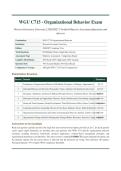
WGU C715 - Organizational Behavior Exam
Western Governors University | 2026/2027 | Verified Objective Assessment Questions and
Answers
Examination WGU C715 Organizational Behavior
Institution Western Governors University
Edition 2026/2027 Academic Year
Total Questions 80 (Multiple Choice, Single Best Answer)
Assessment Type Objective Assessment - Competency-Based
Cognitive Distribution 30% Recall | 50% Application | 20% Analysis
Question Style 70% Scenario-Based | 30% Direct Recall
Competency Coverage All Eight WGU C715 Course Competencies
Examination Structure
Section Domain Questions
1 Foundations of Organizational Behavior (OB Models, Disciplines, Challenges, Opportunities) Q1-12
2 Individual Behavior and Diversity (Personality, Values, Attitudes, Job Satisfaction, Diversity) Q13-22
3 Perception, Attribution, and Decision Making (Perception Process, Attribution, Biases, Decision Models)
Q23-30
4 Motivation Concepts and Applications (Theories, Needs, Reinforcement, Goal-Setting, Engagement)
Q31-40
5 Group and Team Dynamics (Group Development, Team Effectiveness, Roles, Norms, Conflict Management)
Q41-50
6 Leadership and Power (Leadership Theories, Power Bases, Influence Tactics, Political Behavior) Q51-60
7 Organizational Communication and Culture (Communication Processes, Barriers, Culture, Climate)Q61-68
8 Organizational Change and Stress Management (Change Models, Resistance, Stressors, Coping Strategies)
Q69-80
Instructions to the Candidate
Read each question carefully and select the single best answer from the four options provided (A, B, C, D). Each question
carries equal weight. Rationales are provided after each question with WGU C715-specific organizational behavior
reasoning, including theoretical frameworks, practical applications, evidence-based management principles, and
organizational performance considerations. The correct answer is marked [CORRECT] in green alongside the option, and
the rationale explains why the correct answer is right and why the distractors are wrong. Time allocated: 120 minutes.
Passing benchmark: 70% or higher (WGU competency threshold).
, WGU C715 Organizational Behavior | 2026/2027 | Verified Objective Assessment Q&A
Section 1: Foundations of Organizational Behavior
Q1: A regional hospital implements a management philosophy in which employees are trusted as
professionals, managers act as facilitators rather than supervisors, and employees exercise substantial
self-direction. Which OB model best describes this approach?
A. Autocratic model, which depends on power and authority.
B. Custodial model, which depends on economic resources and benefits.
C. Collegial model, which depends on partnership and shared responsibility. [CORRECT]
D. Supportive model, which depends on leadership support of employee goals.
Correct Answer: C
Rationale:
The collegial model depends on partnership, shared responsibility, and employee self-discipline, with managers acting
as facilitators rather than bosses. The autocratic model (A) relies on authority and obedience. The custodial model (B)
depends on economic resources to maintain employee dependence. The supportive model (D) depends on management
support for employee goals but stops short of true partnership and shared responsibility. WGU C715 emphasizes that
the collegial model is most effective with knowledge workers and professional staff.
Q2: A multinational organization is studying how employees interact within their work units and how
group norms influence individual behavior. Which contributing discipline provides the theoretical
foundation for this analysis?
A. Psychology, which studies individual behavior and mental processes.
B. Sociology, which studies group behavior and social structures. [CORRECT]
C. Anthropology, which studies cultural values and comparative human behavior.
D. Political science, which studies power, conflict, and political behavior.
Correct Answer: B
Rationale:
Sociology contributes to OB through its study of group dynamics, social structures, organizational culture, and how
individuals behave within social systems. Psychology (A) focuses on individual behavior and mental processes.
Anthropology (C) focuses on cultural values and comparative human behavior across societies. Political science (D)
examines power dynamics and conflict. WGU C715 maps group behavior analysis to sociology as a foundational
discipline.
For WGU C715 Examination Preparation Use Page 2
, WGU C715 Organizational Behavior | 2026/2027 | Verified Objective Assessment Q&A
Q3: A manager reviews research on the impact of remote work on team productivity, evaluates the
methodology used, and applies findings only when studies demonstrate strong evidence across multiple
organizations. Which approach does this represent?
A. Traditional management based on intuition and personal experience.
B. Evidence-based management grounded in best-available research. [CORRECT]
C. Theory X management assuming employees dislike work.
D. Contingency management based on situational factors.
Correct Answer: B
Rationale:
Evidence-based management (EBM) involves making decisions based on the best available research evidence,
systematic data, and critical evaluation of methodology rather than intuition or untested assumptions. Traditional
management (A) relies on personal experience. Theory X (C) is a motivational assumption about human nature, not a
decision-making approach. Contingency management (D) adapts to situations but does not necessarily use research
evidence. WGU C715 emphasizes EBM as a core critical-thinking competency.
Q4: An organization is analyzing why a new performance appraisal system is producing inconsistent
results across departments. The analysis examines individual appraisal anxiety, group dynamics within
review panels, and organizational policies governing the process. Which framework is being applied?
A. The three levels of analysis: individual, group, and organizational. [CORRECT]
B. The OB models: autocratic, custodial, supportive, and collegial.
C. The five contributing disciplines of organizational behavior.
D. The four management functions: planning, organizing, leading, and controlling.
Correct Answer: A
Rationale:
The three levels of analysis framework examines phenomena at the individual level (appraisal anxiety), group level
(panel dynamics), and organizational level (policies), providing a comprehensive diagnostic structure. The OB models
(B) describe management philosophies, not levels of analysis. The contributing disciplines (C) are psychology,
sociology, anthropology, political science, and social psychology. The four management functions (D) describe
managerial activities. WGU C715 emphasizes this multi-level framework for organizational diagnosis.
For WGU C715 Examination Preparation Use Page 3
, WGU C715 Organizational Behavior | 2026/2027 | Verified Objective Assessment Q&A
Q5: A company hires independent contractors through a digital platform to complete project-based
design work. These workers are paid per project, manage their own schedules, and do not receive
benefits. Which contemporary trend does this scenario illustrate?
A. Traditional employment with full benefits and job security.
B. Gig economy and alternative work arrangements. [CORRECT]
C. Custodial model of organizational behavior.
D. Autocratic management with strict supervision.
Correct Answer: B
Rationale:
The gig economy involves short-term, project-based, or freelance work arrangements facilitated through digital
platforms, where workers are not traditional employees and lack benefits. Traditional employment (A) involves formal
employment relationships with benefits. The custodial model (C) is a management philosophy focused on economic
benefits to maintain employee loyalty, not a work arrangement. Autocratic management (D) involves power-based
supervision. WGU C715 addresses gig economy implications for motivation and engagement.
Q6: An organization implementing a new performance evaluation system discovers that managers in
different countries interpret honesty, feedback, and recognition differently based on their cultural
backgrounds. Which challenge and opportunity of OB is most directly illustrated?
A. Workforce diversity in age and gender.
B. Globalization and cross-cultural differences. [CORRECT]
C. Technology advancement and digital transformation.
D. Ethics and corporate social responsibility.
Correct Answer: B
Rationale:
Globalization creates challenges related to cross-cultural differences in values, communication, and managerial
practices across countries. Workforce diversity (A) refers to differences within a single country's workforce, including
age, gender, and ethnicity. Technology (C) refers to digital transformation of work processes. Ethics (D) involves
moral decision-making and corporate social responsibility. WGU C715 highlights globalization as a primary OB
challenge requiring cultural competence.
For WGU C715 Examination Preparation Use Page 4
Western Governors University | 2026/2027 | Verified Objective Assessment Questions and
Answers
Examination WGU C715 Organizational Behavior
Institution Western Governors University
Edition 2026/2027 Academic Year
Total Questions 80 (Multiple Choice, Single Best Answer)
Assessment Type Objective Assessment - Competency-Based
Cognitive Distribution 30% Recall | 50% Application | 20% Analysis
Question Style 70% Scenario-Based | 30% Direct Recall
Competency Coverage All Eight WGU C715 Course Competencies
Examination Structure
Section Domain Questions
1 Foundations of Organizational Behavior (OB Models, Disciplines, Challenges, Opportunities) Q1-12
2 Individual Behavior and Diversity (Personality, Values, Attitudes, Job Satisfaction, Diversity) Q13-22
3 Perception, Attribution, and Decision Making (Perception Process, Attribution, Biases, Decision Models)
Q23-30
4 Motivation Concepts and Applications (Theories, Needs, Reinforcement, Goal-Setting, Engagement)
Q31-40
5 Group and Team Dynamics (Group Development, Team Effectiveness, Roles, Norms, Conflict Management)
Q41-50
6 Leadership and Power (Leadership Theories, Power Bases, Influence Tactics, Political Behavior) Q51-60
7 Organizational Communication and Culture (Communication Processes, Barriers, Culture, Climate)Q61-68
8 Organizational Change and Stress Management (Change Models, Resistance, Stressors, Coping Strategies)
Q69-80
Instructions to the Candidate
Read each question carefully and select the single best answer from the four options provided (A, B, C, D). Each question
carries equal weight. Rationales are provided after each question with WGU C715-specific organizational behavior
reasoning, including theoretical frameworks, practical applications, evidence-based management principles, and
organizational performance considerations. The correct answer is marked [CORRECT] in green alongside the option, and
the rationale explains why the correct answer is right and why the distractors are wrong. Time allocated: 120 minutes.
Passing benchmark: 70% or higher (WGU competency threshold).
, WGU C715 Organizational Behavior | 2026/2027 | Verified Objective Assessment Q&A
Section 1: Foundations of Organizational Behavior
Q1: A regional hospital implements a management philosophy in which employees are trusted as
professionals, managers act as facilitators rather than supervisors, and employees exercise substantial
self-direction. Which OB model best describes this approach?
A. Autocratic model, which depends on power and authority.
B. Custodial model, which depends on economic resources and benefits.
C. Collegial model, which depends on partnership and shared responsibility. [CORRECT]
D. Supportive model, which depends on leadership support of employee goals.
Correct Answer: C
Rationale:
The collegial model depends on partnership, shared responsibility, and employee self-discipline, with managers acting
as facilitators rather than bosses. The autocratic model (A) relies on authority and obedience. The custodial model (B)
depends on economic resources to maintain employee dependence. The supportive model (D) depends on management
support for employee goals but stops short of true partnership and shared responsibility. WGU C715 emphasizes that
the collegial model is most effective with knowledge workers and professional staff.
Q2: A multinational organization is studying how employees interact within their work units and how
group norms influence individual behavior. Which contributing discipline provides the theoretical
foundation for this analysis?
A. Psychology, which studies individual behavior and mental processes.
B. Sociology, which studies group behavior and social structures. [CORRECT]
C. Anthropology, which studies cultural values and comparative human behavior.
D. Political science, which studies power, conflict, and political behavior.
Correct Answer: B
Rationale:
Sociology contributes to OB through its study of group dynamics, social structures, organizational culture, and how
individuals behave within social systems. Psychology (A) focuses on individual behavior and mental processes.
Anthropology (C) focuses on cultural values and comparative human behavior across societies. Political science (D)
examines power dynamics and conflict. WGU C715 maps group behavior analysis to sociology as a foundational
discipline.
For WGU C715 Examination Preparation Use Page 2
, WGU C715 Organizational Behavior | 2026/2027 | Verified Objective Assessment Q&A
Q3: A manager reviews research on the impact of remote work on team productivity, evaluates the
methodology used, and applies findings only when studies demonstrate strong evidence across multiple
organizations. Which approach does this represent?
A. Traditional management based on intuition and personal experience.
B. Evidence-based management grounded in best-available research. [CORRECT]
C. Theory X management assuming employees dislike work.
D. Contingency management based on situational factors.
Correct Answer: B
Rationale:
Evidence-based management (EBM) involves making decisions based on the best available research evidence,
systematic data, and critical evaluation of methodology rather than intuition or untested assumptions. Traditional
management (A) relies on personal experience. Theory X (C) is a motivational assumption about human nature, not a
decision-making approach. Contingency management (D) adapts to situations but does not necessarily use research
evidence. WGU C715 emphasizes EBM as a core critical-thinking competency.
Q4: An organization is analyzing why a new performance appraisal system is producing inconsistent
results across departments. The analysis examines individual appraisal anxiety, group dynamics within
review panels, and organizational policies governing the process. Which framework is being applied?
A. The three levels of analysis: individual, group, and organizational. [CORRECT]
B. The OB models: autocratic, custodial, supportive, and collegial.
C. The five contributing disciplines of organizational behavior.
D. The four management functions: planning, organizing, leading, and controlling.
Correct Answer: A
Rationale:
The three levels of analysis framework examines phenomena at the individual level (appraisal anxiety), group level
(panel dynamics), and organizational level (policies), providing a comprehensive diagnostic structure. The OB models
(B) describe management philosophies, not levels of analysis. The contributing disciplines (C) are psychology,
sociology, anthropology, political science, and social psychology. The four management functions (D) describe
managerial activities. WGU C715 emphasizes this multi-level framework for organizational diagnosis.
For WGU C715 Examination Preparation Use Page 3
, WGU C715 Organizational Behavior | 2026/2027 | Verified Objective Assessment Q&A
Q5: A company hires independent contractors through a digital platform to complete project-based
design work. These workers are paid per project, manage their own schedules, and do not receive
benefits. Which contemporary trend does this scenario illustrate?
A. Traditional employment with full benefits and job security.
B. Gig economy and alternative work arrangements. [CORRECT]
C. Custodial model of organizational behavior.
D. Autocratic management with strict supervision.
Correct Answer: B
Rationale:
The gig economy involves short-term, project-based, or freelance work arrangements facilitated through digital
platforms, where workers are not traditional employees and lack benefits. Traditional employment (A) involves formal
employment relationships with benefits. The custodial model (C) is a management philosophy focused on economic
benefits to maintain employee loyalty, not a work arrangement. Autocratic management (D) involves power-based
supervision. WGU C715 addresses gig economy implications for motivation and engagement.
Q6: An organization implementing a new performance evaluation system discovers that managers in
different countries interpret honesty, feedback, and recognition differently based on their cultural
backgrounds. Which challenge and opportunity of OB is most directly illustrated?
A. Workforce diversity in age and gender.
B. Globalization and cross-cultural differences. [CORRECT]
C. Technology advancement and digital transformation.
D. Ethics and corporate social responsibility.
Correct Answer: B
Rationale:
Globalization creates challenges related to cross-cultural differences in values, communication, and managerial
practices across countries. Workforce diversity (A) refers to differences within a single country's workforce, including
age, gender, and ethnicity. Technology (C) refers to digital transformation of work processes. Ethics (D) involves
moral decision-making and corporate social responsibility. WGU C715 highlights globalization as a primary OB
challenge requiring cultural competence.
For WGU C715 Examination Preparation Use Page 4


