
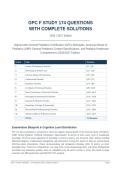
GPC F STUDY 174 QUESTIONS
WITH COMPLETE SOLUTIONS
Edition
Aligned with General Pediatrics Certification (GPC) Standards, American Board of
Pediatrics (ABP) General Pediatrics Content Specifications, and Pediatric Healthcare
Competencies (2026/2027 Edition).
Section Topic Questions
1 Growth, Development, & Nutrition Q1 - Q20
2 Neonatology & Newborn Care Q21 - Q38
3 Infectious Diseases & Immunology Q39 - Q58
4 Cardiovascular Disorders Q59 - Q73
5 Respiratory Disorders Q74 - Q88
6 GI, Hepatic, & Nutritional Disorders Q89 - Q103
7 Renal, Genitourinary, & Electrolyte Disorders Q104 - Q115
8 Neurological & Neuromuscular Disorders Q116 - Q130
9 Endocrine & Metabolic Disorders Q131 - Q142
10 Hematology, Oncology, & Immunology Q143 - Q154
11 Musculoskeletal & Rheumatologic Disorders Q155 - Q164
12 Adolescent Medicine & Behavioral Health Q165 - Q174
TOTAL 174 Questions
Examination Blueprint & Cognitive Level Distribution
This 174-item examination is constructed to mirror the cognitive demand profile of the American Board of Pediatrics
(ABP) General Pediatrics Certifying Examination. Approximately 20 percent of items assess recall of foundational
knowledge, 50 percent assess application of knowledge to clinical scenarios, and 30 percent assess analysis including
differential diagnosis, evidence-based management, and prioritization. Seventy-five percent of items are scenario-based,
reflecting patient presentations, clinical decision-making, and management planning, while 25 percent are direct
knowledge items. Twenty-five comprehensive case study items, twenty pharmacology items, and fifteen developmental
surveillance and anticipatory guidance items are embedded across the twelve sections to ensure full content coverage
consistent with ABP specifications and 2026/2027 GPC standards.
GPC F STUDY 2026/2027 - 174 Questions with Complete Solutions Page 1
, Section 1: Growth, Development, & Nutrition
Twenty items covering growth parameters (WHO/CDC charts, BMI, head circumference), developmental milestones
across domains from birth through adolescence, screening tools (ASQ, M-CHAT-R, PEDS, Denver II), nutrition
(breastfeeding, formula, solids, micronutrients), failure to thrive, obesity, and anticipatory guidance. Items include
developmental surveillance and case studies consistent with 2026/2027 Bright Futures guidelines.
Q1: A 6-month-old former full-term infant presents for a well-child visit. Weight is at the 15th percentile,
length at the 40th percentile, and head circumference at the 50th percentile. The parents report the infant
breastfeeds every 3 hours, takes no solids, and has 6 wet diapers daily. Weight gain has tracked along the 15th
percentile since 2 months of age. What is the most appropriate next step in management?
A. Switch to a higher-calorie formula (24 kcal/oz) and supplement with solids
B. Reassure the parents that growth tracking along an established percentile is normal and continue
breastfeeding *[CORRECT]*
C. Begin workup for failure to thrive with CBC, CMP, and thyroid studies
D. Discontinue breastfeeding and start iron-fortified formula exclusively
Correct Answer: B
Rationale: This infant's weight, length, and head circumference are all within normal limits on WHO/CDC curves and the
weight has tracked consistently along the 15th percentile, which is consistent with healthy growth rather than failure to thrive.
Failure to thrive is defined as weight-for-age below the 5th percentile or a downward crossing of two major percentile lines.
The American Academy of Pediatrics (AAP) Bright Futures (2026/2027) endorses continued exclusive breastfeeding through 6
months with introduction of complementary foods around 6 months. Switching to formula or high-calorie supplement without
indication undermines breastfeeding, and a laboratory workup is unwarranted given consistent tracking along a percentile
line.
Q2: A 4-year-old child is brought in for a well-child visit. The parents are concerned because the child does
not yet pedal a tricycle, frequently trips while running, and cannot stand on one foot for more than one
second. The child speaks in 5- to 6-word sentences and can follow three-step commands. What is the most
appropriate interpretation of these findings?
A. The child has global developmental delay and requires urgent neurology referral
B. Gross motor milestones are delayed; fine motor and language milestones are appropriate *[CORRECT]*
C. All milestones are within normal limits and no further evaluation is needed
D. The child meets criteria for developmental coordination disorder
Correct Answer: B
Rationale: By 4 years of age, a typically developing child should be able to pedal a tricycle, hop on one foot, and stand on one
foot for at least 2 seconds. This child's gross motor skills are delayed. Language (5- to 6-word sentences, three-step
commands) and cognition are age-appropriate. Per the AAP 2026/2027 developmental surveillance guidelines, a delay in a
single domain warrants domain-specific developmental testing and referral to early intervention or pediatric therapy, not
global delay labeling or diagnosis of developmental coordination disorder (which requires substantial functional impairment
and is not diagnosed before 5 years).
Q3: An 18-month-old girl is seen for a well-child visit. She uses 3 words, does not point to share interest, does
not follow her parent's gaze, and does not imitate household tasks. She walks independently. Per the
2026/2027 Bright Futures and AAP periodicity schedule, what is the most appropriate action?
GPC F STUDY 2026/2027 - 174 Questions with Complete Solutions Page 2
, A. Reassure the parents and re-evaluate at the 2-year visit
B. Administer the M-CHAT-R/F screen and, if positive, refer for comprehensive autism evaluation and
audiology *[CORRECT]*
C. Refer directly to a developmental pediatrician without screening
D. Order a head MRI and chromosome microarray
Correct Answer: B
Rationale: Red flags for autism spectrum disorder at 18 months include no pointing to share interest (joint attention), no
gaze-following, no imitation, and fewer than 3 words. The AAP and Bright Futures 2026/2027 Periodicity Schedule
recommend universal autism screening at 18 and 24 months using the M-CHAT-R/F (Modified Checklist for Autism in
Toddlers, Revised with Follow-Up). A positive screen mandates referral for comprehensive diagnostic evaluation, early
intervention, and audiology evaluation. Direct MRI or microarray without screening is not indicated at this stage, and
watchful waiting misses the critical early-intervention window.
Q4: A 2-month-old exclusively breastfed infant is seen for a well-child visit. The mother asks about vitamin
supplementation. The infant was born at term, weighs 5.2 kg (50th percentile), and the mother takes no
medications. Which supplement(s) should be recommended?
A. Vitamin D 400 IU daily; iron is not required at this age *[CORRECT]*
B. Vitamin D 400 IU daily and iron 1 mg/kg/day starting at 4 months
C. Multivitamin drops including vitamins A, C, D, and iron
D. No supplementation is needed while breastfeeding is exclusive
Correct Answer: A
Rationale: Per the AAP 2026/2027 nutrition guidance, exclusively and partially breastfed infants should receive 400 IU of
vitamin D daily starting within the first few days of life to prevent rickets. Iron stores from a term infant are sufficient until
approximately 4 months, at which point breastfed infants should begin iron supplementation (1 mg/kg/day) until iron-rich
complementary foods are introduced. Routine multivitamins are not recommended. Recommending no supplementation would
miss the vitamin D requirement, and starting iron at 2 months is premature for a term infant.
Q5: A 12-month-old child is at the 95th percentile for weight-for-length on the WHO growth chart. The diet
consists of 24 oz of whole milk daily, frequent juice, and minimal vegetables. The parents report the child
refuses table foods. What is the most appropriate counseling?
A. Switch to 2% milk and limit milk to 16 oz/day; eliminate juice; offer vegetables repeatedly without pressure
*[CORRECT]*
B. Place the child on a calorie-restricted diet with regular weight monitoring
C. Recommend 1% milk and restrict all fats to reduce weight gain
D. Continue current intake but add a daily multivitamin
Correct Answer: A
Rationale: Weight-for-length at the 95th percentile indicates risk of overweight per WHO criteria. The AAP 2026/2027 obesity
prevention guidance recommends limiting milk to no more than 16-24 oz/day of whole milk for children 12-24 months,
eliminating juice, and repeated exposure (10-15 times) to vegetables without pressure. Calorie restriction is not recommended
before age 2 due to neurodevelopmental needs. Switching to low-fat milk before age 2 is inappropriate unless there are specific
risk factors; whole milk supports myelination. A multivitamin does not address the dietary pattern problem.
Q6: A 9-month-old infant is exclusively breastfed and has not yet started solid foods. The family is vegetarian
and asks when to introduce iron-rich foods. Which anticipatory guidance is most accurate per Bright Futures
2026/2027?
GPC F STUDY 2026/2027 - 174 Questions with Complete Solutions Page 3
, A. Begin iron-fortified cereal and pureed meats at 4 months
B. Wait until 12 months to introduce solids to reduce allergy risk
C. Introduce iron-fortified cereal, pureed meats, and legumes now, as exclusive breastfeeding beyond 6
months risks iron deficiency *[CORRECT]*
D. Recommend only fruit purees initially and delay iron sources until 12 months
Correct Answer: C
Rationale: Per AAP and Bright Futures 2026/2027, complementary foods should be introduced around 6 months, never later
than 6 months in exclusively breastfed infants because iron stores become depleted. Iron-rich first foods (iron-fortified cereal,
pureed meats, legumes) are particularly important in vegetarian families. Early allergenic food introduction (e.g., peanut)
between 4-6 months reduces allergy risk in high-risk infants, contradicting delayed introduction. Waiting until 12 months
increases the risk of iron deficiency anemia and oral-motor delays.
Q7: A 4-year-old boy is at the 3rd percentile for height with a growth velocity of 4 cm/year. His bone age is
delayed by 2 years. Parents are of average height (father 175 cm, mother 162 cm). Mid-parental target height
is 176 cm. The child is otherwise healthy. What is the most likely diagnosis?
A. Familial short stature
B. Constitutional delay of growth and puberty *[CORRECT]*
C. Growth hormone deficiency
D. Turner syndrome
Correct Answer: B
Rationale: Constitutional delay of growth and puberty (CDGP) presents with short stature, delayed bone age, normal growth
velocity for bone age, and a family history often positive for delayed puberty. Mid-parental target height is normal,
distinguishing CDGP from familial short stature, in which bone age is consistent with chronological age and children track
along a low percentile consistent with family. Growth hormone deficiency typically shows a subnormal growth velocity (<5
cm/year after age 3) regardless of bone age. Turner syndrome occurs in females. Diagnosis requires monitoring and, when
indicated, referral to endocrinology.
Q8: A 5-year-old girl has a BMI at the 97th percentile for age. Blood pressure is 108/68 mmHg (>95th
percentile). Fasting glucose is 110 mg/dL. The mother has type 2 diabetes. Per 2026/2027 AAP obesity
guidelines, what is the most appropriate first-line intervention?
A. Refer for bariatric surgery evaluation
B. Initiate intensive health behavior and lifestyle treatment (IHBLT) including 26+ hours of face-to-face
counseling over 3-12 months *[CORRECT]*
C. Start metformin 500 mg twice daily immediately
D. Recommend a low-carbohydrate ketogenic diet
Correct Answer: B
Rationale: Per the AAP 2026/2027 Clinical Practice Guideline for the Evaluation and Treatment of Children and Adolescents
With Obesity, the recommended first-line treatment for children 2-18 years with overweight or obesity is intensive health
behavior and lifestyle treatment (IHBLT), ideally 26+ hours of face-to-face, family-based, multicomponent counseling over
3-12 months. Pharmacotherapy (e.g., metformin, GLP-1 agonists) may be added as an adjunct for select patients aged 12 and
older or those with comorbidities, but should not replace IHBLT. Bariatric surgery is reserved for adolescents 13+ with severe
obesity and comorbidities. Ketogenic diets are not recommended in this age group.
Q9: A 6-month-old's head circumference has crossed from the 50th to the 95th percentile over 4 months. The
fontanelle is flat, the infant is alert, and motor milestones are normal. What is the most appropriate next step?
GPC F STUDY 2026/2027 - 174 Questions with Complete Solutions Page 4
WITH COMPLETE SOLUTIONS
Edition
Aligned with General Pediatrics Certification (GPC) Standards, American Board of
Pediatrics (ABP) General Pediatrics Content Specifications, and Pediatric Healthcare
Competencies (2026/2027 Edition).
Section Topic Questions
1 Growth, Development, & Nutrition Q1 - Q20
2 Neonatology & Newborn Care Q21 - Q38
3 Infectious Diseases & Immunology Q39 - Q58
4 Cardiovascular Disorders Q59 - Q73
5 Respiratory Disorders Q74 - Q88
6 GI, Hepatic, & Nutritional Disorders Q89 - Q103
7 Renal, Genitourinary, & Electrolyte Disorders Q104 - Q115
8 Neurological & Neuromuscular Disorders Q116 - Q130
9 Endocrine & Metabolic Disorders Q131 - Q142
10 Hematology, Oncology, & Immunology Q143 - Q154
11 Musculoskeletal & Rheumatologic Disorders Q155 - Q164
12 Adolescent Medicine & Behavioral Health Q165 - Q174
TOTAL 174 Questions
Examination Blueprint & Cognitive Level Distribution
This 174-item examination is constructed to mirror the cognitive demand profile of the American Board of Pediatrics
(ABP) General Pediatrics Certifying Examination. Approximately 20 percent of items assess recall of foundational
knowledge, 50 percent assess application of knowledge to clinical scenarios, and 30 percent assess analysis including
differential diagnosis, evidence-based management, and prioritization. Seventy-five percent of items are scenario-based,
reflecting patient presentations, clinical decision-making, and management planning, while 25 percent are direct
knowledge items. Twenty-five comprehensive case study items, twenty pharmacology items, and fifteen developmental
surveillance and anticipatory guidance items are embedded across the twelve sections to ensure full content coverage
consistent with ABP specifications and 2026/2027 GPC standards.
GPC F STUDY 2026/2027 - 174 Questions with Complete Solutions Page 1
, Section 1: Growth, Development, & Nutrition
Twenty items covering growth parameters (WHO/CDC charts, BMI, head circumference), developmental milestones
across domains from birth through adolescence, screening tools (ASQ, M-CHAT-R, PEDS, Denver II), nutrition
(breastfeeding, formula, solids, micronutrients), failure to thrive, obesity, and anticipatory guidance. Items include
developmental surveillance and case studies consistent with 2026/2027 Bright Futures guidelines.
Q1: A 6-month-old former full-term infant presents for a well-child visit. Weight is at the 15th percentile,
length at the 40th percentile, and head circumference at the 50th percentile. The parents report the infant
breastfeeds every 3 hours, takes no solids, and has 6 wet diapers daily. Weight gain has tracked along the 15th
percentile since 2 months of age. What is the most appropriate next step in management?
A. Switch to a higher-calorie formula (24 kcal/oz) and supplement with solids
B. Reassure the parents that growth tracking along an established percentile is normal and continue
breastfeeding *[CORRECT]*
C. Begin workup for failure to thrive with CBC, CMP, and thyroid studies
D. Discontinue breastfeeding and start iron-fortified formula exclusively
Correct Answer: B
Rationale: This infant's weight, length, and head circumference are all within normal limits on WHO/CDC curves and the
weight has tracked consistently along the 15th percentile, which is consistent with healthy growth rather than failure to thrive.
Failure to thrive is defined as weight-for-age below the 5th percentile or a downward crossing of two major percentile lines.
The American Academy of Pediatrics (AAP) Bright Futures (2026/2027) endorses continued exclusive breastfeeding through 6
months with introduction of complementary foods around 6 months. Switching to formula or high-calorie supplement without
indication undermines breastfeeding, and a laboratory workup is unwarranted given consistent tracking along a percentile
line.
Q2: A 4-year-old child is brought in for a well-child visit. The parents are concerned because the child does
not yet pedal a tricycle, frequently trips while running, and cannot stand on one foot for more than one
second. The child speaks in 5- to 6-word sentences and can follow three-step commands. What is the most
appropriate interpretation of these findings?
A. The child has global developmental delay and requires urgent neurology referral
B. Gross motor milestones are delayed; fine motor and language milestones are appropriate *[CORRECT]*
C. All milestones are within normal limits and no further evaluation is needed
D. The child meets criteria for developmental coordination disorder
Correct Answer: B
Rationale: By 4 years of age, a typically developing child should be able to pedal a tricycle, hop on one foot, and stand on one
foot for at least 2 seconds. This child's gross motor skills are delayed. Language (5- to 6-word sentences, three-step
commands) and cognition are age-appropriate. Per the AAP 2026/2027 developmental surveillance guidelines, a delay in a
single domain warrants domain-specific developmental testing and referral to early intervention or pediatric therapy, not
global delay labeling or diagnosis of developmental coordination disorder (which requires substantial functional impairment
and is not diagnosed before 5 years).
Q3: An 18-month-old girl is seen for a well-child visit. She uses 3 words, does not point to share interest, does
not follow her parent's gaze, and does not imitate household tasks. She walks independently. Per the
2026/2027 Bright Futures and AAP periodicity schedule, what is the most appropriate action?
GPC F STUDY 2026/2027 - 174 Questions with Complete Solutions Page 2
, A. Reassure the parents and re-evaluate at the 2-year visit
B. Administer the M-CHAT-R/F screen and, if positive, refer for comprehensive autism evaluation and
audiology *[CORRECT]*
C. Refer directly to a developmental pediatrician without screening
D. Order a head MRI and chromosome microarray
Correct Answer: B
Rationale: Red flags for autism spectrum disorder at 18 months include no pointing to share interest (joint attention), no
gaze-following, no imitation, and fewer than 3 words. The AAP and Bright Futures 2026/2027 Periodicity Schedule
recommend universal autism screening at 18 and 24 months using the M-CHAT-R/F (Modified Checklist for Autism in
Toddlers, Revised with Follow-Up). A positive screen mandates referral for comprehensive diagnostic evaluation, early
intervention, and audiology evaluation. Direct MRI or microarray without screening is not indicated at this stage, and
watchful waiting misses the critical early-intervention window.
Q4: A 2-month-old exclusively breastfed infant is seen for a well-child visit. The mother asks about vitamin
supplementation. The infant was born at term, weighs 5.2 kg (50th percentile), and the mother takes no
medications. Which supplement(s) should be recommended?
A. Vitamin D 400 IU daily; iron is not required at this age *[CORRECT]*
B. Vitamin D 400 IU daily and iron 1 mg/kg/day starting at 4 months
C. Multivitamin drops including vitamins A, C, D, and iron
D. No supplementation is needed while breastfeeding is exclusive
Correct Answer: A
Rationale: Per the AAP 2026/2027 nutrition guidance, exclusively and partially breastfed infants should receive 400 IU of
vitamin D daily starting within the first few days of life to prevent rickets. Iron stores from a term infant are sufficient until
approximately 4 months, at which point breastfed infants should begin iron supplementation (1 mg/kg/day) until iron-rich
complementary foods are introduced. Routine multivitamins are not recommended. Recommending no supplementation would
miss the vitamin D requirement, and starting iron at 2 months is premature for a term infant.
Q5: A 12-month-old child is at the 95th percentile for weight-for-length on the WHO growth chart. The diet
consists of 24 oz of whole milk daily, frequent juice, and minimal vegetables. The parents report the child
refuses table foods. What is the most appropriate counseling?
A. Switch to 2% milk and limit milk to 16 oz/day; eliminate juice; offer vegetables repeatedly without pressure
*[CORRECT]*
B. Place the child on a calorie-restricted diet with regular weight monitoring
C. Recommend 1% milk and restrict all fats to reduce weight gain
D. Continue current intake but add a daily multivitamin
Correct Answer: A
Rationale: Weight-for-length at the 95th percentile indicates risk of overweight per WHO criteria. The AAP 2026/2027 obesity
prevention guidance recommends limiting milk to no more than 16-24 oz/day of whole milk for children 12-24 months,
eliminating juice, and repeated exposure (10-15 times) to vegetables without pressure. Calorie restriction is not recommended
before age 2 due to neurodevelopmental needs. Switching to low-fat milk before age 2 is inappropriate unless there are specific
risk factors; whole milk supports myelination. A multivitamin does not address the dietary pattern problem.
Q6: A 9-month-old infant is exclusively breastfed and has not yet started solid foods. The family is vegetarian
and asks when to introduce iron-rich foods. Which anticipatory guidance is most accurate per Bright Futures
2026/2027?
GPC F STUDY 2026/2027 - 174 Questions with Complete Solutions Page 3
, A. Begin iron-fortified cereal and pureed meats at 4 months
B. Wait until 12 months to introduce solids to reduce allergy risk
C. Introduce iron-fortified cereal, pureed meats, and legumes now, as exclusive breastfeeding beyond 6
months risks iron deficiency *[CORRECT]*
D. Recommend only fruit purees initially and delay iron sources until 12 months
Correct Answer: C
Rationale: Per AAP and Bright Futures 2026/2027, complementary foods should be introduced around 6 months, never later
than 6 months in exclusively breastfed infants because iron stores become depleted. Iron-rich first foods (iron-fortified cereal,
pureed meats, legumes) are particularly important in vegetarian families. Early allergenic food introduction (e.g., peanut)
between 4-6 months reduces allergy risk in high-risk infants, contradicting delayed introduction. Waiting until 12 months
increases the risk of iron deficiency anemia and oral-motor delays.
Q7: A 4-year-old boy is at the 3rd percentile for height with a growth velocity of 4 cm/year. His bone age is
delayed by 2 years. Parents are of average height (father 175 cm, mother 162 cm). Mid-parental target height
is 176 cm. The child is otherwise healthy. What is the most likely diagnosis?
A. Familial short stature
B. Constitutional delay of growth and puberty *[CORRECT]*
C. Growth hormone deficiency
D. Turner syndrome
Correct Answer: B
Rationale: Constitutional delay of growth and puberty (CDGP) presents with short stature, delayed bone age, normal growth
velocity for bone age, and a family history often positive for delayed puberty. Mid-parental target height is normal,
distinguishing CDGP from familial short stature, in which bone age is consistent with chronological age and children track
along a low percentile consistent with family. Growth hormone deficiency typically shows a subnormal growth velocity (<5
cm/year after age 3) regardless of bone age. Turner syndrome occurs in females. Diagnosis requires monitoring and, when
indicated, referral to endocrinology.
Q8: A 5-year-old girl has a BMI at the 97th percentile for age. Blood pressure is 108/68 mmHg (>95th
percentile). Fasting glucose is 110 mg/dL. The mother has type 2 diabetes. Per 2026/2027 AAP obesity
guidelines, what is the most appropriate first-line intervention?
A. Refer for bariatric surgery evaluation
B. Initiate intensive health behavior and lifestyle treatment (IHBLT) including 26+ hours of face-to-face
counseling over 3-12 months *[CORRECT]*
C. Start metformin 500 mg twice daily immediately
D. Recommend a low-carbohydrate ketogenic diet
Correct Answer: B
Rationale: Per the AAP 2026/2027 Clinical Practice Guideline for the Evaluation and Treatment of Children and Adolescents
With Obesity, the recommended first-line treatment for children 2-18 years with overweight or obesity is intensive health
behavior and lifestyle treatment (IHBLT), ideally 26+ hours of face-to-face, family-based, multicomponent counseling over
3-12 months. Pharmacotherapy (e.g., metformin, GLP-1 agonists) may be added as an adjunct for select patients aged 12 and
older or those with comorbidities, but should not replace IHBLT. Bariatric surgery is reserved for adolescents 13+ with severe
obesity and comorbidities. Ketogenic diets are not recommended in this age group.
Q9: A 6-month-old's head circumference has crossed from the 50th to the 95th percentile over 4 months. The
fontanelle is flat, the infant is alert, and motor milestones are normal. What is the most appropriate next step?
GPC F STUDY 2026/2027 - 174 Questions with Complete Solutions Page 4


