

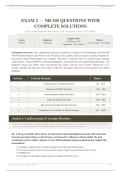
EXAM 2 | NR 545 — Differential Diagnosis and Primary Care Practicum Edition
EXAM 2 — NR 545 QUESTIONS WITH
COMPLETE SOLUTIONS
Differential Diagnosis and Primary Care Practicum · Edition
Cognitive Mix
Course Questions Format
15% Recall · 50%
NR 545 100 Items 75% Scenario · 25% Direct
Application · 35% Analysis
Examination Overview. This comprehensive practice examination is aligned to the Chamberlain University NR
545 Differential Diagnosis and Primary Care Practicum course syllabus, advanced practice nursing competencies,
and current evidence-based primary care standards. The exam is partitioned into six content domains spanning
cardiovascular, respiratory/EENT, gastrointestinal/hepatic, endocrine/renal, musculoskeletal/rheumatologic, and
integrative clinical case studies. Each item presents four options with one correct answer, followed by a 2–4
sentence rationale that links the answer back to NR 545 curriculum content and current primary-care clinical
guidelines.
Section Content Domain Items
1 Cardiovascular & Vascular Disorders Q1 – Q25
2 Respiratory & EENT Disorders Q26 – Q50
3 Gastrointestinal & Hepatic Disorders Q51 – Q65
4 Endocrine & Renal Disorders Q66 – Q80
5 Musculoskeletal & Rheumatologic Disorders Q81 – Q90
6 Comprehensive Case Studies & Clinical Scenarios Q91 – Q100
Section 1: Cardiovascular & Vascular Disorders
Focus: angina pathophysiology · stable vs. unstable angina · MI · acute limb ischemia (6 Ps) · heart failure assessment · antihypertensives
· nitroglycerin · digoxin · metoprolol · ACE inhibitors / ARBs / beta-blockers / diuretics. (25 questions)
Q1. A 58-year-old male with a history of hypertension and hyperlipidemia presents with substernal
chest pressure that radiates to his left arm, occurring after walking two blocks uphill. The pain
consistently resolves within 5 minutes of rest. Which pathophysiologic mechanism best explains this
presentation?
A. Complete coronary artery occlusion causing irreversible myocardial necrosis
B. Transient imbalance between myocardial oxygen supply and demand during exertion
*[CORRECT]*
C. Vasospasm of epicardial coronary arteries occurring exclusively at rest
Chamberlain University · College of Nursing Page 1
,EXAM 2 | NR 545 — Differential Diagnosis and Primary Care Practicum Edition
D. Pericardial inflammation triggered by a recent viral illness
Correct Answer: B
Rationale: Stable angina is caused by a transient imbalance between myocardial oxygen supply and demand during
exertion that resolves with rest or nitroglycerin within 5–10 minutes. Complete occlusion (A) describes acute MI,
vasospasm at rest (C) defines Prinzmetal variant angina, and pericardial inflammation (D) produces pleuritic,
positional pain rather than exertional substernal pressure.
Q2. Which clinical feature most reliably differentiates unstable angina from stable angina in an
outpatient primary-care evaluation?
A. Pain intensity rated 8/10 versus 5/10 on a numeric scale
B. New onset of chest pain at rest or worsening angina pattern within the prior 2 months
*[CORRECT]*
C. Presence of diaphoresis and nausea during episodes
D. Resolution of pain after two sublingual nitroglycerin tablets
Correct Answer: B
Rationale: Unstable angina is defined by new-onset angina at rest, increasing frequency or severity of stable angina, or
angina not relieved by rest within 20 minutes — all signs of plaque destabilization. Pain intensity (A) and associated
symptoms (C) overlap between stable and unstable presentations, and relief after two nitroglycerin tablets (D) is actually
consistent with stable angina rather than a differentiator.
Q3. A 67-year-old woman describes chest pain that woke her from sleep at 3:00 a.m., lasting 25
minutes despite three doses of sublingual nitroglycerin. Vital signs are stable. What is the most
appropriate next step?
A. Schedule outpatient stress testing within 72 hours
B. Instruct the patient to take an additional nitroglycerin dose and follow up in clinic next week
C. Activate emergency medical services and transfer to the nearest emergency department for
evaluation of acute coronary syndrome *[CORRECT]*
D. Prescribe a proton pump inhibitor and reassess for gastroesophageal reflux
Correct Answer: C
Rationale: Chest pain at rest lasting more than 20 minutes despite three nitroglycerin doses meets criteria for unstable
angina/acute coronary syndrome and warrants emergency department evaluation with serial troponins and ECG.
Outpatient stress testing (A) is unsafe in unstable angina, additional nitroglycerin (B) delays definitive care, and empiric
PPI therapy (D) ignores red-flag cardiac features.
Q4. Which description of the pain pattern best characterizes classic myocardial infarction?
A. Sharp, stabbing chest pain that worsens with deep inspiration
B. Sudden tearing chest pain radiating to the back between the scapulae
C. Severe, crushing substernal pressure lasting more than 20 minutes, often with diaphoresis, nausea,
and dyspnea *[CORRECT]*
D. Burning epigastric pain relieved by antacids within 10 minutes
Correct Answer: C
Rationale: Myocardial infarction presents as severe, prolonged substernal pressure or crushing pain exceeding 20
minutes, frequently accompanied by diaphoresis, nausea, dyspnea, and radiation to the arm, jaw, or neck. Pleuritic pain
(A) suggests pericarditis or pneumothorax, tearing back pain (B) is classic for aortic dissection, and burning epigastric
pain relieved by antacids (D) suggests GERD or peptic ulcer disease.
Chamberlain University · College of Nursing Page 2
,EXAM 2 | NR 545 — Differential Diagnosis and Primary Care Practicum Edition
Q5. A 72-year-old male with atrial fibrillation not on anticoagulation suddenly develops a cold,
painful, pulseless right lower extremity. Which constellation of findings constitutes the classic '6 Ps' of
acute limb ischemia?
A. Pain, Pallor, Pulselessness, Paresthesia, Paralysis, Poikilothermia *[CORRECT]*
B. Pain, Purpura, Pulselessness, Paresthesia, Petechiae, Poikilothermia
C. Pallor, Pulse deficit, Purpura, Paresthesia, Paralysis, Pyrexia
D. Pain, Pallor, Pulselessness, Paresthesia, Petechiae, Paralysis
Correct Answer: A
Rationale: Acute limb ischemia presents with the 6 Ps: Pain, Pallor, Pulselessness, Paresthesia, Paralysis, and
Poikilothermia (cold limb). Purpura and petechiae suggest vasculitis or coagulopathy rather than acute arterial
occlusion, and pyrexia is not part of the classic presentation. In atrial fibrillation, emboli arising from the left atrial
appendage are the most common source of acute arterial occlusion.
Q6. A 71-year-old patient with chronic atrial fibrillation asks why a left atrial appendage occlusion
device or systemic anticoagulation is recommended. Which explanation by the NP is most accurate?
A. The left atrial appendage is the most common site of thrombus formation in nonvalvular atrial
fibrillation, and dislodged thrombi can embolize to the systemic circulation causing limb or cerebral
ischemia *[CORRECT]*
B. Atrial fibrillation causes stasis in the pulmonary veins, leading to pulmonary emboli
C. Anticoagulation prevents the development of atherosclerotic plaque in the femoral arteries
D. The left atrial appendage secretes prothrombotic cytokines that trigger peripheral vasospasm
Correct Answer: A
Rationale: In nonvalvular atrial fibrillation, stagnant blood flow in the left atrial appendage promotes thrombus
formation, and dislodged clots can embolize systemically, causing stroke or acute limb ischemia. Pulmonary veins (B)
are not the source, anticoagulation does not prevent atherosclerosis (C), and the appendage is not an endocrine organ
(D).
Q7. A 64-year-old male with heart failure with reduced ejection fraction (HFrEF, EF 32%) reports
increasing dyspnea on exertion, orthopnea requiring three pillows, and waking gasping at night.
Which assessment finding is consistent with paroxysmal nocturnal dyspnea?
A. Chest pain radiating to the left arm occurring at night
B. Sudden onset of severe dyspnea and cough 1–2 hours after lying flat, relieved by sitting upright
*[CORRECT]*
C. Gradual dyspnea worsening over weeks, present at all times of day
D. Wheezing triggered by cold air exposure in the early morning
Correct Answer: B
Rationale: Paroxysmal nocturnal dyspnea (PND) presents as sudden severe dyspnea and cough occurring 1–2 hours
after lying flat, caused by reabsorption of interstitial fluid into the intravascular space increasing preload, and is
relieved by sitting upright. PND is a hallmark of advanced heart failure along with orthopnea, fatigue, hypertension,
and tachycardia.
Q8. Which physical assessment finding is most consistent with decompensated chronic left-sided heart
failure?
A. Bilateral crackles halfway up the lung fields, an S3 gallop, jugular venous distention, and
orthopnea *[CORRECT]*
Chamberlain University · College of Nursing Page 3
, EXAM 2 | NR 545 — Differential Diagnosis and Primary Care Practicum Edition
B. Inspiratory stridor at rest with prolonged inspiratory phase
C. Unilateral decreased breath sounds on the right with tracheal deviation
D. Hyperresonant chest percussion and prolonged expiratory wheeze
Correct Answer: A
Rationale: Decompensated left-sided heart failure produces bilateral basilar or mid-lung crackles from pulmonary
venous congestion, an S3 gallop reflecting rapid ventricular filling, jugular venous distention, and orthopnea. Stridor (B)
suggests upper airway obstruction, unilateral decreased breath sounds with tracheal deviation (C) suggests
pneumothorax or pleural effusion, and hyperresonance with wheeze (D) suggests COPD.
Q9. A 70-year-old patient with HFrEF has been managed with a loop diuretic and an ACE inhibitor.
The patient develops a potassium level of 5.9 mEq/L and creatinine increase of 0.4 mg/dL. Which
addition or change to therapy is most appropriate to reduce mortality and hospitalization risk?
A. Add a potassium-sparing diuretic such as spironolactone after addressing the hyperkalemia
*[CORRECT]*
B. Discontinue the ACE inhibitor and start a calcium channel blocker
C. Switch the loop diuretic to a thiazide diuretic for better potassium sparing
D. Initiate digoxin as first-line therapy to improve contractility
Correct Answer: A
Rationale: Spironolactone, a potassium-sparing aldosterone antagonist, is guideline-recommended in HFrEF to reduce
mortality and hospitalizations, but only after hyperkalemia and renal function are addressed. Calcium channel blockers
(B) do not reduce mortality in HFrEF and may worsen it, thiazides (C) are inadequate for advanced HF, and digoxin
(D) reduces hospitalizations but does not improve survival and is not first-line.
Q10. A patient with chronic stable angina asks about long-term preventive medications. According to
NR 545 evidence-based guidelines, which combination is most appropriate for chronic angina
management?
A. ACE inhibitor (or ARB) plus a beta-blocker, with sublingual nitroglycerin for acute episodes
*[CORRECT]*
B. Calcium channel blocker plus a long-acting nitrate, avoiding beta-blockers
C. Loop diuretic plus digoxin, with intermittent nitroglycerin
D. Aspirin alone without antianginal therapy
Correct Answer: A
Rationale: Long-term angina management includes an ACE inhibitor (or ARB) and a beta-blocker to reduce
myocardial oxygen demand and adverse remodeling, plus sublingual nitroglycerin for acute attacks. Calcium channel
blockers (B) are alternatives when beta-blockers are contraindicated, loop diuretics and digoxin (C) are HF therapies not
chronic angina, and aspirin alone (D) does not provide antianginal benefit.
Q11. A 55-year-old patient with a history of asthma and recently diagnosed hypertension requires
beta-blockade after a myocardial infarction. Which beta-blocker is safest in this clinical scenario?
A. Propranolol, a nonselective beta-blocker
B. Metoprolol, a cardioselective beta-1 selective agent *[CORRECT]*
C. Carvedilol, a nonselective beta-blocker with alpha-1 blockade
D. Nadolol, a nonselective beta-blocker with long half-life
Correct Answer: B
Chamberlain University · College of Nursing Page 4
EXAM 2 — NR 545 QUESTIONS WITH
COMPLETE SOLUTIONS
Differential Diagnosis and Primary Care Practicum · Edition
Cognitive Mix
Course Questions Format
15% Recall · 50%
NR 545 100 Items 75% Scenario · 25% Direct
Application · 35% Analysis
Examination Overview. This comprehensive practice examination is aligned to the Chamberlain University NR
545 Differential Diagnosis and Primary Care Practicum course syllabus, advanced practice nursing competencies,
and current evidence-based primary care standards. The exam is partitioned into six content domains spanning
cardiovascular, respiratory/EENT, gastrointestinal/hepatic, endocrine/renal, musculoskeletal/rheumatologic, and
integrative clinical case studies. Each item presents four options with one correct answer, followed by a 2–4
sentence rationale that links the answer back to NR 545 curriculum content and current primary-care clinical
guidelines.
Section Content Domain Items
1 Cardiovascular & Vascular Disorders Q1 – Q25
2 Respiratory & EENT Disorders Q26 – Q50
3 Gastrointestinal & Hepatic Disorders Q51 – Q65
4 Endocrine & Renal Disorders Q66 – Q80
5 Musculoskeletal & Rheumatologic Disorders Q81 – Q90
6 Comprehensive Case Studies & Clinical Scenarios Q91 – Q100
Section 1: Cardiovascular & Vascular Disorders
Focus: angina pathophysiology · stable vs. unstable angina · MI · acute limb ischemia (6 Ps) · heart failure assessment · antihypertensives
· nitroglycerin · digoxin · metoprolol · ACE inhibitors / ARBs / beta-blockers / diuretics. (25 questions)
Q1. A 58-year-old male with a history of hypertension and hyperlipidemia presents with substernal
chest pressure that radiates to his left arm, occurring after walking two blocks uphill. The pain
consistently resolves within 5 minutes of rest. Which pathophysiologic mechanism best explains this
presentation?
A. Complete coronary artery occlusion causing irreversible myocardial necrosis
B. Transient imbalance between myocardial oxygen supply and demand during exertion
*[CORRECT]*
C. Vasospasm of epicardial coronary arteries occurring exclusively at rest
Chamberlain University · College of Nursing Page 1
,EXAM 2 | NR 545 — Differential Diagnosis and Primary Care Practicum Edition
D. Pericardial inflammation triggered by a recent viral illness
Correct Answer: B
Rationale: Stable angina is caused by a transient imbalance between myocardial oxygen supply and demand during
exertion that resolves with rest or nitroglycerin within 5–10 minutes. Complete occlusion (A) describes acute MI,
vasospasm at rest (C) defines Prinzmetal variant angina, and pericardial inflammation (D) produces pleuritic,
positional pain rather than exertional substernal pressure.
Q2. Which clinical feature most reliably differentiates unstable angina from stable angina in an
outpatient primary-care evaluation?
A. Pain intensity rated 8/10 versus 5/10 on a numeric scale
B. New onset of chest pain at rest or worsening angina pattern within the prior 2 months
*[CORRECT]*
C. Presence of diaphoresis and nausea during episodes
D. Resolution of pain after two sublingual nitroglycerin tablets
Correct Answer: B
Rationale: Unstable angina is defined by new-onset angina at rest, increasing frequency or severity of stable angina, or
angina not relieved by rest within 20 minutes — all signs of plaque destabilization. Pain intensity (A) and associated
symptoms (C) overlap between stable and unstable presentations, and relief after two nitroglycerin tablets (D) is actually
consistent with stable angina rather than a differentiator.
Q3. A 67-year-old woman describes chest pain that woke her from sleep at 3:00 a.m., lasting 25
minutes despite three doses of sublingual nitroglycerin. Vital signs are stable. What is the most
appropriate next step?
A. Schedule outpatient stress testing within 72 hours
B. Instruct the patient to take an additional nitroglycerin dose and follow up in clinic next week
C. Activate emergency medical services and transfer to the nearest emergency department for
evaluation of acute coronary syndrome *[CORRECT]*
D. Prescribe a proton pump inhibitor and reassess for gastroesophageal reflux
Correct Answer: C
Rationale: Chest pain at rest lasting more than 20 minutes despite three nitroglycerin doses meets criteria for unstable
angina/acute coronary syndrome and warrants emergency department evaluation with serial troponins and ECG.
Outpatient stress testing (A) is unsafe in unstable angina, additional nitroglycerin (B) delays definitive care, and empiric
PPI therapy (D) ignores red-flag cardiac features.
Q4. Which description of the pain pattern best characterizes classic myocardial infarction?
A. Sharp, stabbing chest pain that worsens with deep inspiration
B. Sudden tearing chest pain radiating to the back between the scapulae
C. Severe, crushing substernal pressure lasting more than 20 minutes, often with diaphoresis, nausea,
and dyspnea *[CORRECT]*
D. Burning epigastric pain relieved by antacids within 10 minutes
Correct Answer: C
Rationale: Myocardial infarction presents as severe, prolonged substernal pressure or crushing pain exceeding 20
minutes, frequently accompanied by diaphoresis, nausea, dyspnea, and radiation to the arm, jaw, or neck. Pleuritic pain
(A) suggests pericarditis or pneumothorax, tearing back pain (B) is classic for aortic dissection, and burning epigastric
pain relieved by antacids (D) suggests GERD or peptic ulcer disease.
Chamberlain University · College of Nursing Page 2
,EXAM 2 | NR 545 — Differential Diagnosis and Primary Care Practicum Edition
Q5. A 72-year-old male with atrial fibrillation not on anticoagulation suddenly develops a cold,
painful, pulseless right lower extremity. Which constellation of findings constitutes the classic '6 Ps' of
acute limb ischemia?
A. Pain, Pallor, Pulselessness, Paresthesia, Paralysis, Poikilothermia *[CORRECT]*
B. Pain, Purpura, Pulselessness, Paresthesia, Petechiae, Poikilothermia
C. Pallor, Pulse deficit, Purpura, Paresthesia, Paralysis, Pyrexia
D. Pain, Pallor, Pulselessness, Paresthesia, Petechiae, Paralysis
Correct Answer: A
Rationale: Acute limb ischemia presents with the 6 Ps: Pain, Pallor, Pulselessness, Paresthesia, Paralysis, and
Poikilothermia (cold limb). Purpura and petechiae suggest vasculitis or coagulopathy rather than acute arterial
occlusion, and pyrexia is not part of the classic presentation. In atrial fibrillation, emboli arising from the left atrial
appendage are the most common source of acute arterial occlusion.
Q6. A 71-year-old patient with chronic atrial fibrillation asks why a left atrial appendage occlusion
device or systemic anticoagulation is recommended. Which explanation by the NP is most accurate?
A. The left atrial appendage is the most common site of thrombus formation in nonvalvular atrial
fibrillation, and dislodged thrombi can embolize to the systemic circulation causing limb or cerebral
ischemia *[CORRECT]*
B. Atrial fibrillation causes stasis in the pulmonary veins, leading to pulmonary emboli
C. Anticoagulation prevents the development of atherosclerotic plaque in the femoral arteries
D. The left atrial appendage secretes prothrombotic cytokines that trigger peripheral vasospasm
Correct Answer: A
Rationale: In nonvalvular atrial fibrillation, stagnant blood flow in the left atrial appendage promotes thrombus
formation, and dislodged clots can embolize systemically, causing stroke or acute limb ischemia. Pulmonary veins (B)
are not the source, anticoagulation does not prevent atherosclerosis (C), and the appendage is not an endocrine organ
(D).
Q7. A 64-year-old male with heart failure with reduced ejection fraction (HFrEF, EF 32%) reports
increasing dyspnea on exertion, orthopnea requiring three pillows, and waking gasping at night.
Which assessment finding is consistent with paroxysmal nocturnal dyspnea?
A. Chest pain radiating to the left arm occurring at night
B. Sudden onset of severe dyspnea and cough 1–2 hours after lying flat, relieved by sitting upright
*[CORRECT]*
C. Gradual dyspnea worsening over weeks, present at all times of day
D. Wheezing triggered by cold air exposure in the early morning
Correct Answer: B
Rationale: Paroxysmal nocturnal dyspnea (PND) presents as sudden severe dyspnea and cough occurring 1–2 hours
after lying flat, caused by reabsorption of interstitial fluid into the intravascular space increasing preload, and is
relieved by sitting upright. PND is a hallmark of advanced heart failure along with orthopnea, fatigue, hypertension,
and tachycardia.
Q8. Which physical assessment finding is most consistent with decompensated chronic left-sided heart
failure?
A. Bilateral crackles halfway up the lung fields, an S3 gallop, jugular venous distention, and
orthopnea *[CORRECT]*
Chamberlain University · College of Nursing Page 3
, EXAM 2 | NR 545 — Differential Diagnosis and Primary Care Practicum Edition
B. Inspiratory stridor at rest with prolonged inspiratory phase
C. Unilateral decreased breath sounds on the right with tracheal deviation
D. Hyperresonant chest percussion and prolonged expiratory wheeze
Correct Answer: A
Rationale: Decompensated left-sided heart failure produces bilateral basilar or mid-lung crackles from pulmonary
venous congestion, an S3 gallop reflecting rapid ventricular filling, jugular venous distention, and orthopnea. Stridor (B)
suggests upper airway obstruction, unilateral decreased breath sounds with tracheal deviation (C) suggests
pneumothorax or pleural effusion, and hyperresonance with wheeze (D) suggests COPD.
Q9. A 70-year-old patient with HFrEF has been managed with a loop diuretic and an ACE inhibitor.
The patient develops a potassium level of 5.9 mEq/L and creatinine increase of 0.4 mg/dL. Which
addition or change to therapy is most appropriate to reduce mortality and hospitalization risk?
A. Add a potassium-sparing diuretic such as spironolactone after addressing the hyperkalemia
*[CORRECT]*
B. Discontinue the ACE inhibitor and start a calcium channel blocker
C. Switch the loop diuretic to a thiazide diuretic for better potassium sparing
D. Initiate digoxin as first-line therapy to improve contractility
Correct Answer: A
Rationale: Spironolactone, a potassium-sparing aldosterone antagonist, is guideline-recommended in HFrEF to reduce
mortality and hospitalizations, but only after hyperkalemia and renal function are addressed. Calcium channel blockers
(B) do not reduce mortality in HFrEF and may worsen it, thiazides (C) are inadequate for advanced HF, and digoxin
(D) reduces hospitalizations but does not improve survival and is not first-line.
Q10. A patient with chronic stable angina asks about long-term preventive medications. According to
NR 545 evidence-based guidelines, which combination is most appropriate for chronic angina
management?
A. ACE inhibitor (or ARB) plus a beta-blocker, with sublingual nitroglycerin for acute episodes
*[CORRECT]*
B. Calcium channel blocker plus a long-acting nitrate, avoiding beta-blockers
C. Loop diuretic plus digoxin, with intermittent nitroglycerin
D. Aspirin alone without antianginal therapy
Correct Answer: A
Rationale: Long-term angina management includes an ACE inhibitor (or ARB) and a beta-blocker to reduce
myocardial oxygen demand and adverse remodeling, plus sublingual nitroglycerin for acute attacks. Calcium channel
blockers (B) are alternatives when beta-blockers are contraindicated, loop diuretics and digoxin (C) are HF therapies not
chronic angina, and aspirin alone (D) does not provide antianginal benefit.
Q11. A 55-year-old patient with a history of asthma and recently diagnosed hypertension requires
beta-blockade after a myocardial infarction. Which beta-blocker is safest in this clinical scenario?
A. Propranolol, a nonselective beta-blocker
B. Metoprolol, a cardioselective beta-1 selective agent *[CORRECT]*
C. Carvedilol, a nonselective beta-blocker with alpha-1 blockade
D. Nadolol, a nonselective beta-blocker with long half-life
Correct Answer: B
Chamberlain University · College of Nursing Page 4


