
Page 1 of 265
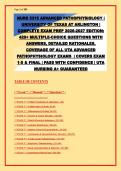
NURS 5315 ADVANCED PATHOPHYSIOLOGY |
UNIVERSITY OF TEXAS AT ARLINGTON |
ANSWERS, DETAILED RATIONALES,
COVERAGE OF ALL UTA ADVANCED
PATHOPHYSIOLOGY EXAMS | COVERS EXAM
TABLE OF CONTENTS
| **Exam** | **Domain** | **Questions** |
|----------|------------|---------------|----------|
| **EXAM 1** | Cellular Foundations & Adaptation | 1-60 |
| **EXAM 1** | Cellular Injury & Death | 61-85 |
| **EXAM 1** | Inflammation & Healing | 86-125 |
| **EXAM 1** | Genetics & Genetic Disorders | 126-150 |
| **EXAM 2** | Fluid & Electrolyte Imbalances | 151-185 |
| **EXAM 2** | Acid-Base Disturbances | 186-210 |
| **EXAM 3** | Immune System & Hypersensitivity | 211-245 |
| **EXAM 3** | Autoimmune & Immunodeficiency Disorders | 246-270 |
| **EXAM 4** | Cardiovascular Pathophysiology | 271-310 |
| **EXAM 4** | Respiratory Pathophysiology | 311-340 |
| **EXAM 5** | Renal, Gastrointestinal, & Endocrine | 341-380 |
| **FINAL** | Comprehensive/Mixed Topics | 381-420 |
,Page 2 of 265
EXAM 1: CELLULAR FOUNDATIONS, ADAPTATION, INJURY, INFLAMMATION, & GENETICS
## Section A: Cellular Adaptation (Questions 1-60)
### Question 1
A 55-year-old male with a 30-year history of smoking undergoes a bronchoscopy. Biopsy results
show abnormal cellular changes including variation in cell size and shape, increased nuclear-to-
cytoplasmic ratio, and loss of normal tissue organization. These changes are characteristic of:
A. Metaplasia
B. Dysplasia
C. Hyperplasia
D. Anaplasia
**CorreCt Answer: B**
**Rationale:** Dysplasia is characterized by abnormal cellular changes including
pleomorphism (variation in size and shape), hyperchromatic nuclei, increased nuclear-to-
cytoplasmic ratio, and disordered tissue organization. It represents a premalignant condition
where cells have lost their normal architectural orientation. Metaplasia (A) is the reversible
replacement of one mature cell type by another. Hyperplasia (C) is an increase in cell number.
Anaplasia (D) represents loss of differentiation seen in malignancy but is more severe than
dysplasia.
---
### Question 2
A patient with chronic gastroesophageal reflux disease (GERD) shows changes in the esophageal
epithelium from squamous to columnar cells. How should the provider document this cellular
adaptation?
,Page 3 of 265
A. Atrophy
B. Hypertrophy
C. Metaplasia
D. Dysplasia
**CorreCt Answer: C**
**Rationale:** Metaplasia represents the reversible replacement of one mature cell type by
another mature cell type that is better able to tolerate the environment. In GERD, the squamous
cells of the esophagus change to columnar cells (Barrett esophagus) to resist acid irritation. This
process is distinct from dysplasia (D), which involves deranged cell growth and is often
precancerous. Atrophy (A) is a decrease in cell size, and hypertrophy (B) is an increase in cell
size.
---
### Question 3
Which of the following best describes physiologic atrophy?
A. Decrease in cell size due to reduced workload
B. Increase in cell number due to hormonal stimulation
C. Decrease in cell size occurring as a normal process
D. Increase in cell size due to increased demand
**CorreCt Answer: C**
, Page 4 of 265
**Rationale:** Physiologic atrophy is a normal, expected reduction in cell size that occurs
as part of development or aging. A classic example is the involution of the thymus gland in early
childhood. Pathologic atrophy (A) occurs due to reduced workload, denervation, or ischemia.
Hyperplasia (B) is an increase in cell number. Hypertrophy (D) is an increase in cell size.
---
### Question 4
A weightlifter develops increased muscle mass through resistance training. This cellular
adaptation is best classified as:
A. Physiologic hyperplasia
B. Pathologic hyperplasia
C. Physiologic hypertrophy
D. Pathologic hypertrophy
**CorreCt Answer: C**
**Rationale:** Physiologic hypertrophy is an increase in cell size in response to increased
workload or demand that occurs as a normal adaptive process. Weightlifting-induced muscle
growth is a classic example. Pathologic hypertrophy (D) occurs in disease states such as
hypertension-induced cardiomegaly. Hyperplasia (A, B) involves an increase in cell number, not
cell size.
---
NURS 5315 ADVANCED PATHOPHYSIOLOGY |
UNIVERSITY OF TEXAS AT ARLINGTON |
ANSWERS, DETAILED RATIONALES,
COVERAGE OF ALL UTA ADVANCED
PATHOPHYSIOLOGY EXAMS | COVERS EXAM
TABLE OF CONTENTS
| **Exam** | **Domain** | **Questions** |
|----------|------------|---------------|----------|
| **EXAM 1** | Cellular Foundations & Adaptation | 1-60 |
| **EXAM 1** | Cellular Injury & Death | 61-85 |
| **EXAM 1** | Inflammation & Healing | 86-125 |
| **EXAM 1** | Genetics & Genetic Disorders | 126-150 |
| **EXAM 2** | Fluid & Electrolyte Imbalances | 151-185 |
| **EXAM 2** | Acid-Base Disturbances | 186-210 |
| **EXAM 3** | Immune System & Hypersensitivity | 211-245 |
| **EXAM 3** | Autoimmune & Immunodeficiency Disorders | 246-270 |
| **EXAM 4** | Cardiovascular Pathophysiology | 271-310 |
| **EXAM 4** | Respiratory Pathophysiology | 311-340 |
| **EXAM 5** | Renal, Gastrointestinal, & Endocrine | 341-380 |
| **FINAL** | Comprehensive/Mixed Topics | 381-420 |
,Page 2 of 265
EXAM 1: CELLULAR FOUNDATIONS, ADAPTATION, INJURY, INFLAMMATION, & GENETICS
## Section A: Cellular Adaptation (Questions 1-60)
### Question 1
A 55-year-old male with a 30-year history of smoking undergoes a bronchoscopy. Biopsy results
show abnormal cellular changes including variation in cell size and shape, increased nuclear-to-
cytoplasmic ratio, and loss of normal tissue organization. These changes are characteristic of:
A. Metaplasia
B. Dysplasia
C. Hyperplasia
D. Anaplasia
**CorreCt Answer: B**
**Rationale:** Dysplasia is characterized by abnormal cellular changes including
pleomorphism (variation in size and shape), hyperchromatic nuclei, increased nuclear-to-
cytoplasmic ratio, and disordered tissue organization. It represents a premalignant condition
where cells have lost their normal architectural orientation. Metaplasia (A) is the reversible
replacement of one mature cell type by another. Hyperplasia (C) is an increase in cell number.
Anaplasia (D) represents loss of differentiation seen in malignancy but is more severe than
dysplasia.
---
### Question 2
A patient with chronic gastroesophageal reflux disease (GERD) shows changes in the esophageal
epithelium from squamous to columnar cells. How should the provider document this cellular
adaptation?
,Page 3 of 265
A. Atrophy
B. Hypertrophy
C. Metaplasia
D. Dysplasia
**CorreCt Answer: C**
**Rationale:** Metaplasia represents the reversible replacement of one mature cell type by
another mature cell type that is better able to tolerate the environment. In GERD, the squamous
cells of the esophagus change to columnar cells (Barrett esophagus) to resist acid irritation. This
process is distinct from dysplasia (D), which involves deranged cell growth and is often
precancerous. Atrophy (A) is a decrease in cell size, and hypertrophy (B) is an increase in cell
size.
---
### Question 3
Which of the following best describes physiologic atrophy?
A. Decrease in cell size due to reduced workload
B. Increase in cell number due to hormonal stimulation
C. Decrease in cell size occurring as a normal process
D. Increase in cell size due to increased demand
**CorreCt Answer: C**
, Page 4 of 265
**Rationale:** Physiologic atrophy is a normal, expected reduction in cell size that occurs
as part of development or aging. A classic example is the involution of the thymus gland in early
childhood. Pathologic atrophy (A) occurs due to reduced workload, denervation, or ischemia.
Hyperplasia (B) is an increase in cell number. Hypertrophy (D) is an increase in cell size.
---
### Question 4
A weightlifter develops increased muscle mass through resistance training. This cellular
adaptation is best classified as:
A. Physiologic hyperplasia
B. Pathologic hyperplasia
C. Physiologic hypertrophy
D. Pathologic hypertrophy
**CorreCt Answer: C**
**Rationale:** Physiologic hypertrophy is an increase in cell size in response to increased
workload or demand that occurs as a normal adaptive process. Weightlifting-induced muscle
growth is a classic example. Pathologic hypertrophy (D) occurs in disease states such as
hypertension-induced cardiomegaly. Hyperplasia (A, B) involves an increase in cell number, not
cell size.
---


