

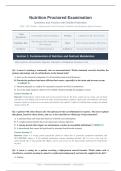
Nutrition Proctored Examination
Questions and Answers with Detailed Rationales
Edition - Aligned with Current Dietary Guidelines and Evidence-Based Practice
Total
100 Multiple-Choice Questions Format: 4 Options (A-D), One Correct
Questions:
30% Recall / 45% Application /
Cognitive Mix: Style: 70% Scenario-Based / 30% Direct
25% Analysis
Sections: 7 Content Domains Audience: Nursing Students & Practitioners
Section 1: Fundamentals of Nutrition and Nutrient Metabolism
Macronutrients, Micronutrients, Digestion, Absorption, & Metabolism (Questions 1-15)
Q1: A nurse is teaching a community class on macronutrients. Which statement correctly describes the
primary physiologic role of carbohydrates in the human body?
A. Serve as the structural component of cell membranes and steroid hormones
B. Provide the preferred and most efficient fuel source, especially for the brain and nervous system
[CORRECT]
C. Function primarily as catalysts for enzymatic reactions involved in metabolism
D. Act as the main transport vehicle for fat-soluble vitamins through the lymphatic system
Correct Answer: B
Rationale: Carbohydrates yield 4 kcal/g and are the preferred fuel for the brain, central nervous system, and red blood
cells; glucose is the obligate fuel for the brain under normal physiologic conditions. Lipids form cell membranes and steroid
hormones (option A); proteins serve enzymatic and catalytic roles (option C); lipids, not carbohydrates, transport fat-soluble
vitamins (option D).
Q2: A patient with celiac disease asks why gluten provokes an inflammatory response. The nurse explains
that gluten, found in wheat, barley, and rye, is best classified as which type of macronutrient?
A. A saturated fatty acid chain that interferes with bile acid reabsorption
B. A complex polysaccharide that resists pancreatic amylase digestion
C. A storage protein that triggers an autoimmune reaction in susceptible individuals [CORRECT]
D. A disaccharide that cannot be hydrolyzed by intestinal brush-border enzymes
Correct Answer: C
Rationale: Gluten is a storage protein (specifically gliadin in wheat) that, in genetically predisposed individuals with
HLA-DQ2/DQ8, triggers a T-cell mediated autoimmune response damaging intestinal villi. It is not a fatty acid (A),
polysaccharide (B), or disaccharide (D). Maltose, lactose, and sucrose are the disaccharides hydrolyzed by brush-border
enzymes.
Q3: A nurse is caring for a patient receiving a high-protein enteral formula. Which amino acid is
classified as essential, meaning it cannot be synthesized endogenously and must be supplied in the diet?
A. Alanine
Page 1 | Nutrition Proctored Exam 2026/2027 | 100 Questions
,Nutrition Proctored Examination 2026/2027 - Questions and Answers
B. Glutamine
C. Leucine [CORRECT]
D. Glycine
Correct Answer: C
Rationale: Leucine is one of the nine essential (indispensable) amino acids that must be obtained from the diet because
humans lack the biosynthetic pathways to produce it; it is also a branched-chain amino acid critical for muscle protein
synthesis. Alanine, glutamine, and glycine are nonessential (conditionally indispensable) amino acids that the body can
synthesize under normal conditions.
Q4: A patient with fat malabsorption due to chronic pancreatitis is at highest risk for deficiency of which
fat-soluble vitamin responsible for calcium homeostasis and bone mineralization?
A. Vitamin A (retinol)
B. Vitamin D (cholecalciferol) [CORRECT]
C. Vitamin E (tocopherol)
D. Vitamin K (phylloquinone)
Correct Answer: B
Rationale: Vitamin D (cholecalciferol) is the fat-soluble vitamin primarily responsible for calcium and phosphorus
homeostasis; it promotes intestinal calcium absorption and bone mineralization. Deficiency causes rickets in children and
osteomalacia in adults. Vitamin A supports vision and epithelial integrity (A); vitamin E is an antioxidant (C); vitamin K is
essential for clotting factor activation (D). All require dietary fat for absorption, but only D directly governs calcium
homeostasis.
Q5: A nurse is assessing a patient with angular stomatitis, glossitis, and magenta-colored tongue. These
findings are classic manifestations of deficiency of which B-complex vitamin?
A. Thiamin (B1)
B. Riboflavin (B2) [CORRECT]
C. Niacin (B3)
D. Pyridoxine (B6)
Correct Answer: B
Rationale: Riboflavin (B2) deficiency classically presents with angular stomatitis (cracking at lip corners), glossitis,
cheilosis, and a magenta-colored tongue, along with seborrheic dermatitis. Thiamin deficiency causes beriberi and
Wernicke-Korsakoff (A); niacin deficiency causes pellagra with the 3 Ds (dermatitis, diarrhea, dementia) (C); pyridoxine
deficiency causes microcytic anemia and seizures (D).
Q6: A patient receiving long-term furosemide therapy is monitored for electrolyte disturbances. Which
electrolyte imbalance poses the greatest risk of fatal cardiac dysrhythmia due to profound depletion from
this loop diuretic?
A. Hypernatremia
B. Hypokalemia [CORRECT]
C. Hypercalcemia
D. Hypomagnesemia
Correct Answer: B
Rationale: Loop diuretics like furosemide inhibit the Na-K-2Cl cotransporter in the thick ascending limb, causing significant
urinary loss of potassium and resulting in hypokalemia, which can precipitate fatal ventricular dysrhythmias. While
hypomagnesemia (D) can also occur and worsen hypokalemia, the immediate life-threatening arrhythmia risk is from
Page 2 | Nutrition Proctored Exam 2026/2027 | 100 Questions
, Nutrition Proctored Examination 2026/2027 - Questions and Answers
hypokalemia. Hypernatremia and hypercalcemia are not typical furosemide effects.
Q7: A nurse is explaining the digestion of starch to nursing students. Which enzyme, secreted by the
salivary glands and pancreas, is primarily responsible for the initial breakdown of dietary starch into
smaller polysaccharides?
A. Sucrase
B. Lipase
C. Amylase [CORRECT]
D. Pepsin
Correct Answer: C
Rationale: Amylase, present in saliva (salivary amylase/ptyalin) and pancreatic secretions (pancreatic amylase), hydrolyzes
the alpha-1,4 glycosidic bonds in starch to yield maltose, maltotriose, and alpha-limit dextrins. Sucrase breaks down sucrose
(A); lipase digests triglycerides (B); pepsin digests proteins in the stomach (D).
Q8: A patient who has undergone a terminal ileum resection is at highest risk for malabsorption of which
nutrient due to loss of its specific absorption site?
A. Iron
B. Vitamin B12 [CORRECT]
C. Calcium
D. Folate
Correct Answer: B
Rationale: Vitamin B12 binds intrinsic factor in the stomach, and the intrinsic factor-B12 complex is absorbed specifically
in the terminal ileum. Resection of this segment causes B12 deficiency, leading to megaloblastic anemia and irreversible
neurologic damage if untreated. Iron is absorbed in the duodenum (A), calcium throughout the small intestine (C), and folate
in the jejunum (D).
Q9: A nurse is caring for a patient with chronic alcohol use disorder admitted with confusion, ataxia, and
ophthalmoplegia. Which nutrient should be administered immediately to prevent irreversible neurologic
damage?
A. Pyridoxine (B6) intravenously
B. Thiamine (B1) intravenously before any glucose [CORRECT]
C. Cyanocobalamin (B12) intramuscularly
D. Folic acid orally
Correct Answer: B
Rationale: This patient presents with Wernicke encephalopathy (confusion, ataxia, nystagmus/ophthalmoplegia) caused by
thiamine (B1) deficiency, most commonly seen in alcohol use disorder. IV thiamine must be given BEFORE glucose
administration, because glucose metabolism consumes thiamine and can precipitate or worsen Wernicke-Korsakoff
syndrome. Untreated, it progresses to irreversible Korsakoff psychosis.
Q10: A nurse is calculating the caloric contribution of macronutrients in a patient's diet. Using the
Atwater factors, how many kilocalories per gram does dietary fat yield?
A. 4 kcal/g
B. 7 kcal/g
C. 9 kcal/g [CORRECT]
Page 3 | Nutrition Proctored Exam 2026/2027 | 100 Questions
Questions and Answers with Detailed Rationales
Edition - Aligned with Current Dietary Guidelines and Evidence-Based Practice
Total
100 Multiple-Choice Questions Format: 4 Options (A-D), One Correct
Questions:
30% Recall / 45% Application /
Cognitive Mix: Style: 70% Scenario-Based / 30% Direct
25% Analysis
Sections: 7 Content Domains Audience: Nursing Students & Practitioners
Section 1: Fundamentals of Nutrition and Nutrient Metabolism
Macronutrients, Micronutrients, Digestion, Absorption, & Metabolism (Questions 1-15)
Q1: A nurse is teaching a community class on macronutrients. Which statement correctly describes the
primary physiologic role of carbohydrates in the human body?
A. Serve as the structural component of cell membranes and steroid hormones
B. Provide the preferred and most efficient fuel source, especially for the brain and nervous system
[CORRECT]
C. Function primarily as catalysts for enzymatic reactions involved in metabolism
D. Act as the main transport vehicle for fat-soluble vitamins through the lymphatic system
Correct Answer: B
Rationale: Carbohydrates yield 4 kcal/g and are the preferred fuel for the brain, central nervous system, and red blood
cells; glucose is the obligate fuel for the brain under normal physiologic conditions. Lipids form cell membranes and steroid
hormones (option A); proteins serve enzymatic and catalytic roles (option C); lipids, not carbohydrates, transport fat-soluble
vitamins (option D).
Q2: A patient with celiac disease asks why gluten provokes an inflammatory response. The nurse explains
that gluten, found in wheat, barley, and rye, is best classified as which type of macronutrient?
A. A saturated fatty acid chain that interferes with bile acid reabsorption
B. A complex polysaccharide that resists pancreatic amylase digestion
C. A storage protein that triggers an autoimmune reaction in susceptible individuals [CORRECT]
D. A disaccharide that cannot be hydrolyzed by intestinal brush-border enzymes
Correct Answer: C
Rationale: Gluten is a storage protein (specifically gliadin in wheat) that, in genetically predisposed individuals with
HLA-DQ2/DQ8, triggers a T-cell mediated autoimmune response damaging intestinal villi. It is not a fatty acid (A),
polysaccharide (B), or disaccharide (D). Maltose, lactose, and sucrose are the disaccharides hydrolyzed by brush-border
enzymes.
Q3: A nurse is caring for a patient receiving a high-protein enteral formula. Which amino acid is
classified as essential, meaning it cannot be synthesized endogenously and must be supplied in the diet?
A. Alanine
Page 1 | Nutrition Proctored Exam 2026/2027 | 100 Questions
,Nutrition Proctored Examination 2026/2027 - Questions and Answers
B. Glutamine
C. Leucine [CORRECT]
D. Glycine
Correct Answer: C
Rationale: Leucine is one of the nine essential (indispensable) amino acids that must be obtained from the diet because
humans lack the biosynthetic pathways to produce it; it is also a branched-chain amino acid critical for muscle protein
synthesis. Alanine, glutamine, and glycine are nonessential (conditionally indispensable) amino acids that the body can
synthesize under normal conditions.
Q4: A patient with fat malabsorption due to chronic pancreatitis is at highest risk for deficiency of which
fat-soluble vitamin responsible for calcium homeostasis and bone mineralization?
A. Vitamin A (retinol)
B. Vitamin D (cholecalciferol) [CORRECT]
C. Vitamin E (tocopherol)
D. Vitamin K (phylloquinone)
Correct Answer: B
Rationale: Vitamin D (cholecalciferol) is the fat-soluble vitamin primarily responsible for calcium and phosphorus
homeostasis; it promotes intestinal calcium absorption and bone mineralization. Deficiency causes rickets in children and
osteomalacia in adults. Vitamin A supports vision and epithelial integrity (A); vitamin E is an antioxidant (C); vitamin K is
essential for clotting factor activation (D). All require dietary fat for absorption, but only D directly governs calcium
homeostasis.
Q5: A nurse is assessing a patient with angular stomatitis, glossitis, and magenta-colored tongue. These
findings are classic manifestations of deficiency of which B-complex vitamin?
A. Thiamin (B1)
B. Riboflavin (B2) [CORRECT]
C. Niacin (B3)
D. Pyridoxine (B6)
Correct Answer: B
Rationale: Riboflavin (B2) deficiency classically presents with angular stomatitis (cracking at lip corners), glossitis,
cheilosis, and a magenta-colored tongue, along with seborrheic dermatitis. Thiamin deficiency causes beriberi and
Wernicke-Korsakoff (A); niacin deficiency causes pellagra with the 3 Ds (dermatitis, diarrhea, dementia) (C); pyridoxine
deficiency causes microcytic anemia and seizures (D).
Q6: A patient receiving long-term furosemide therapy is monitored for electrolyte disturbances. Which
electrolyte imbalance poses the greatest risk of fatal cardiac dysrhythmia due to profound depletion from
this loop diuretic?
A. Hypernatremia
B. Hypokalemia [CORRECT]
C. Hypercalcemia
D. Hypomagnesemia
Correct Answer: B
Rationale: Loop diuretics like furosemide inhibit the Na-K-2Cl cotransporter in the thick ascending limb, causing significant
urinary loss of potassium and resulting in hypokalemia, which can precipitate fatal ventricular dysrhythmias. While
hypomagnesemia (D) can also occur and worsen hypokalemia, the immediate life-threatening arrhythmia risk is from
Page 2 | Nutrition Proctored Exam 2026/2027 | 100 Questions
, Nutrition Proctored Examination 2026/2027 - Questions and Answers
hypokalemia. Hypernatremia and hypercalcemia are not typical furosemide effects.
Q7: A nurse is explaining the digestion of starch to nursing students. Which enzyme, secreted by the
salivary glands and pancreas, is primarily responsible for the initial breakdown of dietary starch into
smaller polysaccharides?
A. Sucrase
B. Lipase
C. Amylase [CORRECT]
D. Pepsin
Correct Answer: C
Rationale: Amylase, present in saliva (salivary amylase/ptyalin) and pancreatic secretions (pancreatic amylase), hydrolyzes
the alpha-1,4 glycosidic bonds in starch to yield maltose, maltotriose, and alpha-limit dextrins. Sucrase breaks down sucrose
(A); lipase digests triglycerides (B); pepsin digests proteins in the stomach (D).
Q8: A patient who has undergone a terminal ileum resection is at highest risk for malabsorption of which
nutrient due to loss of its specific absorption site?
A. Iron
B. Vitamin B12 [CORRECT]
C. Calcium
D. Folate
Correct Answer: B
Rationale: Vitamin B12 binds intrinsic factor in the stomach, and the intrinsic factor-B12 complex is absorbed specifically
in the terminal ileum. Resection of this segment causes B12 deficiency, leading to megaloblastic anemia and irreversible
neurologic damage if untreated. Iron is absorbed in the duodenum (A), calcium throughout the small intestine (C), and folate
in the jejunum (D).
Q9: A nurse is caring for a patient with chronic alcohol use disorder admitted with confusion, ataxia, and
ophthalmoplegia. Which nutrient should be administered immediately to prevent irreversible neurologic
damage?
A. Pyridoxine (B6) intravenously
B. Thiamine (B1) intravenously before any glucose [CORRECT]
C. Cyanocobalamin (B12) intramuscularly
D. Folic acid orally
Correct Answer: B
Rationale: This patient presents with Wernicke encephalopathy (confusion, ataxia, nystagmus/ophthalmoplegia) caused by
thiamine (B1) deficiency, most commonly seen in alcohol use disorder. IV thiamine must be given BEFORE glucose
administration, because glucose metabolism consumes thiamine and can precipitate or worsen Wernicke-Korsakoff
syndrome. Untreated, it progresses to irreversible Korsakoff psychosis.
Q10: A nurse is calculating the caloric contribution of macronutrients in a patient's diet. Using the
Atwater factors, how many kilocalories per gram does dietary fat yield?
A. 4 kcal/g
B. 7 kcal/g
C. 9 kcal/g [CORRECT]
Page 3 | Nutrition Proctored Exam 2026/2027 | 100 Questions


