
Barney Fletcher Final Exam | 2026/2027 | All Questions with Verified Answers | Graded A+ Page 1
Barney Fletcher Final Exam
2026/2027 Edition | All Questions with 100% Verified Correct Answers
Graded A+ | Comprehensive Real Estate Examination Preparation
Aligned with current federal and state real estate licensing standards (2026-2027)
This comprehensive final examination contains 150 multiple-choice questions distributed across nine content domains
that mirror the structure of the Barney Fletcher Schools real estate licensing curriculum. Each question is followed by
four options (A-D), the correct answer, and a concise rationale grounded in real estate principles, statutory authority,
finance, appraisal methodology, agency law, and professional ethics. The exam is designed to test recall
(approximately 30%), application (approximately 45%), and analysis (approximately 25%) in proportions consistent
with the cognitive demands of the state licensing examination. Review each rationale carefully; the distractors
intentionally capture common Barney Fletcher final exam pitfalls such as agency relationship confusion, contract law
application errors, mortgage calculation mistakes, appraisal method misapplication, fair housing violations, and closing
procedure errors.
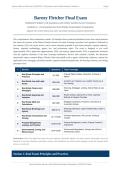
# Section Questions Topic Coverage
Real Estate Principles and Property Rights, Estates, Ownership, Contracts &
1 Q1-Q25
Practices Agency
Real Estate Law and Legal Contract Law, Property Law, Landlord-Tenant Law &
2 Q26-Q45
Issues Fair Housing
Real Estate Finance and Financing, Mortgages, Lending, Interest Rates & Loan
3 Q46-Q65
Mortgages Types
Real Estate Appraisal and Market Analysis, Approaches to Value, Appraisal
4 Q66-Q80
Valuation Methods & Valuation Principles
Real Estate Math and Mortgage Calculations, Prorations, Commission &
5 Q81-Q95
Calculations Investment Analysis
Real Estate Brokerage and Brokerage Operations, Agency Relationships, Duties &
6 Q96-Q110
Agency Disclosure
Real Estate Transactions and Purchase Agreements, Title, Escrow, Closing &
7 Q111-Q125
Closing Transfer
Property Management, Property Management, Leases, Property Taxation &
8 Q126-Q140
Leasing, and Taxation Assessment
Environmental, Zoning, and Environmental Regulations, Zoning Laws, Ethics &
9 Q141-Q150
Ethical Issues Professional Conduct
Instructions: Select the single best answer for each question. Rationales identify the correct answer and explain why each
distractor is incorrect. Reference principles, statutes, and calculations are cited in plain language so that the rationale itself
serves as a study aid.
Section 1: Real Estate Principles and Practices
Barney Fletcher Schools | Real Estate Examination Preparation | 2026-2027 Edition
,Barney Fletcher Final Exam | 2026/2027 | All Questions with Verified Answers | Graded A+ Page 2
Focus: Property Rights, Estates, Ownership, Contracts & Agency
1. A property owner holds fee simple absolute title to a parcel of land. Which of the following
best describes the nature of this ownership interest?
A. An ownership interest that automatically terminates upon the death of the grantee.
B. The highest form of ownership recognized under American common law, with no time limit
and no conditions on use. [CORRECT]
C. An ownership interest subject to a condition subsequent that may trigger automatic reversion.
D. A leasehold interest granting the holder exclusive possession for a stated term.
Correct Answer: B
Rationale: Fee simple absolute is the highest and most complete estate in land recognized under Anglo-American property
law, conferring full bundle of rights (use, sell, lease, devise, encumber) with no time limit and no conditional language.
Options A and D describe lesser estates (life estate and leasehold). Option C describes a fee simple subject to condition
subsequent, which is a defeasible estate, not absolute.
2. A grandmother conveys her home "to my grandson for his natural life, then to my
great-granddaughter." What estate does the great-granddaughter hold during the grandson's
lifetime?
A. A reversionary interest held by the grantor.
B. A vested remainder subject to complete divestment.
C. A contingent remainder in fee simple. [CORRECT]
D. A leasehold estate for years.
Correct Answer: C
Rationale: Because the great-granddaughter is not yet identified/ascertained as a taker until the grandmother's death (and
may predecease the grandson), her interest is a contingent remainder, not vested. A reversion (A) would be held by the
grantor only if no future interest were created. A vested remainder (B) requires a present, identifiable taker. A leasehold (D) is
a non-freehold possession interest, not a future interest.
3. Which of the following is a non-freehold estate that automatically renews period-to-period
until either party gives proper notice to terminate?
A. Estate for years.
B. Estate at sufferance.
C. Periodic tenancy. [CORRECT]
D. Tenancy at will.
Correct Answer: C
Rationale: A periodic tenancy renews automatically from period to period (month-to-month or year-to-year) until terminated
by proper notice. An estate for years (A) terminates automatically on its stated end date. Estate at sufferance (B) arises when a
tenant wrongfully holds over after expiration. Tenancy at will (D) is terminable at any time by either party and does not
renew on a fixed period.
Barney Fletcher Schools | Real Estate Examination Preparation | 2026-2027 Edition
,Barney Fletcher Final Exam | 2026/2027 | All Questions with Verified Answers | Graded A+ Page 3
4. A utility company holds a recorded easement to maintain power lines across a residential
parcel even though the company owns no adjoining land. This easement is best classified as:
A. Easement appurtenant.
B. Easement in gross. [CORRECT]
C. License.
D. Profit a prendre.
Correct Answer: B
Rationale: An easement in gross benefits a person or entity rather than a parcel of land and is personal to the holder; utility
easements are the classic example. An easement appurtenant (A) requires both a dominant and servient tenement. A license
(C) is a revocable personal privilege, not an interest in land. A profit a prendre (D) authorizes removal of a resource (timber,
minerals) and is not the same as a right of way.
5. A buyer is disputing whether a custom-built chandelier conveys with the sale of a residence.
Which of the following tests is MOST determinative under the MARIA framework?
A. The cost of the item when originally purchased.
B. The method of annexation and the adaptability of the item to the land's ordinary use.
[CORRECT]
C. Whether the item was listed in the personal property exclusion clause.
D. The agreement of the parties' real estate agents.
Correct Answer: B
Rationale: Under the MARIA test (Method of annexation, Adaptability to land, Relationship of parties, Intention of parties,
Agreement), the method of annexation and adaptability are central. A fixture is typically bolted, plumbed, or wired in such a
way that removal would damage the property or that the item is adapted to the property's use. Cost (A) and agent agreements
(D) are irrelevant. The written agreement (C) controls as a matter of contract, but the analytical framework for whether the
item is a fixture in the first place is MARIA.
6. A commercial tenant installs specialized trade fixtures in a leased storefront. Upon lease
expiration, which statement is MOST accurate regarding the tenant's rights?
A. Trade fixtures become the landlord's property automatically and cannot be removed.
B. Trade fixtures may be removed by the tenant within a reasonable time, provided any damage
is repaired. [CORRECT]
C. Trade fixtures are real property the moment they are installed and must be conveyed with the
leasehold.
D. Trade fixtures are removable only with the landlord's written consent.
Correct Answer: B
Rationale: Trade fixtures installed by a tenant for the purpose of carrying on a trade are considered personal property and are
removable by the tenant before lease expiration or within a reasonable time thereafter, provided the tenant repairs any
physical damage. Options A and C mischaracterize trade fixtures as automatically real property. Option D is incorrect
because removal is a tenant right, not a privilege requiring landlord consent, though the tenant must cure damage.
Barney Fletcher Schools | Real Estate Examination Preparation | 2026-2027 Edition
, Barney Fletcher Final Exam | 2026/2027 | All Questions with Verified Answers | Graded A+ Page 4
7. Which of the following items is generally classified as real property rather than personal
property?
A. A free-standing refrigerator in the kitchen.
B. Growing wheat that has not yet been harvested. [CORRECT]
C. A portable space heater on wheels.
D. A throw rug that is not affixed to the floor.
Correct Answer: B
Rationale: Growing crops (emblements) are part of the land and classified as real property until severed, after which they
become personal property. A free-standing refrigerator (A), portable space heater (C), and unattached throw rug (D) are all
unattached, movable items treated as personal property unless contractually conveyed.
8. A legal description begins at a designated point of beginning (POB), then describes courses
and distances around the perimeter of the parcel until returning to the POB. This is the:
A. Government rectangular survey system.
B. Lot and block system.
C. Metes and bounds system. [CORRECT]
D. Torrens system.
Correct Answer: C
Rationale: The metes and bounds system uses a point of beginning, courses (directions), and distances (lengths) to describe
the perimeter of a parcel. The government rectangular survey (A) uses townships, ranges, and sections. Lot and block (B)
references a recorded subdivision plat. The Torrens system (D) is a title registration system, not a method of describing land.
9. In the government rectangular survey system, a township contains how many sections, and
each section contains how many acres?
A. 16 sections of 640 acres each.
B. 36 sections of 640 acres each. [CORRECT]
C. 36 sections of 160 acres each.
D. 24 sections of 320 acres each.
Correct Answer: B
Rationale: Under the government rectangular survey system, a township is six miles square and contains 36 sections, each
one mile square (640 acres). Sections are further divided into halves, quarters, and quarter-quarters. The other options present
incorrect section counts or acreages.
10. A parcel is identified as "Lot 14, Block 7, Sunset Hills Subdivision, recorded in Plat Book 42,
Page 19, County Records." This description is:
A. Insufficient because it lacks a point of beginning.
B. A valid lot and block (recorded plat) description. [CORRECT]
C. An informal shorthand that must be converted to metes and bounds.
D. A reference to a government survey section.
Correct Answer: B
Rationale: The lot and block system references a recorded subdivision plat and is a legally sufficient description when the
plat is properly recorded. No point of beginning is required because the plat map itself defines the parcel boundaries. It is not
informal nor is it a government survey reference.
Barney Fletcher Schools | Real Estate Examination Preparation | 2026-2027 Edition
Barney Fletcher Final Exam
2026/2027 Edition | All Questions with 100% Verified Correct Answers
Graded A+ | Comprehensive Real Estate Examination Preparation
Aligned with current federal and state real estate licensing standards (2026-2027)
This comprehensive final examination contains 150 multiple-choice questions distributed across nine content domains
that mirror the structure of the Barney Fletcher Schools real estate licensing curriculum. Each question is followed by
four options (A-D), the correct answer, and a concise rationale grounded in real estate principles, statutory authority,
finance, appraisal methodology, agency law, and professional ethics. The exam is designed to test recall
(approximately 30%), application (approximately 45%), and analysis (approximately 25%) in proportions consistent
with the cognitive demands of the state licensing examination. Review each rationale carefully; the distractors
intentionally capture common Barney Fletcher final exam pitfalls such as agency relationship confusion, contract law
application errors, mortgage calculation mistakes, appraisal method misapplication, fair housing violations, and closing
procedure errors.
# Section Questions Topic Coverage
Real Estate Principles and Property Rights, Estates, Ownership, Contracts &
1 Q1-Q25
Practices Agency
Real Estate Law and Legal Contract Law, Property Law, Landlord-Tenant Law &
2 Q26-Q45
Issues Fair Housing
Real Estate Finance and Financing, Mortgages, Lending, Interest Rates & Loan
3 Q46-Q65
Mortgages Types
Real Estate Appraisal and Market Analysis, Approaches to Value, Appraisal
4 Q66-Q80
Valuation Methods & Valuation Principles
Real Estate Math and Mortgage Calculations, Prorations, Commission &
5 Q81-Q95
Calculations Investment Analysis
Real Estate Brokerage and Brokerage Operations, Agency Relationships, Duties &
6 Q96-Q110
Agency Disclosure
Real Estate Transactions and Purchase Agreements, Title, Escrow, Closing &
7 Q111-Q125
Closing Transfer
Property Management, Property Management, Leases, Property Taxation &
8 Q126-Q140
Leasing, and Taxation Assessment
Environmental, Zoning, and Environmental Regulations, Zoning Laws, Ethics &
9 Q141-Q150
Ethical Issues Professional Conduct
Instructions: Select the single best answer for each question. Rationales identify the correct answer and explain why each
distractor is incorrect. Reference principles, statutes, and calculations are cited in plain language so that the rationale itself
serves as a study aid.
Section 1: Real Estate Principles and Practices
Barney Fletcher Schools | Real Estate Examination Preparation | 2026-2027 Edition
,Barney Fletcher Final Exam | 2026/2027 | All Questions with Verified Answers | Graded A+ Page 2
Focus: Property Rights, Estates, Ownership, Contracts & Agency
1. A property owner holds fee simple absolute title to a parcel of land. Which of the following
best describes the nature of this ownership interest?
A. An ownership interest that automatically terminates upon the death of the grantee.
B. The highest form of ownership recognized under American common law, with no time limit
and no conditions on use. [CORRECT]
C. An ownership interest subject to a condition subsequent that may trigger automatic reversion.
D. A leasehold interest granting the holder exclusive possession for a stated term.
Correct Answer: B
Rationale: Fee simple absolute is the highest and most complete estate in land recognized under Anglo-American property
law, conferring full bundle of rights (use, sell, lease, devise, encumber) with no time limit and no conditional language.
Options A and D describe lesser estates (life estate and leasehold). Option C describes a fee simple subject to condition
subsequent, which is a defeasible estate, not absolute.
2. A grandmother conveys her home "to my grandson for his natural life, then to my
great-granddaughter." What estate does the great-granddaughter hold during the grandson's
lifetime?
A. A reversionary interest held by the grantor.
B. A vested remainder subject to complete divestment.
C. A contingent remainder in fee simple. [CORRECT]
D. A leasehold estate for years.
Correct Answer: C
Rationale: Because the great-granddaughter is not yet identified/ascertained as a taker until the grandmother's death (and
may predecease the grandson), her interest is a contingent remainder, not vested. A reversion (A) would be held by the
grantor only if no future interest were created. A vested remainder (B) requires a present, identifiable taker. A leasehold (D) is
a non-freehold possession interest, not a future interest.
3. Which of the following is a non-freehold estate that automatically renews period-to-period
until either party gives proper notice to terminate?
A. Estate for years.
B. Estate at sufferance.
C. Periodic tenancy. [CORRECT]
D. Tenancy at will.
Correct Answer: C
Rationale: A periodic tenancy renews automatically from period to period (month-to-month or year-to-year) until terminated
by proper notice. An estate for years (A) terminates automatically on its stated end date. Estate at sufferance (B) arises when a
tenant wrongfully holds over after expiration. Tenancy at will (D) is terminable at any time by either party and does not
renew on a fixed period.
Barney Fletcher Schools | Real Estate Examination Preparation | 2026-2027 Edition
,Barney Fletcher Final Exam | 2026/2027 | All Questions with Verified Answers | Graded A+ Page 3
4. A utility company holds a recorded easement to maintain power lines across a residential
parcel even though the company owns no adjoining land. This easement is best classified as:
A. Easement appurtenant.
B. Easement in gross. [CORRECT]
C. License.
D. Profit a prendre.
Correct Answer: B
Rationale: An easement in gross benefits a person or entity rather than a parcel of land and is personal to the holder; utility
easements are the classic example. An easement appurtenant (A) requires both a dominant and servient tenement. A license
(C) is a revocable personal privilege, not an interest in land. A profit a prendre (D) authorizes removal of a resource (timber,
minerals) and is not the same as a right of way.
5. A buyer is disputing whether a custom-built chandelier conveys with the sale of a residence.
Which of the following tests is MOST determinative under the MARIA framework?
A. The cost of the item when originally purchased.
B. The method of annexation and the adaptability of the item to the land's ordinary use.
[CORRECT]
C. Whether the item was listed in the personal property exclusion clause.
D. The agreement of the parties' real estate agents.
Correct Answer: B
Rationale: Under the MARIA test (Method of annexation, Adaptability to land, Relationship of parties, Intention of parties,
Agreement), the method of annexation and adaptability are central. A fixture is typically bolted, plumbed, or wired in such a
way that removal would damage the property or that the item is adapted to the property's use. Cost (A) and agent agreements
(D) are irrelevant. The written agreement (C) controls as a matter of contract, but the analytical framework for whether the
item is a fixture in the first place is MARIA.
6. A commercial tenant installs specialized trade fixtures in a leased storefront. Upon lease
expiration, which statement is MOST accurate regarding the tenant's rights?
A. Trade fixtures become the landlord's property automatically and cannot be removed.
B. Trade fixtures may be removed by the tenant within a reasonable time, provided any damage
is repaired. [CORRECT]
C. Trade fixtures are real property the moment they are installed and must be conveyed with the
leasehold.
D. Trade fixtures are removable only with the landlord's written consent.
Correct Answer: B
Rationale: Trade fixtures installed by a tenant for the purpose of carrying on a trade are considered personal property and are
removable by the tenant before lease expiration or within a reasonable time thereafter, provided the tenant repairs any
physical damage. Options A and C mischaracterize trade fixtures as automatically real property. Option D is incorrect
because removal is a tenant right, not a privilege requiring landlord consent, though the tenant must cure damage.
Barney Fletcher Schools | Real Estate Examination Preparation | 2026-2027 Edition
, Barney Fletcher Final Exam | 2026/2027 | All Questions with Verified Answers | Graded A+ Page 4
7. Which of the following items is generally classified as real property rather than personal
property?
A. A free-standing refrigerator in the kitchen.
B. Growing wheat that has not yet been harvested. [CORRECT]
C. A portable space heater on wheels.
D. A throw rug that is not affixed to the floor.
Correct Answer: B
Rationale: Growing crops (emblements) are part of the land and classified as real property until severed, after which they
become personal property. A free-standing refrigerator (A), portable space heater (C), and unattached throw rug (D) are all
unattached, movable items treated as personal property unless contractually conveyed.
8. A legal description begins at a designated point of beginning (POB), then describes courses
and distances around the perimeter of the parcel until returning to the POB. This is the:
A. Government rectangular survey system.
B. Lot and block system.
C. Metes and bounds system. [CORRECT]
D. Torrens system.
Correct Answer: C
Rationale: The metes and bounds system uses a point of beginning, courses (directions), and distances (lengths) to describe
the perimeter of a parcel. The government rectangular survey (A) uses townships, ranges, and sections. Lot and block (B)
references a recorded subdivision plat. The Torrens system (D) is a title registration system, not a method of describing land.
9. In the government rectangular survey system, a township contains how many sections, and
each section contains how many acres?
A. 16 sections of 640 acres each.
B. 36 sections of 640 acres each. [CORRECT]
C. 36 sections of 160 acres each.
D. 24 sections of 320 acres each.
Correct Answer: B
Rationale: Under the government rectangular survey system, a township is six miles square and contains 36 sections, each
one mile square (640 acres). Sections are further divided into halves, quarters, and quarter-quarters. The other options present
incorrect section counts or acreages.
10. A parcel is identified as "Lot 14, Block 7, Sunset Hills Subdivision, recorded in Plat Book 42,
Page 19, County Records." This description is:
A. Insufficient because it lacks a point of beginning.
B. A valid lot and block (recorded plat) description. [CORRECT]
C. An informal shorthand that must be converted to metes and bounds.
D. A reference to a government survey section.
Correct Answer: B
Rationale: The lot and block system references a recorded subdivision plat and is a legally sufficient description when the
plat is properly recorded. No point of beginning is required because the plat map itself defines the parcel boundaries. It is not
informal nor is it a government survey reference.
Barney Fletcher Schools | Real Estate Examination Preparation | 2026-2027 Edition


