

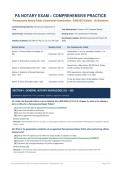
PA NOTARY EXAM – COMPREHENSIVE PRACTICE
Pennsylvania Notary Public Commission Examination • 2026/2027 Edition • 30 Questions
Commissioning Authority: Pennsylvania Department of
State Test Administrator: Pearson VUE (Computer-Based)
Exam Format: 30 Multiple-Choice Questions | 60 Minutes Passing Score: 75% (Scaled Score Threshold)
Key Statutory Update: $25,000 Surety Bond (Eff. March 28,
Statutory Authority: RULONA (57 Pa.C.S. Ch. 3) & PA Code 2026)
Domain Section Question Count Key Competencies Tested
Section 1: General Notary Knowledge (Q1 – Qualifications, 4-yr term, statewide jurisdiction, 3-hr
Q8) 8 Questions (26.7%) education course, $42 fee
Six RULONA powers, acknowledgments vs.
Section 2: Notarial Acts & Duties (Q9 – Q16) 8 Questions (26.7%) verifications, oaths, copy certification, UPL
Journal rules, rubber stamp, $25,000 bond, 45-day
Section 3: Official Requirements (Q17 – Q24) 8 Questions (26.7%) county recording, $5 standard fees
Section 4: Electronic & Remote Notarization RON requirements, state technology notification,
(Q25 – Q27) 3 Questions (10.0%) credential analysis & KBA, 10-yr video
10-day lost stamp notice, 30-day address change,
Section 5: Ethics & Penalties (Q28 – Q30) 3 Questions (10.0%) $1,000 max administrative penalties
SECTION 1: GENERAL NOTARY KNOWLEDGE (Q1 – Q8)
Qualifications, Appointment, Term, Jurisdiction, Eligibility & Application Standards
Q1. Under the Revised Uniform Law on Notarial Acts (RULONA) (57 Pa.C.S. Chapter 3), what is the statutory
term of office for a Pennsylvania Notary Public?
[A] 4 years from the date of appointment/commission [CORRECT]
[B] 2 years from the date of commission
[C] 5 years from the date of recording with the county
[D] Lifetime appointment during good behavior
Correct Answer: [A]
Rationale: Under RULONA (57 Pa.C.S. § 321), a notary public commission in the Commonwealth of Pennsylvania is issued for a term of
exactly 4 years.
Q2. What is the geographic jurisdiction of an appointed Pennsylvania Notary Public when performing official
notarial acts?
[A] Strictly within the specific county where the notary resides or maintains an office
[B] Coextensive with the entire geographic boundaries of the Commonwealth of Pennsylvania [CORRECT]
[C] Anywhere in the United States if the document originated in Pennsylvania
[D] Only within the municipal township or city limits of appointment
Correct Answer: [B]
Rationale: A Pennsylvania notary public possesses statewide jurisdiction and may perform notarial acts anywhere within the
Commonwealth of Pennsylvania.
Pennsylvania Notary Public Commission Examination | 30 Questions Total Page 1 of 9
, PA Notary Public Commission Exam – Comprehensive Practice (2026/2027)
Q3. What is the minimum age requirement and educational prerequisite for an individual applying for an
initial notary public commission in Pennsylvania?
[A] At least 21 years old and a 4-year university degree
[B] At least 16 years old with parental consent
[C] At least 18 years old, a completed 3-hour approved notary education course within 6 months prior to application,
and passing the Pearson VUE examination [CORRECT]
[D] At least 18 years old with zero education requirements
Correct Answer: [C]
Rationale: An applicant must be at least 18 years of age, complete a 3-hour Department-approved notary education course within 6
months prior to applying, and pass the state exam.
Q4. Which government official or entity possesses the constitutional and statutory authority to appoint and
commission Notaries Public in Pennsylvania?
[A] The Chief Justice of the Pennsylvania Supreme Court
[B] The County Prothonotary
[C] The Attorney General of the United States
[D] The Governor, acting through the Pennsylvania Department of State (Secretary of the Commonwealth) [CORRECT]
Correct Answer: [D]
Rationale: Notaries in Pennsylvania are appointed and commissioned by the Governor through the Pennsylvania Department of State.
Q5. What are the citizenship and residency/employment eligibility standards for an applicant seeking a
Pennsylvania notary commission?
[A] Must be a U.S. citizen or lawful permanent resident, and either reside in Pennsylvania or maintain a regular place of
employment or practice within the Commonwealth [CORRECT]
[B] Must be a native-born U.S. citizen living in Pennsylvania for at least 10 years
[C] Must be a resident of Pennsylvania; out-of-state residents can never qualify under any circumstances
[D] Must hold dual citizenship with another country
Correct Answer: [A]
Rationale: Applicants must be U.S. citizens or permanent legal residents, and must either reside in Pennsylvania or be regularly
employed or practicing a business in the Commonwealth.
Q6. An individual who resides in New Jersey is employed full-time at a corporate office in Philadelphia,
Pennsylvania. Under RULONA, is this person eligible to become a Pennsylvania notary public?
[A] No, because non-residents of Pennsylvania are completely ineligible
[B] Yes, because non-residents who maintain a regular place of employment or practice within Pennsylvania satisfy
the statutory residency/employment qualification [CORRECT]
[C] Yes, but they may only notarize documents inside the New Jersey border
[D] No, unless they purchase residential real estate in Philadelphia
Correct Answer: [B]
Rationale: Non-residents who maintain regular employment or a business practice in Pennsylvania are eligible for appointment, though
they may only perform notarial acts while physically inside PA.
Pennsylvania Notary Public Commission Examination | 30 Questions Total Page 2 of 9
Pennsylvania Notary Public Commission Examination • 2026/2027 Edition • 30 Questions
Commissioning Authority: Pennsylvania Department of
State Test Administrator: Pearson VUE (Computer-Based)
Exam Format: 30 Multiple-Choice Questions | 60 Minutes Passing Score: 75% (Scaled Score Threshold)
Key Statutory Update: $25,000 Surety Bond (Eff. March 28,
Statutory Authority: RULONA (57 Pa.C.S. Ch. 3) & PA Code 2026)
Domain Section Question Count Key Competencies Tested
Section 1: General Notary Knowledge (Q1 – Qualifications, 4-yr term, statewide jurisdiction, 3-hr
Q8) 8 Questions (26.7%) education course, $42 fee
Six RULONA powers, acknowledgments vs.
Section 2: Notarial Acts & Duties (Q9 – Q16) 8 Questions (26.7%) verifications, oaths, copy certification, UPL
Journal rules, rubber stamp, $25,000 bond, 45-day
Section 3: Official Requirements (Q17 – Q24) 8 Questions (26.7%) county recording, $5 standard fees
Section 4: Electronic & Remote Notarization RON requirements, state technology notification,
(Q25 – Q27) 3 Questions (10.0%) credential analysis & KBA, 10-yr video
10-day lost stamp notice, 30-day address change,
Section 5: Ethics & Penalties (Q28 – Q30) 3 Questions (10.0%) $1,000 max administrative penalties
SECTION 1: GENERAL NOTARY KNOWLEDGE (Q1 – Q8)
Qualifications, Appointment, Term, Jurisdiction, Eligibility & Application Standards
Q1. Under the Revised Uniform Law on Notarial Acts (RULONA) (57 Pa.C.S. Chapter 3), what is the statutory
term of office for a Pennsylvania Notary Public?
[A] 4 years from the date of appointment/commission [CORRECT]
[B] 2 years from the date of commission
[C] 5 years from the date of recording with the county
[D] Lifetime appointment during good behavior
Correct Answer: [A]
Rationale: Under RULONA (57 Pa.C.S. § 321), a notary public commission in the Commonwealth of Pennsylvania is issued for a term of
exactly 4 years.
Q2. What is the geographic jurisdiction of an appointed Pennsylvania Notary Public when performing official
notarial acts?
[A] Strictly within the specific county where the notary resides or maintains an office
[B] Coextensive with the entire geographic boundaries of the Commonwealth of Pennsylvania [CORRECT]
[C] Anywhere in the United States if the document originated in Pennsylvania
[D] Only within the municipal township or city limits of appointment
Correct Answer: [B]
Rationale: A Pennsylvania notary public possesses statewide jurisdiction and may perform notarial acts anywhere within the
Commonwealth of Pennsylvania.
Pennsylvania Notary Public Commission Examination | 30 Questions Total Page 1 of 9
, PA Notary Public Commission Exam – Comprehensive Practice (2026/2027)
Q3. What is the minimum age requirement and educational prerequisite for an individual applying for an
initial notary public commission in Pennsylvania?
[A] At least 21 years old and a 4-year university degree
[B] At least 16 years old with parental consent
[C] At least 18 years old, a completed 3-hour approved notary education course within 6 months prior to application,
and passing the Pearson VUE examination [CORRECT]
[D] At least 18 years old with zero education requirements
Correct Answer: [C]
Rationale: An applicant must be at least 18 years of age, complete a 3-hour Department-approved notary education course within 6
months prior to applying, and pass the state exam.
Q4. Which government official or entity possesses the constitutional and statutory authority to appoint and
commission Notaries Public in Pennsylvania?
[A] The Chief Justice of the Pennsylvania Supreme Court
[B] The County Prothonotary
[C] The Attorney General of the United States
[D] The Governor, acting through the Pennsylvania Department of State (Secretary of the Commonwealth) [CORRECT]
Correct Answer: [D]
Rationale: Notaries in Pennsylvania are appointed and commissioned by the Governor through the Pennsylvania Department of State.
Q5. What are the citizenship and residency/employment eligibility standards for an applicant seeking a
Pennsylvania notary commission?
[A] Must be a U.S. citizen or lawful permanent resident, and either reside in Pennsylvania or maintain a regular place of
employment or practice within the Commonwealth [CORRECT]
[B] Must be a native-born U.S. citizen living in Pennsylvania for at least 10 years
[C] Must be a resident of Pennsylvania; out-of-state residents can never qualify under any circumstances
[D] Must hold dual citizenship with another country
Correct Answer: [A]
Rationale: Applicants must be U.S. citizens or permanent legal residents, and must either reside in Pennsylvania or be regularly
employed or practicing a business in the Commonwealth.
Q6. An individual who resides in New Jersey is employed full-time at a corporate office in Philadelphia,
Pennsylvania. Under RULONA, is this person eligible to become a Pennsylvania notary public?
[A] No, because non-residents of Pennsylvania are completely ineligible
[B] Yes, because non-residents who maintain a regular place of employment or practice within Pennsylvania satisfy
the statutory residency/employment qualification [CORRECT]
[C] Yes, but they may only notarize documents inside the New Jersey border
[D] No, unless they purchase residential real estate in Philadelphia
Correct Answer: [B]
Rationale: Non-residents who maintain regular employment or a business practice in Pennsylvania are eligible for appointment, though
they may only perform notarial acts while physically inside PA.
Pennsylvania Notary Public Commission Examination | 30 Questions Total Page 2 of 9


