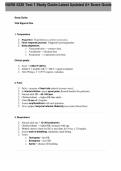
NURS 5220 Test 1:NURS 5220 Test 1 Study Guide:Latest Updated A+ Score Guide:100% Verified
Temperature Regulation: Hypothalamus controls temperature. Fever response (pyrexia): Triggered by prostaglandins. Body adaptations: o Vasoconstriction — conserve heat. o Vasodilation — dissipate heat. o Perspiration — evaporation cools body. Clinical pearls: Fever = 100.4°F (38°C). Infants 0—3 months with T 100.4 = urgent evaluation. After 90 days, T 105°F requires evaluation. 2. Pulse Pulse = measure of heart rate (arterial pressure wave). In infants/children: assess apical pulse; femoral/brachial for perfusion. = Normal adult HR = 60-100 bpm. Children/infants — higher HR than adults. Count 30 sec x 2 if regular. Assess amplitude/force with cach pulsation. Never palpatc temporal arteries bilaterally (can restrict blood flow). = &= = &= 3. Respirations Normal adult rate = 12—20 breaths/min. Children/infants — higher RR, decreases with age. Method: observe chest rise/fall or auscultate for 30 sec x 2 if regular. Assess work of breathing: rctractions, nasal flaring. Terms: o Tachypnea = fast RR. o Bradypnea =slow RR. o Apnea = absence of breathing. NURS 5220 Test 1 Study Guide:Latest Updated A+ Score Guide4. Blood Pressure Definition: Force of blood on arterial walls. o Systolic = ventricular contraction. o Diastolic = peripheral resistance during relaxation. Pulse pressure = systolic — diastolic. Normal adult: 120/80. Hypertension (adults): 140/90 on 3 occasions. Children: BP diagnostic value based on age, height, and gender percentiles . Begin measuring at age 3. Cuff size is critical: o Too big = falsely low. o Too small = falsely high.
Document information
- Uploaded on
- September 8, 2026
- Number of pages
- 26
- Written in
- 2026/2027
- Type
- Exam (elaborations)
- Contains
- Questions & answers