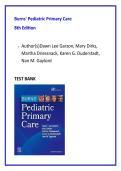
Burns' Pediatric Primary Care
8th Edition
• Author(s)Dawn Lee Garzon, Mary Dirks,
Martha Driessnack, Karen G. Duderstadt,
Nan M. Gaylord
TEST BANK
,
,Question 1
Question:
A parent asks a pediatric primary care provider to explain the difference
between primary care and primary prevention. Which response by the
provider is most accurate?
A. Primary care focuses exclusively on preventing disease, whereas
primary prevention focuses on treating illness.
B. Primary care provides ongoing, comprehensive healthcare, whereas
primary prevention refers to interventions intended to prevent disease
or injury before it occurs.
C. Primary care is limited to treatment provided during acute illness,
whereas primary prevention occurs only in community settings.
D. Primary care and primary prevention are interchangeable terms for
routine pediatric healthcare.
Correct Answer: B. Primary care provides ongoing, comprehensive
healthcare, whereas primary prevention refers to interventions
intended to prevent disease or injury before it occurs.
Rationale:
Pediatric primary care is a broad model of continuous, comprehensive,
accessible, coordinated, and family-centered healthcare. Primary
prevention is a specific prevention strategy aimed at avoiding disease,
injury, or other adverse health outcomes before they occur.
Immunization, injury-prevention counseling, and anticipatory guidance
can be examples of primary prevention delivered within primary care.
, Why the Other Options Are Incorrect:
A. Primary care includes prevention but is not limited to it; it also
encompasses assessment, diagnosis, treatment, follow-up, and
coordination.
C. Primary care is not restricted to acute illness or a particular setting.
D. The terms describe related but distinct concepts and should not be
used interchangeably.
Question 2
Question:
A 4-year-old child presents for a scheduled health supervision visit. The
child has no current complaints. Which activity best demonstrates the
comprehensive nature of pediatric primary care?
A. Obtaining the child's temperature and documenting the result
B. Providing an antibiotic prescription for a presumed future infection
C. Assessing growth and development, reviewing preventive needs,
screening for health risks, and providing anticipatory guidance
D. Referring the child to a specialist because preventive care is outside
the primary care provider's role
Correct Answer: C. Assessing growth and development, reviewing
preventive needs, screening for health risks, and providing
anticipatory guidance
Rationale:
Well-child care is more than a physical examination. Pediatric primary
care integrates health supervision, developmental monitoring,
screening, prevention, counseling, and family-centered anticipatory
8th Edition
• Author(s)Dawn Lee Garzon, Mary Dirks,
Martha Driessnack, Karen G. Duderstadt,
Nan M. Gaylord
TEST BANK
,
,Question 1
Question:
A parent asks a pediatric primary care provider to explain the difference
between primary care and primary prevention. Which response by the
provider is most accurate?
A. Primary care focuses exclusively on preventing disease, whereas
primary prevention focuses on treating illness.
B. Primary care provides ongoing, comprehensive healthcare, whereas
primary prevention refers to interventions intended to prevent disease
or injury before it occurs.
C. Primary care is limited to treatment provided during acute illness,
whereas primary prevention occurs only in community settings.
D. Primary care and primary prevention are interchangeable terms for
routine pediatric healthcare.
Correct Answer: B. Primary care provides ongoing, comprehensive
healthcare, whereas primary prevention refers to interventions
intended to prevent disease or injury before it occurs.
Rationale:
Pediatric primary care is a broad model of continuous, comprehensive,
accessible, coordinated, and family-centered healthcare. Primary
prevention is a specific prevention strategy aimed at avoiding disease,
injury, or other adverse health outcomes before they occur.
Immunization, injury-prevention counseling, and anticipatory guidance
can be examples of primary prevention delivered within primary care.
, Why the Other Options Are Incorrect:
A. Primary care includes prevention but is not limited to it; it also
encompasses assessment, diagnosis, treatment, follow-up, and
coordination.
C. Primary care is not restricted to acute illness or a particular setting.
D. The terms describe related but distinct concepts and should not be
used interchangeably.
Question 2
Question:
A 4-year-old child presents for a scheduled health supervision visit. The
child has no current complaints. Which activity best demonstrates the
comprehensive nature of pediatric primary care?
A. Obtaining the child's temperature and documenting the result
B. Providing an antibiotic prescription for a presumed future infection
C. Assessing growth and development, reviewing preventive needs,
screening for health risks, and providing anticipatory guidance
D. Referring the child to a specialist because preventive care is outside
the primary care provider's role
Correct Answer: C. Assessing growth and development, reviewing
preventive needs, screening for health risks, and providing
anticipatory guidance
Rationale:
Well-child care is more than a physical examination. Pediatric primary
care integrates health supervision, developmental monitoring,
screening, prevention, counseling, and family-centered anticipatory