

https://www.stuvia.com/user/performance
BROADBAND SYSTEMS: NG-PON2, G.FAST DIAGNOSTICS, AND HIGH-DENSITY
CABLE PREPARATION Original Questions with Answers and Rationales
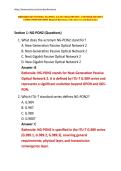
Section 1: NG-PON2 (Questions)
1. What does the acronym NG-PON2 stand for?
A. New Generation Passive Optical Network 2
B. Next-Generation Passive Optical Network 2
C. Next Gigabit Passive Optical Network 2
D. New Gigabit Passive Optical Network 2
Answer: B
Rationale: NG-PON2 stands for Next-Generation Passive
Optical Network 2. It is defined by ITU-T G.989 series and
represents a significant evolution beyond GPON and XGS-
PON.
2. Which ITU-T standard series defines NG-PON2?
A. G.984
B. G.987
C. G.989
D. G.9807
Answer: C
Rationale: NG-PON2 is specified in the ITU-T G.989 series
(G.989.1, G.989.2, G.989.3), covering general
requirements, physical layer, and transmission
convergence layer.
,https://www.stuvia.com/user/performance
3. What is the key enabling technology of NG-PON2 that
differentiates it from previous PON standards?
A. Higher laser power
B. TWDM (Time and Wavelength Division Multiplexing)
C. Copper transmission
D. Wireless backhaul
Answer: B
Rationale: NG-PON2 uses TWDM, combining multiple
wavelengths with time division multiplexing on each
wavelength, enabling much higher aggregate capacity
and flexible bandwidth allocation.
4. What is the maximum aggregate downstream capacity of
NG-PON2?
A. 10 Gbps
B. 40 Gbps
C. 80 Gbps
D. 100 Gbps
Answer: B
Rationale: NG-PON2 supports up to 4 downstream
wavelength pairs at 10 Gbps each, providing 40 Gbps
aggregate downstream capacity (and 40 Gbps upstream).
5. How many wavelength pairs (channels) does NG-PON2
support as defined in the initial standard?
A. 2
, https://www.stuvia.com/user/performance
B. 4
C. 8
D. 16
Answer: C
Rationale: The NG-PON2 standard defines up to 8
wavelength pairs (4 upstream and 4 downstream
initially), with expansion possible. Each pair operates at
10 Gbps.
6. What is the downstream wavelength range used by NG-
PON2?
A. 1490 nm
B. 1577 nm
C. 1596–1603 nm (approximately)
D. 1310 nm
Answer: C
Rationale: NG-PON2 uses wavelengths in the 1596–1603
nm range for downstream (and 1524–1544 nm for
upstream), distinct from GPON and XGS-PON to enable
coexistence.
7. What is the upstream wavelength range used by NG-
PON2?
A. 1270 nm
B. 1310 nm
C. 1524–1544 nm (approximately)
BROADBAND SYSTEMS: NG-PON2, G.FAST DIAGNOSTICS, AND HIGH-DENSITY
CABLE PREPARATION Original Questions with Answers and Rationales
Section 1: NG-PON2 (Questions)
1. What does the acronym NG-PON2 stand for?
A. New Generation Passive Optical Network 2
B. Next-Generation Passive Optical Network 2
C. Next Gigabit Passive Optical Network 2
D. New Gigabit Passive Optical Network 2
Answer: B
Rationale: NG-PON2 stands for Next-Generation Passive
Optical Network 2. It is defined by ITU-T G.989 series and
represents a significant evolution beyond GPON and XGS-
PON.
2. Which ITU-T standard series defines NG-PON2?
A. G.984
B. G.987
C. G.989
D. G.9807
Answer: C
Rationale: NG-PON2 is specified in the ITU-T G.989 series
(G.989.1, G.989.2, G.989.3), covering general
requirements, physical layer, and transmission
convergence layer.
,https://www.stuvia.com/user/performance
3. What is the key enabling technology of NG-PON2 that
differentiates it from previous PON standards?
A. Higher laser power
B. TWDM (Time and Wavelength Division Multiplexing)
C. Copper transmission
D. Wireless backhaul
Answer: B
Rationale: NG-PON2 uses TWDM, combining multiple
wavelengths with time division multiplexing on each
wavelength, enabling much higher aggregate capacity
and flexible bandwidth allocation.
4. What is the maximum aggregate downstream capacity of
NG-PON2?
A. 10 Gbps
B. 40 Gbps
C. 80 Gbps
D. 100 Gbps
Answer: B
Rationale: NG-PON2 supports up to 4 downstream
wavelength pairs at 10 Gbps each, providing 40 Gbps
aggregate downstream capacity (and 40 Gbps upstream).
5. How many wavelength pairs (channels) does NG-PON2
support as defined in the initial standard?
A. 2
, https://www.stuvia.com/user/performance
B. 4
C. 8
D. 16
Answer: C
Rationale: The NG-PON2 standard defines up to 8
wavelength pairs (4 upstream and 4 downstream
initially), with expansion possible. Each pair operates at
10 Gbps.
6. What is the downstream wavelength range used by NG-
PON2?
A. 1490 nm
B. 1577 nm
C. 1596–1603 nm (approximately)
D. 1310 nm
Answer: C
Rationale: NG-PON2 uses wavelengths in the 1596–1603
nm range for downstream (and 1524–1544 nm for
upstream), distinct from GPON and XGS-PON to enable
coexistence.
7. What is the upstream wavelength range used by NG-
PON2?
A. 1270 nm
B. 1310 nm
C. 1524–1544 nm (approximately)


