
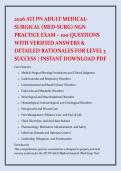
2026 ATI PN ADULT MEDICAL-
SURGICAL (MED-SURG) NGN
PRACTICE EXAM – 100 QUESTIONS
WITH VERIFIED ANSWERS &
DETAILED RATIONALES FOR LEVEL 3
SUCCESS | INSTANT DOWNLOAD PDF
Core Domains
• Medical-Surgical Nursing Foundations and Clinical Judgment
• Cardiovascular and Respiratory Disorders
• Gastrointestinal and Renal/Urinary Disorders
• Endocrine and Metabolic Disorders
• Neurological and Musculoskeletal Disorders
• Hematological, Immunological, and Oncological Disorders
• Perioperative and Wound Care
• Pain Management, Palliative Care, and End-of-Life
• Fluid, Electrolyte, and Acid-Base Balance
• Pharmacology, Medication Administration, and Safety
• Infectious Diseases and Infection Control
• Leadership, Delegation, and Prioritization
Introduction
This comprehensive practice examination is designed to prepare practical
nursing students for the ATI PN Adult Medical-Surgical (Med-Surg) Next
,Generation NCLEX (NGN) examination. The assessment covers all major
content areas including cardiovascular, respiratory, gastrointestinal,
endocrine, neurological, musculoskeletal, and perioperative nursing care. The
multiple-choice and NGN-style questions challenge students to apply
theoretical knowledge to realistic clinical scenarios, emphasizing clinical
judgment, prioritization, delegation, patient safety, and evidence-based
practice. Each question is followed by the correct answer and a detailed
rationale to reinforce understanding of key concepts in adult medical-surgical
nursing and ensure readiness for ATI testing success and Level 3 proficiency.
SECTION ONE: QUESTIONS 1–100
Question 1
A nurse is caring for a client who has heart failure and is receiving furosemide.
Which of the following findings indicates the medication is having the
desired therapeutic effect?
A. Heart rate 110/min
B. Weight loss of 2 kg (4.4 lb) in 24 hours
C. Blood pressure 152/90 mm Hg
D. Crackles auscultated in the lung bases
B. Weight loss of 2 kg (4.4 lb) in 24 hours
RATIONALE: Furosemide is a loop diuretic used to reduce fluid volume
overload in heart failure. A weight loss of 1-2 kg in 24 hours indicates effective
diuresis and reduction of excess fluid. Tachycardia, hypertension, and
crackles indicate worsening heart failure or fluid overload.
Question 2
A nurse is providing teaching to a client who has a new diagnosis of type 2
diabetes mellitus. Which of the following statements by the client indicates
an understanding of the teaching?
,A. "I will check my blood glucose before each meal and at bedtime."
B. "I will take my metformin only when I eat a meal high in carbohydrates."
C. "I will stop taking my medication when my blood glucose is normal."
D. "I will inject my insulin into my abdomen using a 45-degree angle."
A. "I will check my blood glucose before each meal and at bedtime."
RATIONALE: Blood glucose monitoring before meals and at bedtime is
essential for managing type 2 diabetes and adjusting treatment. Metformin
should be taken consistently with meals, not only when eating high-
carbohydrate foods. Medications should not be stopped without provider
guidance. Insulin is injected subcutaneously at a 90-degree angle (or 45
degrees in thin clients), but this client is taking an oral medication.
Question 3
A nurse is assessing a client who has chronic obstructive pulmonary disease
(COPD). Which of the following findings should the nurse report to the
provider?
A. Oxygen saturation 90% on room air
B. Barrel-shaped chest
C. Pursed-lip breathing
D. Clubbing of the fingers
A. Oxygen saturation 90% on room air
RATIONALE: An oxygen saturation of 90% on room air indicates
hypoxemia and requires intervention. Barrel-shaped chest, pursed-lip
breathing, and clubbing are expected findings in clients with COPD.
Question 4
A nurse is caring for a client who is 2 days postoperative following a total hip
arthroplasty. Which of the following actions should the nurse take to prevent
dislocation of the prosthesis?
A. Place a pillow between the client's legs when turning.
B. Position the client with the affected leg internally rotated.
, C. Maintain the client in a high-Fowler's position.
D. Encourage the client to cross their legs when sitting.
A. Place a pillow between the client's legs when turning.
RATIONALE: After hip arthroplasty, the client's legs should be abducted
with a pillow between the legs to prevent dislocation. Internal rotation,
crossing legs, and hip flexion beyond 90 degrees should be avoided.
Question 5
A nurse is preparing to administer a blood transfusion to a client. Which of
the following actions should the nurse take first?
A. Verify the client's identity using two identifiers.
B. Obtain the blood product from the blood bank.
C. Start an IV line with 0.9% sodium chloride.
D. Check the client's vital signs.
A. Verify the client's identity using two identifiers.
RATIONALE: Verification of client identity using two identifiers is the
first and most critical step in safe blood transfusion administration to prevent
transfusion errors.
Question 6
A client with a history of angina reports chest pain. The nurse administers
sublingual nitroglycerin. After 5 minutes, the client reports the pain is
unchanged. Which action should the nurse take?
A. Administer a second dose of nitroglycerin.
B. Notify the provider immediately.
C. Apply oxygen at 2 L/min via nasal cannula.
D. Obtain a 12-lead electrocardiogram.
A. Administer a second dose of nitroglycerin.
SURGICAL (MED-SURG) NGN
PRACTICE EXAM – 100 QUESTIONS
WITH VERIFIED ANSWERS &
DETAILED RATIONALES FOR LEVEL 3
SUCCESS | INSTANT DOWNLOAD PDF
Core Domains
• Medical-Surgical Nursing Foundations and Clinical Judgment
• Cardiovascular and Respiratory Disorders
• Gastrointestinal and Renal/Urinary Disorders
• Endocrine and Metabolic Disorders
• Neurological and Musculoskeletal Disorders
• Hematological, Immunological, and Oncological Disorders
• Perioperative and Wound Care
• Pain Management, Palliative Care, and End-of-Life
• Fluid, Electrolyte, and Acid-Base Balance
• Pharmacology, Medication Administration, and Safety
• Infectious Diseases and Infection Control
• Leadership, Delegation, and Prioritization
Introduction
This comprehensive practice examination is designed to prepare practical
nursing students for the ATI PN Adult Medical-Surgical (Med-Surg) Next
,Generation NCLEX (NGN) examination. The assessment covers all major
content areas including cardiovascular, respiratory, gastrointestinal,
endocrine, neurological, musculoskeletal, and perioperative nursing care. The
multiple-choice and NGN-style questions challenge students to apply
theoretical knowledge to realistic clinical scenarios, emphasizing clinical
judgment, prioritization, delegation, patient safety, and evidence-based
practice. Each question is followed by the correct answer and a detailed
rationale to reinforce understanding of key concepts in adult medical-surgical
nursing and ensure readiness for ATI testing success and Level 3 proficiency.
SECTION ONE: QUESTIONS 1–100
Question 1
A nurse is caring for a client who has heart failure and is receiving furosemide.
Which of the following findings indicates the medication is having the
desired therapeutic effect?
A. Heart rate 110/min
B. Weight loss of 2 kg (4.4 lb) in 24 hours
C. Blood pressure 152/90 mm Hg
D. Crackles auscultated in the lung bases
B. Weight loss of 2 kg (4.4 lb) in 24 hours
RATIONALE: Furosemide is a loop diuretic used to reduce fluid volume
overload in heart failure. A weight loss of 1-2 kg in 24 hours indicates effective
diuresis and reduction of excess fluid. Tachycardia, hypertension, and
crackles indicate worsening heart failure or fluid overload.
Question 2
A nurse is providing teaching to a client who has a new diagnosis of type 2
diabetes mellitus. Which of the following statements by the client indicates
an understanding of the teaching?
,A. "I will check my blood glucose before each meal and at bedtime."
B. "I will take my metformin only when I eat a meal high in carbohydrates."
C. "I will stop taking my medication when my blood glucose is normal."
D. "I will inject my insulin into my abdomen using a 45-degree angle."
A. "I will check my blood glucose before each meal and at bedtime."
RATIONALE: Blood glucose monitoring before meals and at bedtime is
essential for managing type 2 diabetes and adjusting treatment. Metformin
should be taken consistently with meals, not only when eating high-
carbohydrate foods. Medications should not be stopped without provider
guidance. Insulin is injected subcutaneously at a 90-degree angle (or 45
degrees in thin clients), but this client is taking an oral medication.
Question 3
A nurse is assessing a client who has chronic obstructive pulmonary disease
(COPD). Which of the following findings should the nurse report to the
provider?
A. Oxygen saturation 90% on room air
B. Barrel-shaped chest
C. Pursed-lip breathing
D. Clubbing of the fingers
A. Oxygen saturation 90% on room air
RATIONALE: An oxygen saturation of 90% on room air indicates
hypoxemia and requires intervention. Barrel-shaped chest, pursed-lip
breathing, and clubbing are expected findings in clients with COPD.
Question 4
A nurse is caring for a client who is 2 days postoperative following a total hip
arthroplasty. Which of the following actions should the nurse take to prevent
dislocation of the prosthesis?
A. Place a pillow between the client's legs when turning.
B. Position the client with the affected leg internally rotated.
, C. Maintain the client in a high-Fowler's position.
D. Encourage the client to cross their legs when sitting.
A. Place a pillow between the client's legs when turning.
RATIONALE: After hip arthroplasty, the client's legs should be abducted
with a pillow between the legs to prevent dislocation. Internal rotation,
crossing legs, and hip flexion beyond 90 degrees should be avoided.
Question 5
A nurse is preparing to administer a blood transfusion to a client. Which of
the following actions should the nurse take first?
A. Verify the client's identity using two identifiers.
B. Obtain the blood product from the blood bank.
C. Start an IV line with 0.9% sodium chloride.
D. Check the client's vital signs.
A. Verify the client's identity using two identifiers.
RATIONALE: Verification of client identity using two identifiers is the
first and most critical step in safe blood transfusion administration to prevent
transfusion errors.
Question 6
A client with a history of angina reports chest pain. The nurse administers
sublingual nitroglycerin. After 5 minutes, the client reports the pain is
unchanged. Which action should the nurse take?
A. Administer a second dose of nitroglycerin.
B. Notify the provider immediately.
C. Apply oxygen at 2 L/min via nasal cannula.
D. Obtain a 12-lead electrocardiogram.
A. Administer a second dose of nitroglycerin.


