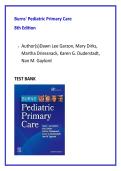
Burns' Pediatric Primary Care
8th Edition
• Author(s)Dawn Lee Garzon, Mary Dirks,
Martha Driessnack, Karen G. Duderstadt,
Nan M. Gaylord
TEST BANK
,
,Question 1
Question:
A pediatric primary care practice is redesigning its services to better
reflect the principles of primary health care. Which practice change best
demonstrates comprehensive pediatric primary care?
A. Limiting visits to treatment of acute illnesses
B. Providing ongoing health supervision, prevention, screening,
treatment, and coordination of referrals
C. Referring all children with chronic conditions to subspecialists
D. Offering immunizations only during school enrollment
Correct Answer: B. Providing ongoing health supervision, prevention,
screening, treatment, and coordination of referrals
Rationale:
Pediatric primary care is broader than treating illness. It includes first-
contact care, health supervision, preventive services, developmental
and psychosocial assessment, treatment of acute and chronic
conditions, and coordination of services when specialty care is needed.
Continuity and coordination are central features of high-quality
pediatric primary care. (AAP Publications)
Why the Other Options Are Incorrect:
A. This approach limits primary care to episodic sick care and omits
prevention, health promotion, and ongoing health supervision.
C. Primary care providers remain responsible for coordinating care even
when subspecialty consultation is necessary.
, D. Immunization is an important preventive service, but restricting
primary care to immunizations excludes many essential health services.
Question 2
Question:
A nurse practitioner explains the difference between primary care and
primary prevention to a nursing student. Which statement by the
student indicates correct understanding?
A. “Primary care and primary prevention mean the same thing.”
B. “Primary prevention refers to the clinical setting where children
receive care.”
C. “Primary care is a broad model of healthcare delivery, whereas
primary prevention aims to prevent disease before it occurs.”
D. “Primary prevention occurs only during well-child examinations.”
Correct Answer: C. “Primary care is a broad model of healthcare
delivery, whereas primary prevention aims to prevent disease before
it occurs.”
Rationale:
Primary care describes an accessible, continuous, comprehensive, and
coordinated approach to healthcare. Primary prevention is an
intervention strategy intended to reduce the occurrence of disease or
injury before it develops, such as vaccination and injury-prevention
counseling.
Why the Other Options Are Incorrect:
A. The terms describe different concepts: one is a healthcare delivery
model, and the other is a prevention strategy.
8th Edition
• Author(s)Dawn Lee Garzon, Mary Dirks,
Martha Driessnack, Karen G. Duderstadt,
Nan M. Gaylord
TEST BANK
,
,Question 1
Question:
A pediatric primary care practice is redesigning its services to better
reflect the principles of primary health care. Which practice change best
demonstrates comprehensive pediatric primary care?
A. Limiting visits to treatment of acute illnesses
B. Providing ongoing health supervision, prevention, screening,
treatment, and coordination of referrals
C. Referring all children with chronic conditions to subspecialists
D. Offering immunizations only during school enrollment
Correct Answer: B. Providing ongoing health supervision, prevention,
screening, treatment, and coordination of referrals
Rationale:
Pediatric primary care is broader than treating illness. It includes first-
contact care, health supervision, preventive services, developmental
and psychosocial assessment, treatment of acute and chronic
conditions, and coordination of services when specialty care is needed.
Continuity and coordination are central features of high-quality
pediatric primary care. (AAP Publications)
Why the Other Options Are Incorrect:
A. This approach limits primary care to episodic sick care and omits
prevention, health promotion, and ongoing health supervision.
C. Primary care providers remain responsible for coordinating care even
when subspecialty consultation is necessary.
, D. Immunization is an important preventive service, but restricting
primary care to immunizations excludes many essential health services.
Question 2
Question:
A nurse practitioner explains the difference between primary care and
primary prevention to a nursing student. Which statement by the
student indicates correct understanding?
A. “Primary care and primary prevention mean the same thing.”
B. “Primary prevention refers to the clinical setting where children
receive care.”
C. “Primary care is a broad model of healthcare delivery, whereas
primary prevention aims to prevent disease before it occurs.”
D. “Primary prevention occurs only during well-child examinations.”
Correct Answer: C. “Primary care is a broad model of healthcare
delivery, whereas primary prevention aims to prevent disease before
it occurs.”
Rationale:
Primary care describes an accessible, continuous, comprehensive, and
coordinated approach to healthcare. Primary prevention is an
intervention strategy intended to reduce the occurrence of disease or
injury before it develops, such as vaccination and injury-prevention
counseling.
Why the Other Options Are Incorrect:
A. The terms describe different concepts: one is a healthcare delivery
model, and the other is a prevention strategy.