
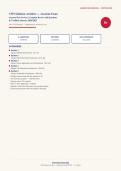
AMAZON WEB SERVICES • CERTIFICATION
AWS Solutions Architect — Associate Exam
Amazon Web Services | Complete Review with Questions
& Verified Answers 2026/2027
SAA-C03 Domains • Application & Analysis Level
A+
A+ QUESTIONS SECTIONS 100% RATIONALES
VERIFIED 5 DOMAINS INCLUDED
CATEGORIES
Section 1
Design Resilient Architectures (Q1–13)
Section 2
Design High-Performing Architectures (Q14–26)
Section 3
Design Secure Applications and Architectures (Q27–39)
Section 4
Design Cost-Optimized Architectures (Q40–52)
Section 5
Design Sustainable Architectures (Q53–65)
• Multiple-choice format with four options (A–D)
• One mark per question • Total 65 marks
• Passing score: 72% (scaled)
• Bloom’s level: Application / Analysis
• Aligned to AWS SAA-C03 public exam guide domains
• Scenario-based stems with item-specific rationales
STUVIAACTUALEXAM
AWS Solutions Architect — Associate Exam 2026/2027 • A+ Verified
, SECTION 1 • DESIGN RESILIENT ARCHITECTURES (Q1–13)
Q1. A company runs a critical web application on Amazon EC2 instances behind an Application Load Balancer. The architecture must remain
available even if an entire Availability Zone fails. The solutions architect should primarily:
A. Deploy the EC2 instances and load balancer across at least two Availability Zones
B. Place all instances in a single AZ and rely on Auto Scaling alone
C. Use only Amazon S3 for the application tier
D. Disable health checks on the load balancer to avoid instance replacement
Correct Answer: A
Rationale: Multi-AZ deployment of both compute and the load balancer provides fault isolation so that failure of one AZ does not take the application offline. Single-AZ designs
cannot meet the stated resilience requirement.
Q2. An application stores session state in the local file system of EC2 instances. After an instance failure, users lose their sessions. To improve
resilience while keeping the application largely unchanged, the architect should:
A. Move session state to a shared, durable store such as Amazon ElastiCache or DynamoDB
B. Increase the size of the instance root volume
C. Disable Auto Scaling so instances never terminate
D. Store sessions only in instance store volumes
Correct Answer: A
Rationale: Externalizing session state to a managed, multi-AZ store decouples user sessions from individual instance lifetimes and enables seamless recovery after instance
replacement.
Q3. A database running on a single EC2 instance must be made highly available with automatic failover and minimal operational overhead. The
preferred AWS service approach is:
A. Keep the single EC2 instance and add a cron-based snapshot script
B. Use Amazon S3 as the primary database engine
C. Run two independent EC2 databases without replication
D. Migrate to Amazon RDS Multi-AZ
Correct Answer: D
Rationale: RDS Multi-AZ provides synchronous standby in another AZ, automatic failover, and managed backups with far less operational burden than self-managed EC2
databases.
Q4. A company needs to protect an Amazon S3 bucket containing critical backups from accidental deletion. The most effective combination of
controls is:
A. Enable S3 Versioning and apply a bucket policy that denies unauthenticated delete actions; optionally use MFA Delete
B. Disable all logging to reduce cost
C. Make the bucket public so multiple teams can recover objects
D. Turn off encryption so restores are faster
Correct Answer: A
Rationale: Versioning preserves prior object versions after deletes or overwrites. Restrictive policies and MFA Delete further reduce the risk of permanent data loss.
Q5. An application uses Amazon SQS to decouple producers and consumers. During a traffic spike, messages accumulate and some are
processed more than once. To improve processing reliability the architect should:
A. Delete the queue whenever the backlog grows
B. Reduce the number of consumers to one
C. Implement idempotent consumers and configure an appropriate visibility timeout
D. Store messages only in instance memory
Correct Answer: C
Rationale: Visibility timeout prevents other consumers from receiving an in-flight message too soon. Idempotent processing ensures duplicate deliveries do not cause
incorrect results.
Q6. A multi-tier application must continue serving read traffic even if the primary relational database becomes unavailable. A suitable resilient
design is:
A. Use Amazon RDS read replicas (or Aurora replicas) to serve reads and promote a replica if the primary fails
B. Route all traffic to a single EC2-hosted MySQL instance
C. Disable automated backups to improve write latency
D. Store the entire database in Amazon CloudFront
Correct Answer: A
Rationale: Read replicas provide scalable read capacity and can be promoted to primary during failover scenarios, improving both performance and resilience.
Q7. A solutions architect is designing a disaster-recovery strategy with a recovery time objective (RTO) of under 15 minutes for a stateful
application. The most appropriate approach among the following is:
A. Backup and restore from weekly S3 snapshots only
B. Pilot light or warm standby with automated failover across Regions
C. Redeploy the entire stack manually from documentation after a failure
D. Single-AZ deployment with no cross-Region copy
Correct Answer: B
Rationale: Pilot light / warm standby keep core components running or quickly scalable in a second Region, enabling recovery within aggressive RTO targets that pure
backup/restore cannot meet.
STUVIAACTUALEXAM • AWS SAA Associate 2026/2027 • Page 2
AWS Solutions Architect — Associate Exam
Amazon Web Services | Complete Review with Questions
& Verified Answers 2026/2027
SAA-C03 Domains • Application & Analysis Level
A+
A+ QUESTIONS SECTIONS 100% RATIONALES
VERIFIED 5 DOMAINS INCLUDED
CATEGORIES
Section 1
Design Resilient Architectures (Q1–13)
Section 2
Design High-Performing Architectures (Q14–26)
Section 3
Design Secure Applications and Architectures (Q27–39)
Section 4
Design Cost-Optimized Architectures (Q40–52)
Section 5
Design Sustainable Architectures (Q53–65)
• Multiple-choice format with four options (A–D)
• One mark per question • Total 65 marks
• Passing score: 72% (scaled)
• Bloom’s level: Application / Analysis
• Aligned to AWS SAA-C03 public exam guide domains
• Scenario-based stems with item-specific rationales
STUVIAACTUALEXAM
AWS Solutions Architect — Associate Exam 2026/2027 • A+ Verified
, SECTION 1 • DESIGN RESILIENT ARCHITECTURES (Q1–13)
Q1. A company runs a critical web application on Amazon EC2 instances behind an Application Load Balancer. The architecture must remain
available even if an entire Availability Zone fails. The solutions architect should primarily:
A. Deploy the EC2 instances and load balancer across at least two Availability Zones
B. Place all instances in a single AZ and rely on Auto Scaling alone
C. Use only Amazon S3 for the application tier
D. Disable health checks on the load balancer to avoid instance replacement
Correct Answer: A
Rationale: Multi-AZ deployment of both compute and the load balancer provides fault isolation so that failure of one AZ does not take the application offline. Single-AZ designs
cannot meet the stated resilience requirement.
Q2. An application stores session state in the local file system of EC2 instances. After an instance failure, users lose their sessions. To improve
resilience while keeping the application largely unchanged, the architect should:
A. Move session state to a shared, durable store such as Amazon ElastiCache or DynamoDB
B. Increase the size of the instance root volume
C. Disable Auto Scaling so instances never terminate
D. Store sessions only in instance store volumes
Correct Answer: A
Rationale: Externalizing session state to a managed, multi-AZ store decouples user sessions from individual instance lifetimes and enables seamless recovery after instance
replacement.
Q3. A database running on a single EC2 instance must be made highly available with automatic failover and minimal operational overhead. The
preferred AWS service approach is:
A. Keep the single EC2 instance and add a cron-based snapshot script
B. Use Amazon S3 as the primary database engine
C. Run two independent EC2 databases without replication
D. Migrate to Amazon RDS Multi-AZ
Correct Answer: D
Rationale: RDS Multi-AZ provides synchronous standby in another AZ, automatic failover, and managed backups with far less operational burden than self-managed EC2
databases.
Q4. A company needs to protect an Amazon S3 bucket containing critical backups from accidental deletion. The most effective combination of
controls is:
A. Enable S3 Versioning and apply a bucket policy that denies unauthenticated delete actions; optionally use MFA Delete
B. Disable all logging to reduce cost
C. Make the bucket public so multiple teams can recover objects
D. Turn off encryption so restores are faster
Correct Answer: A
Rationale: Versioning preserves prior object versions after deletes or overwrites. Restrictive policies and MFA Delete further reduce the risk of permanent data loss.
Q5. An application uses Amazon SQS to decouple producers and consumers. During a traffic spike, messages accumulate and some are
processed more than once. To improve processing reliability the architect should:
A. Delete the queue whenever the backlog grows
B. Reduce the number of consumers to one
C. Implement idempotent consumers and configure an appropriate visibility timeout
D. Store messages only in instance memory
Correct Answer: C
Rationale: Visibility timeout prevents other consumers from receiving an in-flight message too soon. Idempotent processing ensures duplicate deliveries do not cause
incorrect results.
Q6. A multi-tier application must continue serving read traffic even if the primary relational database becomes unavailable. A suitable resilient
design is:
A. Use Amazon RDS read replicas (or Aurora replicas) to serve reads and promote a replica if the primary fails
B. Route all traffic to a single EC2-hosted MySQL instance
C. Disable automated backups to improve write latency
D. Store the entire database in Amazon CloudFront
Correct Answer: A
Rationale: Read replicas provide scalable read capacity and can be promoted to primary during failover scenarios, improving both performance and resilience.
Q7. A solutions architect is designing a disaster-recovery strategy with a recovery time objective (RTO) of under 15 minutes for a stateful
application. The most appropriate approach among the following is:
A. Backup and restore from weekly S3 snapshots only
B. Pilot light or warm standby with automated failover across Regions
C. Redeploy the entire stack manually from documentation after a failure
D. Single-AZ deployment with no cross-Region copy
Correct Answer: B
Rationale: Pilot light / warm standby keep core components running or quickly scalable in a second Region, enabling recovery within aggressive RTO targets that pure
backup/restore cannot meet.
STUVIAACTUALEXAM • AWS SAA Associate 2026/2027 • Page 2


