
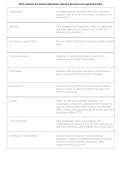
D078 - Business Environment Applications Business Structures and Legal Environment
Organization An organized body of people who have a particular
purpose, such as to form a business, a society, or an
association
Structure An arrangement of components within an organization
that helps determine its mission and channel the
behavior of its members
Functions or departments Serve to define the division of work along task-oriented
lines
Chain of command Hierarchy of control and decision making from
superiors down through subordinates
Centralized Decision-making function lies with a central figure or
group, such as the CEO or board of trustees
Decentrlized Decision-making function does not lie with a central
figure or group, but with department managers and
other key personnel
C-level Refers to high-level corporate positions in an
organization, where the C stands for chief in positions
such as chief executive officer (CEO), chief financial
officer (CFO), chief operations officer (COO), and chief
technology officer (CTO)
Level of formality How procedures, rules, and guidelines are
implemented, the behavioral norms and expectations,
and how it influences and facilitates the overall culture
Functional or departmental Structure most often found in manufacturing
companies, based on departments and their functions,
such as marketing, finance, production, sales,
customer service, and so on
, D078 - Business Environment Applications Business Structures and Legal Environment
Divisional Structure is most often found in consumer products
companies, grouped by organizational function, such
as product division (specific make/model of vehicle) or
geographical division (northeast/southwest or North
America/South America)
Matrix Structure most often found when combining two
different forms of departments, such as functional and
product, that have complementary strengths and
weaknesses
Teams Structure most often found in high-tech companies as a
newer type of organizational structure that includes a
group of workers, with complementary skills, all working
toward a common goal, such as a specific project
Scientific management Organizational theory that analyzes work flows to
improve efficiency, especially labor productivity in
manufacturing industries, typically by focusing on
employee selection, training, and testing
Bureaucratic Organizational theory that focuses on creating rules
and regulations to simplify complex procedures in
societies and workplaces
Administrative Organizational theory that focuses on efficiency
through management training and behavioral
characteristics with the goal of improving workplace
productivity
Neoclassical Organizational theory that emphasizes differences
among people and social interactions with a goal of
developing stronger relationships among coworkers
Modern Organizational theory that espouses the belief that
changing one variable impacts many other variables,
so adjusting and adapting to changes in the
environment is essential to maintain equilibrium
Contingency or situational Organizational theory that emphasizes managers must
have the ability to make adjustments and to adapt how
they manage their organizations contingent upon
changing environmental conditions
, D078 - Business Environment Applications Business Structures and Legal Environment
What is characteristic of grouping It allows for coordination of similar tasks and activities.
employees by departments? 3 multiple choice options
What is an advantage of an It clearly defines reporting relationships among
organizational structure with a rigidly employees.
hierarchical chain of command? 3 multiple choice options
A company's CEO makes all decisions Centralization
for the organization. 3 multiple choice options
Which organizational factor is
influencing the source of this decision-
making?
Company employees greet each other Level of formality
using their full names and titles in all 3 multiple choice options
communications.
Which organizational factor does this
describe?
How is contingency/situational theory It recognizes the importance of management flexibility.
applicable to organizational structure? 3 multiple choice options
A company has recently grown very Matrix
complex and is now operating in 3 multiple choice options
several locations around the world,
producing multiple specialized products.
The company needs a new
organizational structure that will support
the geographical locations and allow for
cross-departmental communication.
Which organizational structure is best
suited to the company's goals?
A company director wants to improve Administrative
workplace productivity by providing 3 multiple choice options
more training to managers.
Which organization theory focuses on
this approach?
A business wants to improve worker Scientific management
productivity by analyzing work flows. 3 multiple choice options
Which theory focuses on this
approach?
Organization An organized body of people who have a particular
purpose, such as to form a business, a society, or an
association
Structure An arrangement of components within an organization
that helps determine its mission and channel the
behavior of its members
Functions or departments Serve to define the division of work along task-oriented
lines
Chain of command Hierarchy of control and decision making from
superiors down through subordinates
Centralized Decision-making function lies with a central figure or
group, such as the CEO or board of trustees
Decentrlized Decision-making function does not lie with a central
figure or group, but with department managers and
other key personnel
C-level Refers to high-level corporate positions in an
organization, where the C stands for chief in positions
such as chief executive officer (CEO), chief financial
officer (CFO), chief operations officer (COO), and chief
technology officer (CTO)
Level of formality How procedures, rules, and guidelines are
implemented, the behavioral norms and expectations,
and how it influences and facilitates the overall culture
Functional or departmental Structure most often found in manufacturing
companies, based on departments and their functions,
such as marketing, finance, production, sales,
customer service, and so on
, D078 - Business Environment Applications Business Structures and Legal Environment
Divisional Structure is most often found in consumer products
companies, grouped by organizational function, such
as product division (specific make/model of vehicle) or
geographical division (northeast/southwest or North
America/South America)
Matrix Structure most often found when combining two
different forms of departments, such as functional and
product, that have complementary strengths and
weaknesses
Teams Structure most often found in high-tech companies as a
newer type of organizational structure that includes a
group of workers, with complementary skills, all working
toward a common goal, such as a specific project
Scientific management Organizational theory that analyzes work flows to
improve efficiency, especially labor productivity in
manufacturing industries, typically by focusing on
employee selection, training, and testing
Bureaucratic Organizational theory that focuses on creating rules
and regulations to simplify complex procedures in
societies and workplaces
Administrative Organizational theory that focuses on efficiency
through management training and behavioral
characteristics with the goal of improving workplace
productivity
Neoclassical Organizational theory that emphasizes differences
among people and social interactions with a goal of
developing stronger relationships among coworkers
Modern Organizational theory that espouses the belief that
changing one variable impacts many other variables,
so adjusting and adapting to changes in the
environment is essential to maintain equilibrium
Contingency or situational Organizational theory that emphasizes managers must
have the ability to make adjustments and to adapt how
they manage their organizations contingent upon
changing environmental conditions
, D078 - Business Environment Applications Business Structures and Legal Environment
What is characteristic of grouping It allows for coordination of similar tasks and activities.
employees by departments? 3 multiple choice options
What is an advantage of an It clearly defines reporting relationships among
organizational structure with a rigidly employees.
hierarchical chain of command? 3 multiple choice options
A company's CEO makes all decisions Centralization
for the organization. 3 multiple choice options
Which organizational factor is
influencing the source of this decision-
making?
Company employees greet each other Level of formality
using their full names and titles in all 3 multiple choice options
communications.
Which organizational factor does this
describe?
How is contingency/situational theory It recognizes the importance of management flexibility.
applicable to organizational structure? 3 multiple choice options
A company has recently grown very Matrix
complex and is now operating in 3 multiple choice options
several locations around the world,
producing multiple specialized products.
The company needs a new
organizational structure that will support
the geographical locations and allow for
cross-departmental communication.
Which organizational structure is best
suited to the company's goals?
A company director wants to improve Administrative
workplace productivity by providing 3 multiple choice options
more training to managers.
Which organization theory focuses on
this approach?
A business wants to improve worker Scientific management
productivity by analyzing work flows. 3 multiple choice options
Which theory focuses on this
approach?


