
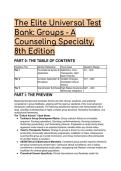
The Elite Universal Test
Bank: Groups - A
Counseling Specialty,
8th Edition
PART 0: THE TABLE OF CONTENTS
Cognitive Tier Section Reference Focus Area Question Range
Tier 1 Foundational Syntax & Definitions, Core Q1 – Q10
Application Frameworks, Hard
Deck Theories
Tier 2 Complex Application & Variable Changes, Q11 – Q20
Simulation Immediate Clinical
Actions
Tier 3 Grandmaster Synthesis High-Stakes Scenarios, Q21 – Q30
Multimodal Integration
PART I: THE PREVIEW
Mastering this test bank translates directly into elite clinical, academic, and analytical
competence in group facilitation, aligning with the rigorous standards of the most advanced
therapeutic institutions globally. The following assessment replaces rote memorization with a
deep, simplified understanding of highly complex group dynamics, theoretical foundations, and
multicultural frameworks.
The "Critical Axioms" Cheat Sheet:
● Tuckman's Group Development Matrix: Group evolution follows an immutable
sequence: Forming (orientation), Storming (conflict/resistance), Norming (cohesion),
Performing (productivity), and Terminating (closure). Progression is rarely strictly linear;
regression under stress is an expected systemic variable within any clinical milieu.
● Yalom's Therapeutic Factors: Change in groups is driven by core curative mechanisms,
prominently Universality (disconfirming uniqueness), Instillation of Hope, Interpersonal
Learning (the group as a social microcosm), and Group Cohesiveness (the prerequisite
for all other factors to function).
● ASGW Ethical & Multicultural Mandates: Competent group practice requires intentional
pre-group screening to prevent harm, continuous ethical surveillance, and a radical
commitment to intersectional social justice, recognizing that Western universal models are
insufficient for diverse global populations.
● Theoretical Domain Specificity: Clinical interventions must flawlessly match the
, theoretical framework being utilized. Cognitive-Behavioral (REBT) focuses on the A-B-C
model; Gestalt demands here-and-now sensory awareness; Transactional Analysis
targets structural ego states; and Psychodrama requires active behavioral reenactment
through auxiliary egos and doubling.
● Empirical Equivalency: Extensive outcome research dictates that group psychotherapy
is fundamentally equivalent to individual psychotherapy in efficacy, driven predominantly
by the therapeutic alliance and routine outcome monitoring.
PART II: THE ELITE TEST BANK
Tier 1: Foundational Syntax & Application
Q1: A clinician is designing an intervention for community members seeking to understand and
manage early-stage hypertension. The intervention will involve didactic instruction on diet, brief
discussions on lifestyle changes, and skill-building exercises. Based on the principles of the
Association for Specialists in Group Work (ASGW) group classification, which action/conclusion
is the MOST ACCURATE? A) The clinician should classify this as a Counseling Group to
facilitate deep interpersonal processing regarding the trauma of chronic illness. B) The clinician
should classify this as a Psychotherapy Group, as medical issues inherently require personality
reconstruction. C) The clinician should classify this as a Psychoeducational Group, prioritizing
information dissemination and preventative skill acquisition. D) The clinician should classify this
as a Task/Work Group to ensure the members produce a tangible output document regarding
dietary guidelines.
● Answer: C (The clinician should classify this as a Psychoeducational Group, prioritizing
information dissemination and preventative skill acquisition.)
● Distractor Analysis:
○ A is incorrect: Counseling groups focus on interpersonal process and
problem-solving for normative developmental concerns, not primarily on didactic
instruction.
○ B is incorrect: Psychotherapy groups address deep-seated psychological
dysfunction and severe clinical pathology, which is contextually inappropriate for
basic medical education.
○ D is incorrect: Task/work groups aim to accomplish a specific external mandate or
produce a product (e.g., a committee or task force), rather than educating the
internal members on personal health.
The Mentor's Analysis: Psychoeducational groups emphasize utilizing educational methods to
acquire information and develop related meaning and skills. When facing an audience lacking
specific knowledge, the immediate priority is structured information dissemination coupled with
skill-building. By utilizing a Psychoeducational framework, the facilitator bypasses the common
trap of over-pathologizing normative knowledge deficits. Professional/Academic Intuition:
When the primary mechanism of change is didactic instruction and skill acquisition, the
group is inherently psychoeducational.
Q2: During the first session of a new clinical group, members exhibit high levels of anxiety,
frequently look to the leader for explicit direction, and engage in superficial, socially acceptable
dialogue. Based on the principles of group development, which action/conclusion is the MOST
ACCURATE? A) The facilitator must recognize this as the Storming phase and confront the
resistance immediately to prevent early attrition. B) The facilitator should interpret the
, dependent transference pattern immediately to disrupt subconscious reliance on authority. C)
The facilitator must recognize this as the Forming stage, characterized by normative orientation
and dependence, and provide structural safety. D) The facilitator should terminate the group due
to poor member selection and lack of immediate cohesive bonding.
● Answer: C (The facilitator must recognize this as the Forming stage, characterized by
normative orientation and dependence, and provide structural safety.)
● Distractor Analysis:
○ A is incorrect: These behaviors represent initial orientation and a search for safety,
not the overt conflict, rebellion, or challenge to authority characteristic of the
Storming phase.
○ B is incorrect: While dependence exists, interpreting transference in session one is
a pacing violation that destroys psychological safety.
○ D is incorrect: High anxiety and superficiality are entirely normative for the first
session; they are not indicators of a failed screening process or flawed group
architecture.
The Mentor's Analysis: The initial stage of any group is defined by uncertainty and a search
for structure. When facing early group anxiety, the immediate priority is establishing safety,
boundaries, and clear norms. By utilizing structural support and validation, the leader bypasses
the common novice error of mistaking normative anxiety for pathological resistance.
Professional/Academic Intuition: Anxiety and dependence in session one are not
pathology; they are the natural psychological prerequisites to group formation.
Q3: A group member consistently dominates the session by telling lengthy, irrelevant stories
that derail the therapeutic focus. Other members are beginning to disengage, looking frustrated
and checking their watches. Based on the principles of effective group leadership, which
action/conclusion is the MOST ACCURATE? A) The leader should employ the drawing out
technique to force other members to interrupt the speaker, thereby building group autonomy. B)
The leader should allow the member to finish to preserve their autonomy, demonstrating
unconditional positive regard. C) The leader should utilize the blocking or cutting off skill to halt
the counterproductive behavior and protect the therapeutic milieu. D) The leader should
interpret the member's storytelling as a manifestation of the Adult ego state processing vital
information.
● Answer: C (The leader should utilize the blocking or cutting off skill to halt the
counterproductive behavior and protect the therapeutic milieu.)
● Distractor Analysis:
○ A is incorrect: Drawing out is a micro-skill used to invite silent members to speak,
not a mechanism to passively manage a monopolizer while avoiding direct
leadership responsibility.
○ B is incorrect: Allowing counterproductive behavior to continue destroys group
cohesion and creates resentment toward the leader for failing to protect the group's
time and safety.
○ D is incorrect: Storytelling to avoid authentic emotion is typically an Adapted Child
or defensive maneuver, not the rational, data-processing Adult ego state found in
Transactional Analysis.
The Mentor's Analysis: Protecting the group's therapeutic environment is a non-negotiable
leadership mandate. When facing a monopolizer, the immediate priority is stopping the
counterproductive behavior. By utilizing blocking, the clinician bypasses the common trap of
sacrificing the group's collective welfare to appease a single dominating member.
Professional/Academic Intuition: To protect the group is to occasionally confront the
Bank: Groups - A
Counseling Specialty,
8th Edition
PART 0: THE TABLE OF CONTENTS
Cognitive Tier Section Reference Focus Area Question Range
Tier 1 Foundational Syntax & Definitions, Core Q1 – Q10
Application Frameworks, Hard
Deck Theories
Tier 2 Complex Application & Variable Changes, Q11 – Q20
Simulation Immediate Clinical
Actions
Tier 3 Grandmaster Synthesis High-Stakes Scenarios, Q21 – Q30
Multimodal Integration
PART I: THE PREVIEW
Mastering this test bank translates directly into elite clinical, academic, and analytical
competence in group facilitation, aligning with the rigorous standards of the most advanced
therapeutic institutions globally. The following assessment replaces rote memorization with a
deep, simplified understanding of highly complex group dynamics, theoretical foundations, and
multicultural frameworks.
The "Critical Axioms" Cheat Sheet:
● Tuckman's Group Development Matrix: Group evolution follows an immutable
sequence: Forming (orientation), Storming (conflict/resistance), Norming (cohesion),
Performing (productivity), and Terminating (closure). Progression is rarely strictly linear;
regression under stress is an expected systemic variable within any clinical milieu.
● Yalom's Therapeutic Factors: Change in groups is driven by core curative mechanisms,
prominently Universality (disconfirming uniqueness), Instillation of Hope, Interpersonal
Learning (the group as a social microcosm), and Group Cohesiveness (the prerequisite
for all other factors to function).
● ASGW Ethical & Multicultural Mandates: Competent group practice requires intentional
pre-group screening to prevent harm, continuous ethical surveillance, and a radical
commitment to intersectional social justice, recognizing that Western universal models are
insufficient for diverse global populations.
● Theoretical Domain Specificity: Clinical interventions must flawlessly match the
, theoretical framework being utilized. Cognitive-Behavioral (REBT) focuses on the A-B-C
model; Gestalt demands here-and-now sensory awareness; Transactional Analysis
targets structural ego states; and Psychodrama requires active behavioral reenactment
through auxiliary egos and doubling.
● Empirical Equivalency: Extensive outcome research dictates that group psychotherapy
is fundamentally equivalent to individual psychotherapy in efficacy, driven predominantly
by the therapeutic alliance and routine outcome monitoring.
PART II: THE ELITE TEST BANK
Tier 1: Foundational Syntax & Application
Q1: A clinician is designing an intervention for community members seeking to understand and
manage early-stage hypertension. The intervention will involve didactic instruction on diet, brief
discussions on lifestyle changes, and skill-building exercises. Based on the principles of the
Association for Specialists in Group Work (ASGW) group classification, which action/conclusion
is the MOST ACCURATE? A) The clinician should classify this as a Counseling Group to
facilitate deep interpersonal processing regarding the trauma of chronic illness. B) The clinician
should classify this as a Psychotherapy Group, as medical issues inherently require personality
reconstruction. C) The clinician should classify this as a Psychoeducational Group, prioritizing
information dissemination and preventative skill acquisition. D) The clinician should classify this
as a Task/Work Group to ensure the members produce a tangible output document regarding
dietary guidelines.
● Answer: C (The clinician should classify this as a Psychoeducational Group, prioritizing
information dissemination and preventative skill acquisition.)
● Distractor Analysis:
○ A is incorrect: Counseling groups focus on interpersonal process and
problem-solving for normative developmental concerns, not primarily on didactic
instruction.
○ B is incorrect: Psychotherapy groups address deep-seated psychological
dysfunction and severe clinical pathology, which is contextually inappropriate for
basic medical education.
○ D is incorrect: Task/work groups aim to accomplish a specific external mandate or
produce a product (e.g., a committee or task force), rather than educating the
internal members on personal health.
The Mentor's Analysis: Psychoeducational groups emphasize utilizing educational methods to
acquire information and develop related meaning and skills. When facing an audience lacking
specific knowledge, the immediate priority is structured information dissemination coupled with
skill-building. By utilizing a Psychoeducational framework, the facilitator bypasses the common
trap of over-pathologizing normative knowledge deficits. Professional/Academic Intuition:
When the primary mechanism of change is didactic instruction and skill acquisition, the
group is inherently psychoeducational.
Q2: During the first session of a new clinical group, members exhibit high levels of anxiety,
frequently look to the leader for explicit direction, and engage in superficial, socially acceptable
dialogue. Based on the principles of group development, which action/conclusion is the MOST
ACCURATE? A) The facilitator must recognize this as the Storming phase and confront the
resistance immediately to prevent early attrition. B) The facilitator should interpret the
, dependent transference pattern immediately to disrupt subconscious reliance on authority. C)
The facilitator must recognize this as the Forming stage, characterized by normative orientation
and dependence, and provide structural safety. D) The facilitator should terminate the group due
to poor member selection and lack of immediate cohesive bonding.
● Answer: C (The facilitator must recognize this as the Forming stage, characterized by
normative orientation and dependence, and provide structural safety.)
● Distractor Analysis:
○ A is incorrect: These behaviors represent initial orientation and a search for safety,
not the overt conflict, rebellion, or challenge to authority characteristic of the
Storming phase.
○ B is incorrect: While dependence exists, interpreting transference in session one is
a pacing violation that destroys psychological safety.
○ D is incorrect: High anxiety and superficiality are entirely normative for the first
session; they are not indicators of a failed screening process or flawed group
architecture.
The Mentor's Analysis: The initial stage of any group is defined by uncertainty and a search
for structure. When facing early group anxiety, the immediate priority is establishing safety,
boundaries, and clear norms. By utilizing structural support and validation, the leader bypasses
the common novice error of mistaking normative anxiety for pathological resistance.
Professional/Academic Intuition: Anxiety and dependence in session one are not
pathology; they are the natural psychological prerequisites to group formation.
Q3: A group member consistently dominates the session by telling lengthy, irrelevant stories
that derail the therapeutic focus. Other members are beginning to disengage, looking frustrated
and checking their watches. Based on the principles of effective group leadership, which
action/conclusion is the MOST ACCURATE? A) The leader should employ the drawing out
technique to force other members to interrupt the speaker, thereby building group autonomy. B)
The leader should allow the member to finish to preserve their autonomy, demonstrating
unconditional positive regard. C) The leader should utilize the blocking or cutting off skill to halt
the counterproductive behavior and protect the therapeutic milieu. D) The leader should
interpret the member's storytelling as a manifestation of the Adult ego state processing vital
information.
● Answer: C (The leader should utilize the blocking or cutting off skill to halt the
counterproductive behavior and protect the therapeutic milieu.)
● Distractor Analysis:
○ A is incorrect: Drawing out is a micro-skill used to invite silent members to speak,
not a mechanism to passively manage a monopolizer while avoiding direct
leadership responsibility.
○ B is incorrect: Allowing counterproductive behavior to continue destroys group
cohesion and creates resentment toward the leader for failing to protect the group's
time and safety.
○ D is incorrect: Storytelling to avoid authentic emotion is typically an Adapted Child
or defensive maneuver, not the rational, data-processing Adult ego state found in
Transactional Analysis.
The Mentor's Analysis: Protecting the group's therapeutic environment is a non-negotiable
leadership mandate. When facing a monopolizer, the immediate priority is stopping the
counterproductive behavior. By utilizing blocking, the clinician bypasses the common trap of
sacrificing the group's collective welfare to appease a single dominating member.
Professional/Academic Intuition: To protect the group is to occasionally confront the


