
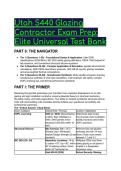
Utah S440 Glazing
Contractor Exam Prep:
Elite Universal Test Bank
PART 0: THE NAVIGATOR
● Tier 1 (Questions 1–28) - Foundational Syntax & Application: Utah DOPL
classifications (S230/S440), IBC 2024 safety glazing definitions, OSHA 1926 Subpart M
fall protection, and foundational structural silicone equations.
● Tier 2 (Questions 29–58) - Complex Application & Simulation: Applied structural bite
calculations, 2026 OSHA Heat Illness protocols, Utah HB 65 security glazing mandates,
and area-weighted thermal computations.
● Tier 3 (Questions 59–88) - Grandmaster Synthesis: Multi-variable scenarios requiring
simultaneous synthesis of wind load calculations, multi-employer site safety, complex
DOPL licensing law, and thermal performance standards.
PART I: THE PRIMER
Mastering this gauntlet guarantees your transition from a baseline tradesperson to an elite
glazing and sign installation contractor, ensuring absolute fluency in structural mechanics,
life-safety codes, and Utah jurisprudence. Your ability to instantly synthesize structural silicone
limits with strict building code mandates directly dictates your operational survivability and
professional supremacy.
The "Critical Axioms" Cheat Sheet:
Axiom Category Critical Rule / Formula Context / Application
DOPL Licensing S230 vs. S440: Glass/Glazing Determines legal scope.
is S230. Sign Installation is Out-of-scope work invalidates
S440. S440 permits minor liability insurance and invites
electrical (120V/20A within 10 DOPL sanctions.
feet).
Structural Silicone Bite Formula: Bite = (0.5 × Minimum bite and glueline
Shortest Leg × Windload) / thickness are both 1/4 inch
Sealant Design Strength (20 psi (6mm). Ratio must remain
standard). between 1:1 and 3:1.
IBC 2024 (Ch. 24) Hazardous Locations: >9 sq Multipane IGUs must have
ft, bottom <18", top >36", within safety glazing on all panes if
36" of walking surface. Doors: located in a designated
within 24" horizontal arc. hazardous zone.
Utah HB 65 (2026) School Security Glazing:
,Axiom Category Critical Rule / Formula Context / Application
Educational (K-12)
builds/remodels require ASTM
F3561 or UL752-23 glass from
floor to 6 feet.
OSHA Safety Fall & Heat: Fall protection Absolute hard-deck survival
strictly at 6 feet (Subpart M). limits for human physiology and
Heat illness protocols trigger at gravity.
80°F (shade/water) and 90°F
(buddy system/breaks).
PART II: THE ELITE TEST BANK
Tier 1 - Foundational Syntax & Application
Q1: An architectural firm specifies non-electrical exterior signs and decorative structural glass
elements for a commercial facade. Based on Utah DOPL administrative rules, which license
classification is strictly required to erect the signage elements? A) S240 Glass and Glazing
Contractor B) S230 Masonry, Siding, Stucco, Glass, and Rain Gutter Contractor C) S440 Sign
Installation Contractor D) B100 General Building Contractor
● The Answer: C (S440 Sign Installation Contractor)
● Distractor Analysis:
○ A is incorrect: The S240 classification is a legacy code consolidated into S230.
○ B is incorrect: S230 covers general glass and glazing but does not specifically
cover permitted sign installation graphics.
○ D is incorrect: A B100 is a general license; specialty sign erection explicitly falls
under S440.
The Mentor's Analysis: Specialty classifications define precise operational boundaries. When
erecting signs and graphic displays requiring permits, the S440 is the native classification.
Professional/Academic Intuition: Always align the specific structural output (signage) with
its exact statutory specialty code to avoid out-of-scope contracting violations.
Q2: An S440 contractor is installing an illuminated awning and needs to extend wiring 8 feet
from an existing 120-volt, 15-ampere outlet. Based on the 2025 HB 28 amendments to Utah
DOPL rules, which action is MOST ACCURATE? A) The contractor must subcontract an E200
General Electrical Contractor. B) The contractor may perform the work without an electrical
license. C) The contractor must obtain an S700 Limited Scope License. D) The contractor must
upgrade to an E201 Residential Electrical Contractor license.
● The Answer: B (The contractor may perform the work without an electrical license.)
● Distractor Analysis:
○ A is incorrect: Subcontracting is allowed but not strictly required for this specific
minor extension.
○ C is incorrect: S700 is for unclassified specialized scope, not defined incidental
electrical work.
○ D is incorrect: E201 is for residential wiring, inappropriate for commercial sign
installation.
The Mentor's Analysis: HB 28 redefines minor electrical work to permit S440 contractors to
extend wiring up to 10 feet from an existing 120V/20A disconnect. Professional/Academic
Intuition: Incidental minor electrical work within strict voltage and distance parameters
,does not require a dedicated electrical subcontractor.
Q3: Under the 2024 International Building Code (IBC) Chapter 24, glazing in an individual fixed
panel is universally considered a hazardous location requiring safety glazing if it meets all
specific criteria. Which of the following is NOT a required criterion for this designation? A) The
exposed area of the individual pane is greater than 9 square feet. B) The bottom edge of the
glazing is less than 18 inches above the walking surface. C) The top edge of the glazing is
greater than 36 inches above the walking surface. D) The pane is installed at a slope of exactly
15 degrees from the vertical.
● The Answer: D (The pane is installed at a slope of exactly 15 degrees from the vertical.)
● Distractor Analysis:
○ A is incorrect: Pane size over 9 square feet is a core condition for vertical
hazardous locations.
○ B is incorrect: A bottom edge below 18 inches is a core condition.
○ C is incorrect: A top edge above 36 inches is a core condition.
The Mentor's Analysis: Slope dictates sloped glazing codes, not the 4-part test for vertical
window hazardous locations. Professional/Academic Intuition: Memorize the 9-18-36-36 rule (9
sq ft, 18" bottom, 36" top, 36" proximity) for rapid hazardous location identification.
Q4: According to OSHA 1926 Subpart M, at what minimum height above a lower level must a
glazier be protected by a personal fall arrest system, guardrail, or safety net? A) 4 feet B) 6 feet
C) 10 feet D) 15 feet
● The Answer: B (6 feet)
● Distractor Analysis:
○ A is incorrect: 4 feet is the general industry standard (1910), not construction
(1926).
○ C is incorrect: 10 feet applies to scaffolds (Subpart L), not general unprotected
edges.
○ D is incorrect: 15 feet is a legacy threshold for steel erection connectors.
The Mentor's Analysis: Construction fall protection triggers universally at 6 feet.
Professional/Academic Intuition: Six feet is the absolute hard deck for construction fall
protection; zero tolerance exists for unprotected edges above this plane.
Q5: When designing a structural silicone glazing (SSG) system, the design strength of the
silicone sealant is universally standardized across the industry to ensure an adequate safety
factor. What is this standard sealant design strength? A) 10 psi B) 20 psi C) 50 psi D) 100 psi
● The Answer: B (20 psi)
● Distractor Analysis:
○ A is incorrect: 10 psi provides an insufficient safety factor against wind load.
○ C is incorrect: 50 psi overestimates dynamic sheer capacity, leading to dangerously
small joint designs.
○ D is incorrect: 100 psi is the ultimate tensile strength of some adhesives, not the
design strength with a 5:1 safety factor.
The Mentor's Analysis: While a sealant may hold 100 psi before tearing, engineering dictates a
minimum 5:1 safety factor. Professional/Academic Intuition: Always calculate structural bite
using 20 psi to absorb dynamic wind and thermal shear forces.
Q6: A specialty contractor applying for a Utah S440 or S230 license must successfully complete
a pre-licensure education program. What is the required duration of this program for specialty
contractors? A) 15 hours B) 25 hours C) 30 hours D) 40 hours
● The Answer: B (25 hours)
● Distractor Analysis:
, ○ A is incorrect: 15 hours is insufficient for any Utah construction license.
○ C is incorrect: 30 hours is required for General (B100, R100, E100) and master
plumbing/electrical licenses.
○ D is incorrect: 40 hours is a fabricated timeline.
The Mentor's Analysis: Utah differentiates general contractors (30 hours) from specialty trades
(25 hours). Professional/Academic Intuition: Specialty licensure streamlines statutory
training hours while maintaining strict business and law exam prerequisites.
Q7: According to ASTM C1184, Standard Specification for Structural Silicone Sealants, which
material is definitively prohibited for use as a primary structural support in SSG systems? A)
Two-component condensation-curing silicone B) High-modulus polyurethane sealant C)
Neutral-curing single-component silicone D) Extruded silicone profiles
● The Answer: B (High-modulus polyurethane sealant)
● Distractor Analysis:
○ A is incorrect: Two-component silicones are heavily utilized in factory SSG bonding.
○ C is incorrect: Neutral-cure silicones are standard for on-site SG applications.
○ D is incorrect: Pre-cured silicone profiles are acceptable weather seals.
The Mentor's Analysis: Only silicone possesses the innate UV resistance necessary to survive
decades of direct solar radiation through glass. Polyurethanes degrade rapidly under UV
exposure. Professional/Academic Intuition: If it structurally bonds glass to metal, it must be
silicone; no chemical substitutes survive the ultraviolet spectrum.
Q8: A homeowner refuses to pay an S230 glazing contractor due to a dispute. The contractor
attempts to access the Utah Residence Lien Recovery Fund. Based on 2026 administrative
updates, what is the MOST ACCURATE status of this fund? A) The fund pays out claims up to a
hard cap of $100,000 per residence. B) The fund is fully replenished annually by a mandatory
$50 special assessment on all contractors. C) Available funds are extremely limited or
unavailable, making new claim satisfaction highly unlikely. D) The fund acts as the primary
guarantor for all commercial and residential disputes.
● The Answer: C (Available funds are extremely limited or unavailable, making new claim
satisfaction highly unlikely.)
● Distractor Analysis:
○ A is incorrect: While caps exist, the fundamental issue is total fund depletion.
○ B is incorrect: Initial assessment fees and special assessments were abolished in
2018.
○ D is incorrect: The fund was strictly for qualifying residential homeowners, not
commercial.
The Mentor's Analysis: Legislative changes systematically defunded the mechanism. You
cannot rely on this fund for bad debt recovery. Professional/Academic Intuition: Secure your
capital via rigorous preliminary notices and direct mechanics liens; the state recovery
fund is effectively insolvent.
Q9: To calculate the overall U-factor of a fenestration assembly for prescriptive energy code
compliance, a designer must use which mathematical methodology? A) The lowest U-factor of
the center-of-glass. B) An unweighted arithmetic mean of the glass and frame. C) An
area-weighted average of the center-of-glass, edge-of-glass, and frame. D) The R-value
summation of the individual components inverted.
● The Answer: C (An area-weighted average of the center-of-glass, edge-of-glass, and
frame.)
● Distractor Analysis:
○ A is incorrect: Ignoring the frame highly skews the performance metric favorably but
Contractor Exam Prep:
Elite Universal Test Bank
PART 0: THE NAVIGATOR
● Tier 1 (Questions 1–28) - Foundational Syntax & Application: Utah DOPL
classifications (S230/S440), IBC 2024 safety glazing definitions, OSHA 1926 Subpart M
fall protection, and foundational structural silicone equations.
● Tier 2 (Questions 29–58) - Complex Application & Simulation: Applied structural bite
calculations, 2026 OSHA Heat Illness protocols, Utah HB 65 security glazing mandates,
and area-weighted thermal computations.
● Tier 3 (Questions 59–88) - Grandmaster Synthesis: Multi-variable scenarios requiring
simultaneous synthesis of wind load calculations, multi-employer site safety, complex
DOPL licensing law, and thermal performance standards.
PART I: THE PRIMER
Mastering this gauntlet guarantees your transition from a baseline tradesperson to an elite
glazing and sign installation contractor, ensuring absolute fluency in structural mechanics,
life-safety codes, and Utah jurisprudence. Your ability to instantly synthesize structural silicone
limits with strict building code mandates directly dictates your operational survivability and
professional supremacy.
The "Critical Axioms" Cheat Sheet:
Axiom Category Critical Rule / Formula Context / Application
DOPL Licensing S230 vs. S440: Glass/Glazing Determines legal scope.
is S230. Sign Installation is Out-of-scope work invalidates
S440. S440 permits minor liability insurance and invites
electrical (120V/20A within 10 DOPL sanctions.
feet).
Structural Silicone Bite Formula: Bite = (0.5 × Minimum bite and glueline
Shortest Leg × Windload) / thickness are both 1/4 inch
Sealant Design Strength (20 psi (6mm). Ratio must remain
standard). between 1:1 and 3:1.
IBC 2024 (Ch. 24) Hazardous Locations: >9 sq Multipane IGUs must have
ft, bottom <18", top >36", within safety glazing on all panes if
36" of walking surface. Doors: located in a designated
within 24" horizontal arc. hazardous zone.
Utah HB 65 (2026) School Security Glazing:
,Axiom Category Critical Rule / Formula Context / Application
Educational (K-12)
builds/remodels require ASTM
F3561 or UL752-23 glass from
floor to 6 feet.
OSHA Safety Fall & Heat: Fall protection Absolute hard-deck survival
strictly at 6 feet (Subpart M). limits for human physiology and
Heat illness protocols trigger at gravity.
80°F (shade/water) and 90°F
(buddy system/breaks).
PART II: THE ELITE TEST BANK
Tier 1 - Foundational Syntax & Application
Q1: An architectural firm specifies non-electrical exterior signs and decorative structural glass
elements for a commercial facade. Based on Utah DOPL administrative rules, which license
classification is strictly required to erect the signage elements? A) S240 Glass and Glazing
Contractor B) S230 Masonry, Siding, Stucco, Glass, and Rain Gutter Contractor C) S440 Sign
Installation Contractor D) B100 General Building Contractor
● The Answer: C (S440 Sign Installation Contractor)
● Distractor Analysis:
○ A is incorrect: The S240 classification is a legacy code consolidated into S230.
○ B is incorrect: S230 covers general glass and glazing but does not specifically
cover permitted sign installation graphics.
○ D is incorrect: A B100 is a general license; specialty sign erection explicitly falls
under S440.
The Mentor's Analysis: Specialty classifications define precise operational boundaries. When
erecting signs and graphic displays requiring permits, the S440 is the native classification.
Professional/Academic Intuition: Always align the specific structural output (signage) with
its exact statutory specialty code to avoid out-of-scope contracting violations.
Q2: An S440 contractor is installing an illuminated awning and needs to extend wiring 8 feet
from an existing 120-volt, 15-ampere outlet. Based on the 2025 HB 28 amendments to Utah
DOPL rules, which action is MOST ACCURATE? A) The contractor must subcontract an E200
General Electrical Contractor. B) The contractor may perform the work without an electrical
license. C) The contractor must obtain an S700 Limited Scope License. D) The contractor must
upgrade to an E201 Residential Electrical Contractor license.
● The Answer: B (The contractor may perform the work without an electrical license.)
● Distractor Analysis:
○ A is incorrect: Subcontracting is allowed but not strictly required for this specific
minor extension.
○ C is incorrect: S700 is for unclassified specialized scope, not defined incidental
electrical work.
○ D is incorrect: E201 is for residential wiring, inappropriate for commercial sign
installation.
The Mentor's Analysis: HB 28 redefines minor electrical work to permit S440 contractors to
extend wiring up to 10 feet from an existing 120V/20A disconnect. Professional/Academic
Intuition: Incidental minor electrical work within strict voltage and distance parameters
,does not require a dedicated electrical subcontractor.
Q3: Under the 2024 International Building Code (IBC) Chapter 24, glazing in an individual fixed
panel is universally considered a hazardous location requiring safety glazing if it meets all
specific criteria. Which of the following is NOT a required criterion for this designation? A) The
exposed area of the individual pane is greater than 9 square feet. B) The bottom edge of the
glazing is less than 18 inches above the walking surface. C) The top edge of the glazing is
greater than 36 inches above the walking surface. D) The pane is installed at a slope of exactly
15 degrees from the vertical.
● The Answer: D (The pane is installed at a slope of exactly 15 degrees from the vertical.)
● Distractor Analysis:
○ A is incorrect: Pane size over 9 square feet is a core condition for vertical
hazardous locations.
○ B is incorrect: A bottom edge below 18 inches is a core condition.
○ C is incorrect: A top edge above 36 inches is a core condition.
The Mentor's Analysis: Slope dictates sloped glazing codes, not the 4-part test for vertical
window hazardous locations. Professional/Academic Intuition: Memorize the 9-18-36-36 rule (9
sq ft, 18" bottom, 36" top, 36" proximity) for rapid hazardous location identification.
Q4: According to OSHA 1926 Subpart M, at what minimum height above a lower level must a
glazier be protected by a personal fall arrest system, guardrail, or safety net? A) 4 feet B) 6 feet
C) 10 feet D) 15 feet
● The Answer: B (6 feet)
● Distractor Analysis:
○ A is incorrect: 4 feet is the general industry standard (1910), not construction
(1926).
○ C is incorrect: 10 feet applies to scaffolds (Subpart L), not general unprotected
edges.
○ D is incorrect: 15 feet is a legacy threshold for steel erection connectors.
The Mentor's Analysis: Construction fall protection triggers universally at 6 feet.
Professional/Academic Intuition: Six feet is the absolute hard deck for construction fall
protection; zero tolerance exists for unprotected edges above this plane.
Q5: When designing a structural silicone glazing (SSG) system, the design strength of the
silicone sealant is universally standardized across the industry to ensure an adequate safety
factor. What is this standard sealant design strength? A) 10 psi B) 20 psi C) 50 psi D) 100 psi
● The Answer: B (20 psi)
● Distractor Analysis:
○ A is incorrect: 10 psi provides an insufficient safety factor against wind load.
○ C is incorrect: 50 psi overestimates dynamic sheer capacity, leading to dangerously
small joint designs.
○ D is incorrect: 100 psi is the ultimate tensile strength of some adhesives, not the
design strength with a 5:1 safety factor.
The Mentor's Analysis: While a sealant may hold 100 psi before tearing, engineering dictates a
minimum 5:1 safety factor. Professional/Academic Intuition: Always calculate structural bite
using 20 psi to absorb dynamic wind and thermal shear forces.
Q6: A specialty contractor applying for a Utah S440 or S230 license must successfully complete
a pre-licensure education program. What is the required duration of this program for specialty
contractors? A) 15 hours B) 25 hours C) 30 hours D) 40 hours
● The Answer: B (25 hours)
● Distractor Analysis:
, ○ A is incorrect: 15 hours is insufficient for any Utah construction license.
○ C is incorrect: 30 hours is required for General (B100, R100, E100) and master
plumbing/electrical licenses.
○ D is incorrect: 40 hours is a fabricated timeline.
The Mentor's Analysis: Utah differentiates general contractors (30 hours) from specialty trades
(25 hours). Professional/Academic Intuition: Specialty licensure streamlines statutory
training hours while maintaining strict business and law exam prerequisites.
Q7: According to ASTM C1184, Standard Specification for Structural Silicone Sealants, which
material is definitively prohibited for use as a primary structural support in SSG systems? A)
Two-component condensation-curing silicone B) High-modulus polyurethane sealant C)
Neutral-curing single-component silicone D) Extruded silicone profiles
● The Answer: B (High-modulus polyurethane sealant)
● Distractor Analysis:
○ A is incorrect: Two-component silicones are heavily utilized in factory SSG bonding.
○ C is incorrect: Neutral-cure silicones are standard for on-site SG applications.
○ D is incorrect: Pre-cured silicone profiles are acceptable weather seals.
The Mentor's Analysis: Only silicone possesses the innate UV resistance necessary to survive
decades of direct solar radiation through glass. Polyurethanes degrade rapidly under UV
exposure. Professional/Academic Intuition: If it structurally bonds glass to metal, it must be
silicone; no chemical substitutes survive the ultraviolet spectrum.
Q8: A homeowner refuses to pay an S230 glazing contractor due to a dispute. The contractor
attempts to access the Utah Residence Lien Recovery Fund. Based on 2026 administrative
updates, what is the MOST ACCURATE status of this fund? A) The fund pays out claims up to a
hard cap of $100,000 per residence. B) The fund is fully replenished annually by a mandatory
$50 special assessment on all contractors. C) Available funds are extremely limited or
unavailable, making new claim satisfaction highly unlikely. D) The fund acts as the primary
guarantor for all commercial and residential disputes.
● The Answer: C (Available funds are extremely limited or unavailable, making new claim
satisfaction highly unlikely.)
● Distractor Analysis:
○ A is incorrect: While caps exist, the fundamental issue is total fund depletion.
○ B is incorrect: Initial assessment fees and special assessments were abolished in
2018.
○ D is incorrect: The fund was strictly for qualifying residential homeowners, not
commercial.
The Mentor's Analysis: Legislative changes systematically defunded the mechanism. You
cannot rely on this fund for bad debt recovery. Professional/Academic Intuition: Secure your
capital via rigorous preliminary notices and direct mechanics liens; the state recovery
fund is effectively insolvent.
Q9: To calculate the overall U-factor of a fenestration assembly for prescriptive energy code
compliance, a designer must use which mathematical methodology? A) The lowest U-factor of
the center-of-glass. B) An unweighted arithmetic mean of the glass and frame. C) An
area-weighted average of the center-of-glass, edge-of-glass, and frame. D) The R-value
summation of the individual components inverted.
● The Answer: C (An area-weighted average of the center-of-glass, edge-of-glass, and
frame.)
● Distractor Analysis:
○ A is incorrect: Ignoring the frame highly skews the performance metric favorably but


