

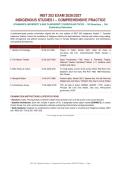
INST 203 EXAM 2026/2027
INDIGENOUS STUDIES I – COMPREHENSIVE PRACTICE
ATHABASCA UNIVERSITY & MULTI-UNIVERSITY CURRICULAR FOCUS • 100 Questions • Full
Explanatory Rationales
A publication-grade practice examination aligned with the core syllabus of INST 203 (Indigenous Studies I / Canadian
Indigenous Studies). Covers the foundations of Indigenous identity and legal definitions, historical and modern treaty-making,
Métis ethnogenesis and political resistance, Supreme Court of Canada Aboriginal rights jurisprudence, and contemporary
socio-political developments.
Curricular Domain Questions Core Subject Matter & Legal/Historical Competencies
1. Identity & Terminology 20 Qs (Q1–Q20) Origins of 'Indian', Section 35(2), Indian Act status vs
non-status, Bill C-31, enfranchisement, Michif, Daniels v.
Canada
2. First Nations Treaties 25 Qs (Q21–Q45) Royal Proclamation 1763, Peace & Friendship Treaties,
Robinson Treaties, Numbered Treaties 1–11, medicine chest,
modern land claims
3. Métis History & Culture 25 Qs (Q46–Q70) Fur trade origins, women of the country, Michif, Red River carts,
beadwork, bison hunt laws, Red River 1869, 1885 Resistance,
Riel, Powley
4. Aboriginal Rights 15 Qs (Q71–Q85) Inherent rights, Section 35(1), Sparrow test, Van der Peet test,
Delgamuukw oral history, Tsilhqot'in title, duty to consult (Haida)
5. Contemporary Issues 15 Qs (Q86–Q100) TRC 94 Calls to Action, MMIWG, UNDRIP / FPIC, Jordan's
Principle, Bill C-92 child welfare, Oka crisis, Wet'suwet'en
governance, OCAP
EXAMINATION INSTRUCTIONS & SPECIFICATIONS
• Structure: Exactly 100 sequentially numbered multiple-choice questions (Q1 to Q100) across 5 core course domains.
• Question Architecture: Each item includes 4 options (A–D), a designated correct option marked [CORRECT], an explicit
Correct Answer line, and a concise explanatory rationale synthesizing historical facts and legal precedents.
• Study Guidance: Designed for comprehensive midterm and final exam review in university-level Indigenous Studies (INST
203 / INDG 201 / POLS 203 / HIST 203).
Turn the page to begin the examination.
INST 203: Indigenous Studies I – Comprehensive Examination (2026/2027 Edition) | Page 1
,Section 1: Identity & Terminology – Origins of 'Indian,' 'Métis,' 'Indigenous,' Social,
Political & Psychological Implications (20 questions)
Origins of 'Indian' from Columbus, Section 35(2) recognition of First Nations, Inuit, and Métis, legal status vs. non-status under
the Indian Act, Bill C-31 (1985), enfranchisement, Michif language, blood quantum vs. kinship, lateral violence, potlatch ban,
and Daniels v. Canada (2016).
Q1: What is the historical origin of the term 'Indian' as applied to the Indigenous peoples of the Americas?
A. It originated from Christopher Columbus's mistaken geographical belief that he had reached the East Indies (India)
in 1492 [CORRECT]
B. It was an indigenous translation of 'children of the earth'
C. It was coined by British Parliament in the British North America Act of 1867
D. It was a term created by French fur traders to describe inland hunting nations
Correct Answer: A
Rationale: The term 'Indian' arose from Christopher Columbus's erroneous navigational assumption in 1492 that he had reached
the subcontinent of India or the East Indies.
Q2: Which three distinct groups of Indigenous peoples are explicitly recognized under Section 35(2) of the
Canadian Constitution Act, 1982?
A. First Nations, Acadians, and Innu
B. Indians (First Nations), Inuit, and Métis [CORRECT]
C. Status Indians, Non-Status Indians, and Treatied Nations
D. Cree, Ojibwe, and Haida
Correct Answer: B
Rationale: Section 35(2) of the Constitution Act, 1982 defines 'Aboriginal peoples of Canada' as including the Indian (First
Nations), Inuit, and Métis peoples.
Q3: In Indigenous studies, how is 'identity' most comprehensively conceptualized from sociological and
psychological perspectives?
A. Exclusively as a biological blood percentage determined by genetic lineage
B. Solely as a legal registration status granted by the federal department of Indigenous affairs
C. As an integrated synthesis of social roles, personal traits, self-images, cultural practices, and relational kinship
within a community [CORRECT]
D. As an unchanging set of archaeological artifacts preserved in national museums
Correct Answer: C
Rationale: Identity encompasses self-concept, social roles, personal traits, cultural attachment, and kinship ties within a
community, extending far beyond narrow legal or biological categories.
Q4: Under the Canadian Indian Act (1876), what constitutes the legal distinction between a 'Status Indian' and a
'Non-Status Indian'?
A. Status Indians speak their ancestral language fluently, whereas Non-Status Indians do not
B. Status Indians live exclusively north of the 60th parallel, whereas Non-Status Indians reside in southern urban centers
C. Status Indians hold Canadian citizenship, while Non-Status Indians do not
D. Status Indians are registered under the federal Indian Register and entitled to specific legal rights under the Indian
Act, whereas Non-Status Indians lack federal registration [CORRECT]
Correct Answer: D
Rationale: Status (Registered) Indians are officially recognized and recorded on the Indian Register maintained by the federal
government under the Indian Act, granting specific statutory provisions.
Q5: Prior to the passage of Bill C-31 in 1985, what was the primary mechanism under Section 12(1)(b) of the Indian
Act that caused thousands of First Nations women to lose their Indian status?
A. Marrying a non-Indian man (or a non-status man) [CORRECT]
INST 203: Indigenous Studies I – Comprehensive Examination (2026/2027 Edition) | Page 2
, B. Graduating from a Canadian secondary school
C. Voting in a provincial or federal election
D. Residing off-reserve for more than twelve consecutive months
Correct Answer: A
Rationale: Section 12(1)(b) enforced patrilineal gender discrimination by stripping First Nations women and their descendants of
their legal status and band membership upon marrying a non-status man.
Q6: What significant legislative change was introduced by Bill C-31 in 1985 regarding Indian Act registration?
A. It abolished all Indian reserves and band councils across Canada
B. It reinstated Indian status to women and individuals who had lost it through discriminatory provisions and created
Section 6(1) and 6(2) registration categories [CORRECT]
C. It transferred all natural resource rights exclusively to provincial governments
D. It mandated that all Indigenous peoples adopt English as their primary language
Correct Answer: B
Rationale: Bill C-31 amended the Indian Act to remove sex-based discrimination, reinstate status to affected women and children,
and establish Section 6(1) and 6(2) rules (the 'second-generation cut-off').
Q7: What is the meaning and linguistic origin of the word 'Inuit' in the Inuktitut language?
A. The Hunters of the Arctic
B. The Eaters of Raw Meat
C. 'The People' (singular: Inuk) [CORRECT]
D. The Dwellers of the Tundra
Correct Answer: C
Rationale: In Inuktitut, 'Inuit' translates directly to 'the people' (the singular form is 'Inuk'), replacing the historical derogatory
exonym 'Eskimo.'
Q8: How does the concept of 'Enfranchisement' historically function within Canadian colonial administration prior
to its abolition in 1985?
A. A policy that granted full treaty land title to Indigenous nations
B. A federal program that funded traditional ceremonial gatherings and potlatches
C. A bilateral treaty process establishing autonomous Indigenous provincial governments
D. A legal process whereby First Nations individuals gave up (voluntarily or involuntarily) their Indian status and
treaty rights to obtain full Canadian citizenship and civil rights [CORRECT]
Correct Answer: D
Rationale: Enfranchisement was an assimilationist policy under the Indian Act where Indigenous individuals surrendered their
legal status and treaty rights in exchange for the right to vote, own private property, or practice professions.
Q9: Which historical event or profession could trigger compulsory (involuntary) enfranchisement of a First Nations
person under the Indian Act prior to the mid-20th century?
A. Earning a university degree, becoming a Christian minister, or becoming a licensed lawyer [CORRECT]
B. Participating in traditional bison hunting or fur trapping
C. Remaining on an Indian reserve throughout winter
D. Constructing a traditional birchbark canoe
Correct Answer: A
Rationale: Under early versions of the Indian Act, obtaining a university degree or entering the legal or religious professions
resulted in automatic, compulsory loss of Indian status to enforce assimilation.
Q10: What is the term used to describe the distinct cultural, linguistic, and political ethnogenesis of the Métis Nation
in Canada?
A. A recent urban migration phenomenon of non-Indigenous people adopting Indigenous arts
INST 203: Indigenous Studies I – Comprehensive Examination (2026/2027 Edition) | Page 3
INDIGENOUS STUDIES I – COMPREHENSIVE PRACTICE
ATHABASCA UNIVERSITY & MULTI-UNIVERSITY CURRICULAR FOCUS • 100 Questions • Full
Explanatory Rationales
A publication-grade practice examination aligned with the core syllabus of INST 203 (Indigenous Studies I / Canadian
Indigenous Studies). Covers the foundations of Indigenous identity and legal definitions, historical and modern treaty-making,
Métis ethnogenesis and political resistance, Supreme Court of Canada Aboriginal rights jurisprudence, and contemporary
socio-political developments.
Curricular Domain Questions Core Subject Matter & Legal/Historical Competencies
1. Identity & Terminology 20 Qs (Q1–Q20) Origins of 'Indian', Section 35(2), Indian Act status vs
non-status, Bill C-31, enfranchisement, Michif, Daniels v.
Canada
2. First Nations Treaties 25 Qs (Q21–Q45) Royal Proclamation 1763, Peace & Friendship Treaties,
Robinson Treaties, Numbered Treaties 1–11, medicine chest,
modern land claims
3. Métis History & Culture 25 Qs (Q46–Q70) Fur trade origins, women of the country, Michif, Red River carts,
beadwork, bison hunt laws, Red River 1869, 1885 Resistance,
Riel, Powley
4. Aboriginal Rights 15 Qs (Q71–Q85) Inherent rights, Section 35(1), Sparrow test, Van der Peet test,
Delgamuukw oral history, Tsilhqot'in title, duty to consult (Haida)
5. Contemporary Issues 15 Qs (Q86–Q100) TRC 94 Calls to Action, MMIWG, UNDRIP / FPIC, Jordan's
Principle, Bill C-92 child welfare, Oka crisis, Wet'suwet'en
governance, OCAP
EXAMINATION INSTRUCTIONS & SPECIFICATIONS
• Structure: Exactly 100 sequentially numbered multiple-choice questions (Q1 to Q100) across 5 core course domains.
• Question Architecture: Each item includes 4 options (A–D), a designated correct option marked [CORRECT], an explicit
Correct Answer line, and a concise explanatory rationale synthesizing historical facts and legal precedents.
• Study Guidance: Designed for comprehensive midterm and final exam review in university-level Indigenous Studies (INST
203 / INDG 201 / POLS 203 / HIST 203).
Turn the page to begin the examination.
INST 203: Indigenous Studies I – Comprehensive Examination (2026/2027 Edition) | Page 1
,Section 1: Identity & Terminology – Origins of 'Indian,' 'Métis,' 'Indigenous,' Social,
Political & Psychological Implications (20 questions)
Origins of 'Indian' from Columbus, Section 35(2) recognition of First Nations, Inuit, and Métis, legal status vs. non-status under
the Indian Act, Bill C-31 (1985), enfranchisement, Michif language, blood quantum vs. kinship, lateral violence, potlatch ban,
and Daniels v. Canada (2016).
Q1: What is the historical origin of the term 'Indian' as applied to the Indigenous peoples of the Americas?
A. It originated from Christopher Columbus's mistaken geographical belief that he had reached the East Indies (India)
in 1492 [CORRECT]
B. It was an indigenous translation of 'children of the earth'
C. It was coined by British Parliament in the British North America Act of 1867
D. It was a term created by French fur traders to describe inland hunting nations
Correct Answer: A
Rationale: The term 'Indian' arose from Christopher Columbus's erroneous navigational assumption in 1492 that he had reached
the subcontinent of India or the East Indies.
Q2: Which three distinct groups of Indigenous peoples are explicitly recognized under Section 35(2) of the
Canadian Constitution Act, 1982?
A. First Nations, Acadians, and Innu
B. Indians (First Nations), Inuit, and Métis [CORRECT]
C. Status Indians, Non-Status Indians, and Treatied Nations
D. Cree, Ojibwe, and Haida
Correct Answer: B
Rationale: Section 35(2) of the Constitution Act, 1982 defines 'Aboriginal peoples of Canada' as including the Indian (First
Nations), Inuit, and Métis peoples.
Q3: In Indigenous studies, how is 'identity' most comprehensively conceptualized from sociological and
psychological perspectives?
A. Exclusively as a biological blood percentage determined by genetic lineage
B. Solely as a legal registration status granted by the federal department of Indigenous affairs
C. As an integrated synthesis of social roles, personal traits, self-images, cultural practices, and relational kinship
within a community [CORRECT]
D. As an unchanging set of archaeological artifacts preserved in national museums
Correct Answer: C
Rationale: Identity encompasses self-concept, social roles, personal traits, cultural attachment, and kinship ties within a
community, extending far beyond narrow legal or biological categories.
Q4: Under the Canadian Indian Act (1876), what constitutes the legal distinction between a 'Status Indian' and a
'Non-Status Indian'?
A. Status Indians speak their ancestral language fluently, whereas Non-Status Indians do not
B. Status Indians live exclusively north of the 60th parallel, whereas Non-Status Indians reside in southern urban centers
C. Status Indians hold Canadian citizenship, while Non-Status Indians do not
D. Status Indians are registered under the federal Indian Register and entitled to specific legal rights under the Indian
Act, whereas Non-Status Indians lack federal registration [CORRECT]
Correct Answer: D
Rationale: Status (Registered) Indians are officially recognized and recorded on the Indian Register maintained by the federal
government under the Indian Act, granting specific statutory provisions.
Q5: Prior to the passage of Bill C-31 in 1985, what was the primary mechanism under Section 12(1)(b) of the Indian
Act that caused thousands of First Nations women to lose their Indian status?
A. Marrying a non-Indian man (or a non-status man) [CORRECT]
INST 203: Indigenous Studies I – Comprehensive Examination (2026/2027 Edition) | Page 2
, B. Graduating from a Canadian secondary school
C. Voting in a provincial or federal election
D. Residing off-reserve for more than twelve consecutive months
Correct Answer: A
Rationale: Section 12(1)(b) enforced patrilineal gender discrimination by stripping First Nations women and their descendants of
their legal status and band membership upon marrying a non-status man.
Q6: What significant legislative change was introduced by Bill C-31 in 1985 regarding Indian Act registration?
A. It abolished all Indian reserves and band councils across Canada
B. It reinstated Indian status to women and individuals who had lost it through discriminatory provisions and created
Section 6(1) and 6(2) registration categories [CORRECT]
C. It transferred all natural resource rights exclusively to provincial governments
D. It mandated that all Indigenous peoples adopt English as their primary language
Correct Answer: B
Rationale: Bill C-31 amended the Indian Act to remove sex-based discrimination, reinstate status to affected women and children,
and establish Section 6(1) and 6(2) rules (the 'second-generation cut-off').
Q7: What is the meaning and linguistic origin of the word 'Inuit' in the Inuktitut language?
A. The Hunters of the Arctic
B. The Eaters of Raw Meat
C. 'The People' (singular: Inuk) [CORRECT]
D. The Dwellers of the Tundra
Correct Answer: C
Rationale: In Inuktitut, 'Inuit' translates directly to 'the people' (the singular form is 'Inuk'), replacing the historical derogatory
exonym 'Eskimo.'
Q8: How does the concept of 'Enfranchisement' historically function within Canadian colonial administration prior
to its abolition in 1985?
A. A policy that granted full treaty land title to Indigenous nations
B. A federal program that funded traditional ceremonial gatherings and potlatches
C. A bilateral treaty process establishing autonomous Indigenous provincial governments
D. A legal process whereby First Nations individuals gave up (voluntarily or involuntarily) their Indian status and
treaty rights to obtain full Canadian citizenship and civil rights [CORRECT]
Correct Answer: D
Rationale: Enfranchisement was an assimilationist policy under the Indian Act where Indigenous individuals surrendered their
legal status and treaty rights in exchange for the right to vote, own private property, or practice professions.
Q9: Which historical event or profession could trigger compulsory (involuntary) enfranchisement of a First Nations
person under the Indian Act prior to the mid-20th century?
A. Earning a university degree, becoming a Christian minister, or becoming a licensed lawyer [CORRECT]
B. Participating in traditional bison hunting or fur trapping
C. Remaining on an Indian reserve throughout winter
D. Constructing a traditional birchbark canoe
Correct Answer: A
Rationale: Under early versions of the Indian Act, obtaining a university degree or entering the legal or religious professions
resulted in automatic, compulsory loss of Indian status to enforce assimilation.
Q10: What is the term used to describe the distinct cultural, linguistic, and political ethnogenesis of the Métis Nation
in Canada?
A. A recent urban migration phenomenon of non-Indigenous people adopting Indigenous arts
INST 203: Indigenous Studies I – Comprehensive Examination (2026/2027 Edition) | Page 3


