

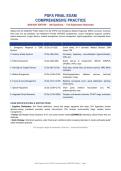
PSFA FINAL EXAM
COMPREHENSIVE PRACTICE
2026/2027 EDITION • 200 Questions • Full Explanatory Rationales
Aligned with the 2026/2027 Public Safety First Aid (PSFA) and Emergency Medical Responder (EMR) curriculum, American
Red Cross first aid standards, and Healthcare Provider CPR/AED competencies. Covers emergency response, anatomy,
patient assessment, oxygen delivery, medical emergencies, trauma management, special populations, and integrated scene
scenarios.
Domain Section Questions Core Competency Focus
1. Emergency Response & EMS 25 Qs (Q1–Q25) Scene safety, 9-1-1 activation, Medical Direction, EMR
Systems scope, PPE
2. Anatomy & Body Systems 20 Qs (Q26–Q45) Circulatory, respiratory, musculoskeletal (ligament/tendon),
CNS, skin
3. Patient Assessment 35 Qs (Q46–Q80) Scene size-up (4 components), ABCCS, SAMPLE,
OPQRST, AVPU, vitals
4. Vital Signs & Oxygen Delivery 25 Qs (Q81–Q105) Pulse sites, normal vitals, O2 devices (cannula, NRB, BVM),
OPA/NPA
5. Medical Emergencies 25 Qs (Q106–Q130) Shock/hypoperfusion, diabetes, seizures, heat/cold,
anaphylaxis, drugs
6. Trauma & Injury Management 25 Qs (Q131–Q155) Bleeding, tourniquets, burns, spinal stabilization, splinting,
chest trauma
7. Special Populations 20 Qs (Q156–Q175) Infant pulse, newborn resuscitation (3:1), PAT,
pediatric/geriatric care
8. Integrated Clinical Scenarios 25 Qs (Q176–Q200) Complex multi-domain scenarios, START triage, extrication,
resuscitation
EXAM SPECIFICATIONS & INSTRUCTIONS
• Cognitive Distribution: 30% Recall (definitions, normal vital ranges, equipment flow rates), 50% Application (clinical
decision-making, procedural execution, priority interventions), 20% Analysis (multi-casualty triage, complex trauma
management).
• Format: 200 Multiple-Choice Questions (A–D, one correct answer marked [CORRECT]) followed by official Answer Key and
Rationale.
• Study Strategy: Attempt all questions under timed exam conditions before reviewing rationales to master prehospital public
safety emergency protocols.
Turn the page to begin the examination. Good luck — execute with excellence.
Public Safety First Aid (PSFA) Final Examination (2026/2027 Edition) | Page 1
,Section 1: Emergency Response & EMS Systems – Scene Safety, EMS Activation,
Medical Direction, EMR Scope (25 questions)
Scene safety, activating EMS via 9-1-1, Medical Director oversight, online vs. offline medical control, EMR/PSFA scope of
practice, PPE standard precautions, consent, abandonment, and HazMat/downed wire protocols.
Q1: What is the single most crucial action a first responder must take immediately after recognizing an emergency
scene?
A. Activate the EMS system by dialing 9-1-1 or dispatching emergency units [CORRECT]
B. Begin a full secondary head-to-toe physical assessment
C. Collect the patient's insurance and billing information
D. Administer oral medication from a personal first aid kit
Correct Answer: A
Rationale: Activating the EMS system immediately ensures that advanced life support and transport resources are en route;
detailed examinations or paperwork must never delay calling 9-1-1.
Q2: In the EMS system, who provides ultimate medical oversight and authorization for the care protocols performed
by first responders?
A. The local police chief or watch commander
B. The Medical Director (a licensed physician) [CORRECT]
C. The hospital triage nurse
D. The city council safety committee
Correct Answer: B
Rationale: Medical oversight and clinical protocols for prehospital providers are established and authorized by the EMS Medical
Director, a licensed physician.
Q3: What defines an Emergency Medical Responder (EMR) / Public Safety First Aid provider in the EMS chain of
survival?
A. The hospital physician who performs emergency surgery
B. The dispatcher who answers incoming emergency telephone calls
C. The first medically trained individual to arrive on scene and provide immediate, life-saving care [CORRECT]
D. The physical therapist who provides long-term rehabilitation
Correct Answer: C
Rationale: An EMR/PSFA provider is the first person on scene trained to initiate basic life support, airway management, bleeding
control, and CPR/AED before higher-level EMS arrives.
Q4: Why is ensuring personal and scene safety the absolute first priority for any emergency responder upon
arrival?
A. To allow bystanders to take photographs uninterrupted
B. To complete administrative incident logbooks prior to patient contact
C. To determine if the patient has valid identification
D. To prevent the responder from becoming an additional casualty, ensuring they can safely help others [CORRECT]
Correct Answer: D
Rationale: Responder safety is paramount; an injured or incapacitated responder cannot provide aid and diverts vital emergency
resources away from the patient.
Q5: Upon arriving at a motor vehicle collision, an emergency responder observes downed electrical power lines
resting across a vehicle with an occupant inside. What is the correct action?
A. Assume the wires are energized, establish a wide safety perimeter, keep the crowd back, instruct the occupant to
stay inside, and notify the power company immediately [CORRECT]
B. Touch the vehicle with a gloved hand to test if the wire is live
Public Safety First Aid (PSFA) Final Examination (2026/2027 Edition) | Page 2
, C. Use a wooden broom handle to lift the electrical wires off the vehicle roof
D. Immediately pull the occupant out of the vehicle through the window
Correct Answer: A
Rationale: All downed power lines must be treated as energized; responders must keep a safe distance, tell occupants to remain
inside the vehicle (unless active fire threatens life), and wait for the utility company to de-energize the lines.
Q6: When an emergency responder communicates directly via two-way radio or telephone with an emergency
physician to obtain orders for specific patient care, this is known as:
A. Offline (indirect) medical direction
B. Online (direct) medical direction [CORRECT]
C. Standing orders protocol
D. Independent provider authorization
Correct Answer: B
Rationale: Online (direct) medical direction involves real-time voice communication with a physician for specific care guidance;
offline (indirect) medical direction refers to pre-established written protocols and standing orders.
Q7: Which of the following interventions falls within the standard Public Safety First Aid (PSFA) / EMR scope of
practice?
A. Performing endotracheal surgical cricothyrotomy
B. Administering intravenous cardiac antiarrhythmic medications
C. Patient assessment, manual splinting, supplemental oxygen delivery, and basic airway adjuncts (OPA/NPA)
[CORRECT]
D. Performing needle thoracostomy for tension pneumothorax
Correct Answer: C
Rationale: PSFA/EMR scope includes basic patient assessment, manual cervical stabilization, hemorrhage control, splinting,
CPR/AED, supplemental oxygen, and basic airway adjuncts; invasive surgical or IV interventions are beyond this scope.
Q8: Which set of equipment represents standard Personal Protective Equipment (PPE) utilized to prevent
bloodborne and airborne pathogen transmission?
A. Leather work boots and a reflective traffic vest only
B. A stethoscope and a blood pressure cuff
C. Cotton gardening gloves and a cloth baseball cap
D. Medical exam gloves, eye protection/glasses, protective gowns, and pocket masks/HEPA face barriers [CORRECT]
Correct Answer: D
Rationale: Standard PPE includes disposable nitrile/latex gloves, eye protection, fluid-resistant gowns, and barrier masks to
protect against bloodborne and airborne infectious materials.
Q9: An unconscious adult patient found lying on a sidewalk requires immediate emergency care. Under which legal
doctrine is the responder authorized to treat this patient without verbal consent?
A. Implied consent [CORRECT]
B. Expressed consent
C. Informed refusal
D. Power of attorney
Correct Answer: A
Rationale: Under implied consent, the law assumes that an unconscious, incapacitated, or critically ill individual who cannot
communicate would consent to life-saving emergency medical care.
Q10: A competent, fully alert, and oriented 35-year-old patient with a minor arm laceration refuses medical
treatment. What is the legally required response?
A. Physically restrain the patient and force them to accept treatment
Public Safety First Aid (PSFA) Final Examination (2026/2027 Edition) | Page 3
, B. Respect the patient's right of refusal, explain the potential risks of refusing care, advise them to seek medical
attention if symptoms worsen, and thoroughly document the refusal with a signed form [CORRECT]
C. Threaten the patient with legal penalties unless they accept an ambulance ride
D. Administer medical care covertly without the patient noticing
Correct Answer: B
Rationale: Mentally competent adults have the legal right to refuse medical care; responders must inform them of risks, encourage
care, and thoroughly document the refusal.
Q11: Leaving an emergency patient without their consent and without transferring care to equally or more qualified
medical personnel is legally defined as:
A. Battery
B. Assault
C. Abandonment [CORRECT]
D. Duty to act
Correct Answer: C
Rationale: Abandonment occurs when an emergency responder discontinues patient care before transferring responsibility to
medical personnel of equal or higher training.
Q12: What legal concept establishes a contractual or occupational obligation for an on-duty emergency responder
to provide care to a patient in need?
A. Good Samaritan protection
B. Proximate cause
C. Res ipsa loquitur
D. Duty to act [CORRECT]
Correct Answer: D
Rationale: Duty to act is the legal obligation of an on-duty public safety responder or healthcare provider to respond to an
emergency and provide care within their scope of practice.
Q13: Under the Health Insurance Portability and Accountability Act (HIPAA), when is it permissible for an
emergency responder to share confidential patient medical information?
A. Only with other healthcare professionals directly involved in the patient's continuing care, for billing/operations, or
as required by law [CORRECT]
B. When posting details of an interesting incident on social media without names
C. With curious neighbors and bystanders at the scene
D. With local news reporters seeking a story
Correct Answer: A
Rationale: HIPAA mandates strict confidentiality; patient information may only be disclosed to providers directly involved in the
patient's immediate medical care, designated reporting entities, or legal court orders.
Q14: What is the primary objective of Critical Incident Stress Management (CISM) and debriefing following a
traumatic mass-casualty incident?
A. Assigning blame to responders for operational errors
B. Helping emergency personnel process acute stress reactions, reduce burnout, and prevent Post-Traumatic Stress
Disorder (PTSD) [CORRECT]
C. Calculating the financial cost of consumed medical supplies
D. Replacing all on-duty personnel permanently
Correct Answer: B
Rationale: CISM and debriefings provide structured psychological support to help emergency responders process critical incident
stress and prevent long-term trauma complications.
Q15: What is the single most effective standard precaution measure to reduce the spread of infectious disease
between patients and healthcare providers?
Public Safety First Aid (PSFA) Final Examination (2026/2027 Edition) | Page 4
COMPREHENSIVE PRACTICE
2026/2027 EDITION • 200 Questions • Full Explanatory Rationales
Aligned with the 2026/2027 Public Safety First Aid (PSFA) and Emergency Medical Responder (EMR) curriculum, American
Red Cross first aid standards, and Healthcare Provider CPR/AED competencies. Covers emergency response, anatomy,
patient assessment, oxygen delivery, medical emergencies, trauma management, special populations, and integrated scene
scenarios.
Domain Section Questions Core Competency Focus
1. Emergency Response & EMS 25 Qs (Q1–Q25) Scene safety, 9-1-1 activation, Medical Direction, EMR
Systems scope, PPE
2. Anatomy & Body Systems 20 Qs (Q26–Q45) Circulatory, respiratory, musculoskeletal (ligament/tendon),
CNS, skin
3. Patient Assessment 35 Qs (Q46–Q80) Scene size-up (4 components), ABCCS, SAMPLE,
OPQRST, AVPU, vitals
4. Vital Signs & Oxygen Delivery 25 Qs (Q81–Q105) Pulse sites, normal vitals, O2 devices (cannula, NRB, BVM),
OPA/NPA
5. Medical Emergencies 25 Qs (Q106–Q130) Shock/hypoperfusion, diabetes, seizures, heat/cold,
anaphylaxis, drugs
6. Trauma & Injury Management 25 Qs (Q131–Q155) Bleeding, tourniquets, burns, spinal stabilization, splinting,
chest trauma
7. Special Populations 20 Qs (Q156–Q175) Infant pulse, newborn resuscitation (3:1), PAT,
pediatric/geriatric care
8. Integrated Clinical Scenarios 25 Qs (Q176–Q200) Complex multi-domain scenarios, START triage, extrication,
resuscitation
EXAM SPECIFICATIONS & INSTRUCTIONS
• Cognitive Distribution: 30% Recall (definitions, normal vital ranges, equipment flow rates), 50% Application (clinical
decision-making, procedural execution, priority interventions), 20% Analysis (multi-casualty triage, complex trauma
management).
• Format: 200 Multiple-Choice Questions (A–D, one correct answer marked [CORRECT]) followed by official Answer Key and
Rationale.
• Study Strategy: Attempt all questions under timed exam conditions before reviewing rationales to master prehospital public
safety emergency protocols.
Turn the page to begin the examination. Good luck — execute with excellence.
Public Safety First Aid (PSFA) Final Examination (2026/2027 Edition) | Page 1
,Section 1: Emergency Response & EMS Systems – Scene Safety, EMS Activation,
Medical Direction, EMR Scope (25 questions)
Scene safety, activating EMS via 9-1-1, Medical Director oversight, online vs. offline medical control, EMR/PSFA scope of
practice, PPE standard precautions, consent, abandonment, and HazMat/downed wire protocols.
Q1: What is the single most crucial action a first responder must take immediately after recognizing an emergency
scene?
A. Activate the EMS system by dialing 9-1-1 or dispatching emergency units [CORRECT]
B. Begin a full secondary head-to-toe physical assessment
C. Collect the patient's insurance and billing information
D. Administer oral medication from a personal first aid kit
Correct Answer: A
Rationale: Activating the EMS system immediately ensures that advanced life support and transport resources are en route;
detailed examinations or paperwork must never delay calling 9-1-1.
Q2: In the EMS system, who provides ultimate medical oversight and authorization for the care protocols performed
by first responders?
A. The local police chief or watch commander
B. The Medical Director (a licensed physician) [CORRECT]
C. The hospital triage nurse
D. The city council safety committee
Correct Answer: B
Rationale: Medical oversight and clinical protocols for prehospital providers are established and authorized by the EMS Medical
Director, a licensed physician.
Q3: What defines an Emergency Medical Responder (EMR) / Public Safety First Aid provider in the EMS chain of
survival?
A. The hospital physician who performs emergency surgery
B. The dispatcher who answers incoming emergency telephone calls
C. The first medically trained individual to arrive on scene and provide immediate, life-saving care [CORRECT]
D. The physical therapist who provides long-term rehabilitation
Correct Answer: C
Rationale: An EMR/PSFA provider is the first person on scene trained to initiate basic life support, airway management, bleeding
control, and CPR/AED before higher-level EMS arrives.
Q4: Why is ensuring personal and scene safety the absolute first priority for any emergency responder upon
arrival?
A. To allow bystanders to take photographs uninterrupted
B. To complete administrative incident logbooks prior to patient contact
C. To determine if the patient has valid identification
D. To prevent the responder from becoming an additional casualty, ensuring they can safely help others [CORRECT]
Correct Answer: D
Rationale: Responder safety is paramount; an injured or incapacitated responder cannot provide aid and diverts vital emergency
resources away from the patient.
Q5: Upon arriving at a motor vehicle collision, an emergency responder observes downed electrical power lines
resting across a vehicle with an occupant inside. What is the correct action?
A. Assume the wires are energized, establish a wide safety perimeter, keep the crowd back, instruct the occupant to
stay inside, and notify the power company immediately [CORRECT]
B. Touch the vehicle with a gloved hand to test if the wire is live
Public Safety First Aid (PSFA) Final Examination (2026/2027 Edition) | Page 2
, C. Use a wooden broom handle to lift the electrical wires off the vehicle roof
D. Immediately pull the occupant out of the vehicle through the window
Correct Answer: A
Rationale: All downed power lines must be treated as energized; responders must keep a safe distance, tell occupants to remain
inside the vehicle (unless active fire threatens life), and wait for the utility company to de-energize the lines.
Q6: When an emergency responder communicates directly via two-way radio or telephone with an emergency
physician to obtain orders for specific patient care, this is known as:
A. Offline (indirect) medical direction
B. Online (direct) medical direction [CORRECT]
C. Standing orders protocol
D. Independent provider authorization
Correct Answer: B
Rationale: Online (direct) medical direction involves real-time voice communication with a physician for specific care guidance;
offline (indirect) medical direction refers to pre-established written protocols and standing orders.
Q7: Which of the following interventions falls within the standard Public Safety First Aid (PSFA) / EMR scope of
practice?
A. Performing endotracheal surgical cricothyrotomy
B. Administering intravenous cardiac antiarrhythmic medications
C. Patient assessment, manual splinting, supplemental oxygen delivery, and basic airway adjuncts (OPA/NPA)
[CORRECT]
D. Performing needle thoracostomy for tension pneumothorax
Correct Answer: C
Rationale: PSFA/EMR scope includes basic patient assessment, manual cervical stabilization, hemorrhage control, splinting,
CPR/AED, supplemental oxygen, and basic airway adjuncts; invasive surgical or IV interventions are beyond this scope.
Q8: Which set of equipment represents standard Personal Protective Equipment (PPE) utilized to prevent
bloodborne and airborne pathogen transmission?
A. Leather work boots and a reflective traffic vest only
B. A stethoscope and a blood pressure cuff
C. Cotton gardening gloves and a cloth baseball cap
D. Medical exam gloves, eye protection/glasses, protective gowns, and pocket masks/HEPA face barriers [CORRECT]
Correct Answer: D
Rationale: Standard PPE includes disposable nitrile/latex gloves, eye protection, fluid-resistant gowns, and barrier masks to
protect against bloodborne and airborne infectious materials.
Q9: An unconscious adult patient found lying on a sidewalk requires immediate emergency care. Under which legal
doctrine is the responder authorized to treat this patient without verbal consent?
A. Implied consent [CORRECT]
B. Expressed consent
C. Informed refusal
D. Power of attorney
Correct Answer: A
Rationale: Under implied consent, the law assumes that an unconscious, incapacitated, or critically ill individual who cannot
communicate would consent to life-saving emergency medical care.
Q10: A competent, fully alert, and oriented 35-year-old patient with a minor arm laceration refuses medical
treatment. What is the legally required response?
A. Physically restrain the patient and force them to accept treatment
Public Safety First Aid (PSFA) Final Examination (2026/2027 Edition) | Page 3
, B. Respect the patient's right of refusal, explain the potential risks of refusing care, advise them to seek medical
attention if symptoms worsen, and thoroughly document the refusal with a signed form [CORRECT]
C. Threaten the patient with legal penalties unless they accept an ambulance ride
D. Administer medical care covertly without the patient noticing
Correct Answer: B
Rationale: Mentally competent adults have the legal right to refuse medical care; responders must inform them of risks, encourage
care, and thoroughly document the refusal.
Q11: Leaving an emergency patient without their consent and without transferring care to equally or more qualified
medical personnel is legally defined as:
A. Battery
B. Assault
C. Abandonment [CORRECT]
D. Duty to act
Correct Answer: C
Rationale: Abandonment occurs when an emergency responder discontinues patient care before transferring responsibility to
medical personnel of equal or higher training.
Q12: What legal concept establishes a contractual or occupational obligation for an on-duty emergency responder
to provide care to a patient in need?
A. Good Samaritan protection
B. Proximate cause
C. Res ipsa loquitur
D. Duty to act [CORRECT]
Correct Answer: D
Rationale: Duty to act is the legal obligation of an on-duty public safety responder or healthcare provider to respond to an
emergency and provide care within their scope of practice.
Q13: Under the Health Insurance Portability and Accountability Act (HIPAA), when is it permissible for an
emergency responder to share confidential patient medical information?
A. Only with other healthcare professionals directly involved in the patient's continuing care, for billing/operations, or
as required by law [CORRECT]
B. When posting details of an interesting incident on social media without names
C. With curious neighbors and bystanders at the scene
D. With local news reporters seeking a story
Correct Answer: A
Rationale: HIPAA mandates strict confidentiality; patient information may only be disclosed to providers directly involved in the
patient's immediate medical care, designated reporting entities, or legal court orders.
Q14: What is the primary objective of Critical Incident Stress Management (CISM) and debriefing following a
traumatic mass-casualty incident?
A. Assigning blame to responders for operational errors
B. Helping emergency personnel process acute stress reactions, reduce burnout, and prevent Post-Traumatic Stress
Disorder (PTSD) [CORRECT]
C. Calculating the financial cost of consumed medical supplies
D. Replacing all on-duty personnel permanently
Correct Answer: B
Rationale: CISM and debriefings provide structured psychological support to help emergency responders process critical incident
stress and prevent long-term trauma complications.
Q15: What is the single most effective standard precaution measure to reduce the spread of infectious disease
between patients and healthcare providers?
Public Safety First Aid (PSFA) Final Examination (2026/2027 Edition) | Page 4


