
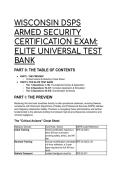
WISCONSIN DSPS
ARMED SECURITY
CERTIFICATION EXAM:
ELITE UNIVERSAL TEST
BANK
PART 0: THE TABLE OF CONTENTS
● PART I: THE PREVIEW
○ Critical Axioms & Statutory Cheat Sheet
● PART II: THE ELITE TEST BANK
○ Tier 1 (Questions 1–18): Foundational Syntax & Application
○ Tier 2 (Questions 19–37): Complex Application & Simulation
○ Tier 3 (Questions 38–55): Grandmaster Synthesis
PART I: THE PREVIEW
Mastering this test bank translates directly to elite operational readiness, ensuring flawless
compliance with Wisconsin Department of Safety and Professional Services (DSPS) statutes
and mitigating catastrophic liability. Precision in navigating these administrative and tactical
fundamentals is the absolute dividing line between high-level professional competence and
criminal negligence.
The "Critical Axioms" Cheat Sheet
Statutory Domain Core Rule / Axiom DSPS Code Reference
Initial Training Armed certification requires a SPS 34.03(1)
strict 36-hour curriculum
covering safety, ethics, and WI
law.
Renewal Training Annual recertification mandates SPS 34.02(3), (4)
a 6-hour refresher; a 5-year
lapse requires the full 36-hour
reset.
Vehicle Transport Loaded handguns must be SPS 34.011
,Statutory Domain Core Rule / Axiom DSPS Code Reference
holstered in plain view; long
guns must be locked and in
plain view. Concealment is
prohibited.
Discharge Reporting Any non-exempt discharge SPS 34.06
demands immediate
police/supervisor notification,
followed by a detailed written
report to DSPS.
Permit Isolation Permits are non-transferable SPS 34.015(3)
and tied to the specific
employing agency. Agency
transfers void the current
permit.
Prohibited Items Replica or facsimile firearms SPS 34.08
are absolutely prohibited on
duty for all personnel.
Use of Force Lethal force (including pointing Wis. Stat. 939.48
a firearm) is strictly reserved for
imminent threats of death or
great bodily harm.
PART II: THE ELITE TEST BANK
Tier 1: Foundational Syntax & Application
Q1: An applicant seeks an initial certificate of proficiency to carry a firearm as a private security
person in Wisconsin. Based on the principles of SPS 34.03, what is the MINIMUM required
duration of the training program? A) 12 hours of combined classroom and range instruction. B)
24 hours focusing exclusively on Wisconsin legal statutes and civil liability. C) 36 hours
encompassing safety, legal use, ethics, and lawful detentions. D) 40 hours of advanced tactical
and evasive driving maneuvers.
● Answer: C (36 hours encompassing safety, legal use, ethics, and lawful detentions)
● Distractor Analysis:
○ A is incorrect: A 12-hour duration represents an outdated legacy standard from
other jurisdictions and does not meet the Wisconsin administrative threshold.
○ B is incorrect: While legal instruction is mandatory, focusing exclusively on it ignores
practical safety, care, and handling requirements dictated by the state.
○ D is incorrect: Advanced tactical driving is not a mandated component of the DSPS
firearms proficiency curriculum.
The Mentor's Analysis: The baseline requirement for initial armed certification in Wisconsin is a
rigid 36-hour curriculum. When facing certification audits, the immediate priority is verifying the
exact hourly breakdown matches DSPS mandates. By utilizing the 36-hour standard, you
bypass the common trap of assuming standard security training covers armed requirements.
Professional Intuition: Always verify the 36-hour initial baseline before an agent ever
touches a duty weapon.
Q2: An armed private security person is preparing for their annual firearm proficiency renewal.
, According to the principles of SPS 34.02, which action is REQUIRED? A) Repeating the full
36-hour initial training course from scratch. B) Completing a 6-hour refresher course covering
required course contents. C) Submitting a notarized log of independent target practice. D)
Passing a psychiatric evaluation and a 12-hour tactical course.
● Answer: B (Completing a 6-hour refresher course covering required course contents)
● Distractor Analysis:
○ A is incorrect: The full 36-hour course is only required if the certificate lapses for a
period of five years.
○ C is incorrect: Independent practice does not satisfy DSPS formal training
mandates, which require an approved certifier.
○ D is incorrect: Routine renewal requires proficiency training, not mandatory
psychiatric evaluations unless separately ordered by the board.
The Mentor's Analysis: Annual recertification relies on a specific 6-hour refresher module. When
facing annual renewals, the immediate priority is securing this 6-hour targeted instruction. By
utilizing an approved certifier for this exact duration, you bypass the common trap of
over-training or relying on non-certified range time. Professional Intuition: The golden ratio for
DSPS firearm training is 36 initial, 6 annual.
Q3: A security agent accidentally discharges their firearm in the agency's parking lot, causing no
injuries. Based on the principles of SPS 34.06, who must be notified IMMEDIATELY? A) The
client and the local hospital emergency room. B) The DSPS credentialing board exclusively via
written report. C) The local law enforcement agency and the agent's supervisor. D) The
Wisconsin Department of Justice and the FBI.
● Answer: C (The local law enforcement agency and the agent's supervisor)
● Distractor Analysis:
○ A is incorrect: The hospital is irrelevant if there are no injuries, and the client is
secondary to legal authorities.
○ B is incorrect: The DSPS requires a written report later, not the immediate verbal
notification mandated by statute.
○ D is incorrect: DOJ and FBI notification represents a gross misunderstanding of
local jurisdictional reporting protocols.
The Mentor's Analysis: Any discharge of a duty weapon triggers a mandatory dual-notification
protocol. When facing a discharge incident, the immediate priority is alerting local authorities
and the chain of command. By utilizing this immediate dual-reporting, you bypass the common
trap of attempting an internal cover-up or delaying law enforcement response. Professional
Intuition: Silence after a discharge is the fastest route to a revoked credential.
Q4: An armed security guard terminates employment with Agency A and is hired the next day
by Agency B. Regarding the guard's firearms permit, which conclusion is the MOST
ACCURATE? A) The permit automatically transfers via the DSPS online portal. B) The permit is
valid for a 30-day grace period during the transition. C) The permit is invalid; Agency B must
obtain a new permit for the guard. D) The permit remains valid as long as the guard uses the
exact same firearm.
● Answer: C (The permit is invalid; Agency B must obtain a new permit for the guard)
● Distractor Analysis:
○ A is incorrect: Permits do not automatically float between competing corporate
entities; they are explicitly anchored to the applicant agency.
○ B is incorrect: There is zero grace period; carrying under Agency B without a new
permit is a direct administrative violation.
○ D is incorrect: The permit is tied to the agency's liability and insurance, not the
ARMED SECURITY
CERTIFICATION EXAM:
ELITE UNIVERSAL TEST
BANK
PART 0: THE TABLE OF CONTENTS
● PART I: THE PREVIEW
○ Critical Axioms & Statutory Cheat Sheet
● PART II: THE ELITE TEST BANK
○ Tier 1 (Questions 1–18): Foundational Syntax & Application
○ Tier 2 (Questions 19–37): Complex Application & Simulation
○ Tier 3 (Questions 38–55): Grandmaster Synthesis
PART I: THE PREVIEW
Mastering this test bank translates directly to elite operational readiness, ensuring flawless
compliance with Wisconsin Department of Safety and Professional Services (DSPS) statutes
and mitigating catastrophic liability. Precision in navigating these administrative and tactical
fundamentals is the absolute dividing line between high-level professional competence and
criminal negligence.
The "Critical Axioms" Cheat Sheet
Statutory Domain Core Rule / Axiom DSPS Code Reference
Initial Training Armed certification requires a SPS 34.03(1)
strict 36-hour curriculum
covering safety, ethics, and WI
law.
Renewal Training Annual recertification mandates SPS 34.02(3), (4)
a 6-hour refresher; a 5-year
lapse requires the full 36-hour
reset.
Vehicle Transport Loaded handguns must be SPS 34.011
,Statutory Domain Core Rule / Axiom DSPS Code Reference
holstered in plain view; long
guns must be locked and in
plain view. Concealment is
prohibited.
Discharge Reporting Any non-exempt discharge SPS 34.06
demands immediate
police/supervisor notification,
followed by a detailed written
report to DSPS.
Permit Isolation Permits are non-transferable SPS 34.015(3)
and tied to the specific
employing agency. Agency
transfers void the current
permit.
Prohibited Items Replica or facsimile firearms SPS 34.08
are absolutely prohibited on
duty for all personnel.
Use of Force Lethal force (including pointing Wis. Stat. 939.48
a firearm) is strictly reserved for
imminent threats of death or
great bodily harm.
PART II: THE ELITE TEST BANK
Tier 1: Foundational Syntax & Application
Q1: An applicant seeks an initial certificate of proficiency to carry a firearm as a private security
person in Wisconsin. Based on the principles of SPS 34.03, what is the MINIMUM required
duration of the training program? A) 12 hours of combined classroom and range instruction. B)
24 hours focusing exclusively on Wisconsin legal statutes and civil liability. C) 36 hours
encompassing safety, legal use, ethics, and lawful detentions. D) 40 hours of advanced tactical
and evasive driving maneuvers.
● Answer: C (36 hours encompassing safety, legal use, ethics, and lawful detentions)
● Distractor Analysis:
○ A is incorrect: A 12-hour duration represents an outdated legacy standard from
other jurisdictions and does not meet the Wisconsin administrative threshold.
○ B is incorrect: While legal instruction is mandatory, focusing exclusively on it ignores
practical safety, care, and handling requirements dictated by the state.
○ D is incorrect: Advanced tactical driving is not a mandated component of the DSPS
firearms proficiency curriculum.
The Mentor's Analysis: The baseline requirement for initial armed certification in Wisconsin is a
rigid 36-hour curriculum. When facing certification audits, the immediate priority is verifying the
exact hourly breakdown matches DSPS mandates. By utilizing the 36-hour standard, you
bypass the common trap of assuming standard security training covers armed requirements.
Professional Intuition: Always verify the 36-hour initial baseline before an agent ever
touches a duty weapon.
Q2: An armed private security person is preparing for their annual firearm proficiency renewal.
, According to the principles of SPS 34.02, which action is REQUIRED? A) Repeating the full
36-hour initial training course from scratch. B) Completing a 6-hour refresher course covering
required course contents. C) Submitting a notarized log of independent target practice. D)
Passing a psychiatric evaluation and a 12-hour tactical course.
● Answer: B (Completing a 6-hour refresher course covering required course contents)
● Distractor Analysis:
○ A is incorrect: The full 36-hour course is only required if the certificate lapses for a
period of five years.
○ C is incorrect: Independent practice does not satisfy DSPS formal training
mandates, which require an approved certifier.
○ D is incorrect: Routine renewal requires proficiency training, not mandatory
psychiatric evaluations unless separately ordered by the board.
The Mentor's Analysis: Annual recertification relies on a specific 6-hour refresher module. When
facing annual renewals, the immediate priority is securing this 6-hour targeted instruction. By
utilizing an approved certifier for this exact duration, you bypass the common trap of
over-training or relying on non-certified range time. Professional Intuition: The golden ratio for
DSPS firearm training is 36 initial, 6 annual.
Q3: A security agent accidentally discharges their firearm in the agency's parking lot, causing no
injuries. Based on the principles of SPS 34.06, who must be notified IMMEDIATELY? A) The
client and the local hospital emergency room. B) The DSPS credentialing board exclusively via
written report. C) The local law enforcement agency and the agent's supervisor. D) The
Wisconsin Department of Justice and the FBI.
● Answer: C (The local law enforcement agency and the agent's supervisor)
● Distractor Analysis:
○ A is incorrect: The hospital is irrelevant if there are no injuries, and the client is
secondary to legal authorities.
○ B is incorrect: The DSPS requires a written report later, not the immediate verbal
notification mandated by statute.
○ D is incorrect: DOJ and FBI notification represents a gross misunderstanding of
local jurisdictional reporting protocols.
The Mentor's Analysis: Any discharge of a duty weapon triggers a mandatory dual-notification
protocol. When facing a discharge incident, the immediate priority is alerting local authorities
and the chain of command. By utilizing this immediate dual-reporting, you bypass the common
trap of attempting an internal cover-up or delaying law enforcement response. Professional
Intuition: Silence after a discharge is the fastest route to a revoked credential.
Q4: An armed security guard terminates employment with Agency A and is hired the next day
by Agency B. Regarding the guard's firearms permit, which conclusion is the MOST
ACCURATE? A) The permit automatically transfers via the DSPS online portal. B) The permit is
valid for a 30-day grace period during the transition. C) The permit is invalid; Agency B must
obtain a new permit for the guard. D) The permit remains valid as long as the guard uses the
exact same firearm.
● Answer: C (The permit is invalid; Agency B must obtain a new permit for the guard)
● Distractor Analysis:
○ A is incorrect: Permits do not automatically float between competing corporate
entities; they are explicitly anchored to the applicant agency.
○ B is incorrect: There is zero grace period; carrying under Agency B without a new
permit is a direct administrative violation.
○ D is incorrect: The permit is tied to the agency's liability and insurance, not the


