
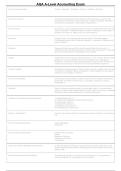
AQA A-Level Accounting Exam
Full Accounting Equation Assets + Expenses + Drawings = Capital + Liabilities + Revenue
Non-Current Assets An Asset of a business which are owned (1) for more than one year(1). Not
purchased to be re-sold(1). Help to generate a profit(1). Examples; Vehicles(1),
Computers(1), Buildings(1), Machinery(1), Equipment(1)
Current Assets Are cash(1), or can be quickly turned into cash(1). Current means within the next
year(1). Examples; Trade Receivables(1), money in the Bank(1). Once again, a
business owns them(1). Often known as Liquid Assets(1)
Expenses Ongoing Costs (1)to acquire goods and services(1). Examples; Wages,
Purchases(of goods), Rent, Heating & Lighting(1), Insurance(1). Expenses will
reduce Profits(1)
Drawings Resources [mostly money(1)] but could be goods taken for own use (1),
withdrawn(1) from the business owner(1) for their own private use(1). At the end
of the accounting period it is subtracted(1) from Capital
Capital Investments(1) by the owner(1) of the business i.e., the money(1) that the owner
initially put in. Or and alternative form of an investment e.g., Vehicle(1) or
Property(1). At the end of the accounting period we add the firm's Profit(1) and
subtract any Drawings(1). The owner can introduce Additional Capital (1)
Current Liabilities Something a business owes (1). Debts (1) that must be re-paid(1) within the next
12 months(1). Examples; (Bank Overdrafts(1), Trade Payables (1) any unpaid
expense such as Wages (1), Rent(1)
Non-Current Liabilities Something a business Owes(1). Debts (1) that must be re-paid(1) but will take
longer than 12 months to fully re-pay (1). Examples; Long-term Loans(1),
Mortgages (1).
Revenue Earns(1) revenue by selling goods(1), can be cash sales (1) or credit sales of
goods (1). Sales of Non-current Assests DO NOT count as revenue(1). Additional
Revenue(1) such as Rent Received(1) or anything Recieved.
6 Reasons for keeping Accounting Records 1) Legal Requirement (1)
2) To help when applying for External Borrowing (1)
3) Calculating Profits (1)
4) Valuing the business (1)
5) Monitoring and Control (1)
6) Forecasting (1) for the Future
What is a stakeholder? A person who shows interest in the business/company whether it is financially or
not
List the Internal Stakeholders Owners/Managers
Employees
List the External Stakeholders HM Revenue & Customs
Banks
Suppliers of the firm
Customers of the firm
Competitors
Why would Owners/ Managers be interested? To help with decision making (1) such as hiring new staff (1) launching a new
product opening a new premises. Assessing how much Drawings (1) they can
afford to take.
Why would Employees be interested? To assess job security (1), see if they can increase pay (1), improvement in
working conditions (1), promotions (1) or bonuses(1).
, AQA A-Level Accounting Exam
Why would HM Revenue & Customs be interested? For assessing Income Tax Liabilities (1) and also responsible for the collection of
VAT (1).
Why would be banks be interested ? To check whether a firm is able to re-pay loans (1) plus interest (1), and re-pay
on time (1).
Why would be suppliers be interested? To check the financial health of the firm before offering to supply on credit (1) and
assess if you can repay (1), and repay on time! (1)
Why would be customers be interested? will need to know that it will remain in business for the foreseeable future in order
that they can ensure a continuing supply (1).If the business does close down
then the customer will need to spend time and money looking for a new supplier
(1).
Why would be competitors be interested? Use another firms accounts for benchmarking (1) they may want to find out
whether they are more or less profitable and if not then why not? (1)
What is a Source Document? A document that provides written evidence of a business transaction
Why are source documents used ? Provide Evidence and verification that a transaction has taken place
Help clarify misunderstandings and resolve disputes
Help ensure the right goods are delivered to the right place at the right time
Examples of Source Documents: Sales Invoice
Purchase Invoice
Cheque Counterfoils
Paying in slip counterfoils
Cash Receipts
Till Roles
Credit Notes
Bank Statements
Define Sales Invoice Proof of Credit Sales (1), the supplier would send the customer a sales invoice
which confirms how much money is owed, and when payment is expected and
details of the goods sold.
Define Purchase Invoice Proof of Credit Purchases (1) we would receive a purchase invoice which
confirms how much money we owe and when we must re-pay and details of the
goods purchased.
Define Cheque Counterfoils Proof of payments by cheque (1). The stub left in a chequebook which provides
details of any cheques that have been written to our suppliers, including the
amount, the date and the name of the recipient.
Define Paying in slip Counterfoils Proof of money paid into the Bank (1). The stub left in a paying in book, which
provides details of cash and cheques received from our customers which we
have paid into our bank including the amount, the date, the name of the person
or business from whom we have received the cheque or cash. This document is
stamped by the bank employee for confirmation.
Define Cash Receipts These are receipts that are received/issued following immediate payment (1) for
example, Cash, Debit Card, Cheque etc (1). They have nothing to do with Credit
Sales or Credit Purchases.
Define Till Roles Provide a running total of Cash Sales (1) that have taken place
Full Accounting Equation Assets + Expenses + Drawings = Capital + Liabilities + Revenue
Non-Current Assets An Asset of a business which are owned (1) for more than one year(1). Not
purchased to be re-sold(1). Help to generate a profit(1). Examples; Vehicles(1),
Computers(1), Buildings(1), Machinery(1), Equipment(1)
Current Assets Are cash(1), or can be quickly turned into cash(1). Current means within the next
year(1). Examples; Trade Receivables(1), money in the Bank(1). Once again, a
business owns them(1). Often known as Liquid Assets(1)
Expenses Ongoing Costs (1)to acquire goods and services(1). Examples; Wages,
Purchases(of goods), Rent, Heating & Lighting(1), Insurance(1). Expenses will
reduce Profits(1)
Drawings Resources [mostly money(1)] but could be goods taken for own use (1),
withdrawn(1) from the business owner(1) for their own private use(1). At the end
of the accounting period it is subtracted(1) from Capital
Capital Investments(1) by the owner(1) of the business i.e., the money(1) that the owner
initially put in. Or and alternative form of an investment e.g., Vehicle(1) or
Property(1). At the end of the accounting period we add the firm's Profit(1) and
subtract any Drawings(1). The owner can introduce Additional Capital (1)
Current Liabilities Something a business owes (1). Debts (1) that must be re-paid(1) within the next
12 months(1). Examples; (Bank Overdrafts(1), Trade Payables (1) any unpaid
expense such as Wages (1), Rent(1)
Non-Current Liabilities Something a business Owes(1). Debts (1) that must be re-paid(1) but will take
longer than 12 months to fully re-pay (1). Examples; Long-term Loans(1),
Mortgages (1).
Revenue Earns(1) revenue by selling goods(1), can be cash sales (1) or credit sales of
goods (1). Sales of Non-current Assests DO NOT count as revenue(1). Additional
Revenue(1) such as Rent Received(1) or anything Recieved.
6 Reasons for keeping Accounting Records 1) Legal Requirement (1)
2) To help when applying for External Borrowing (1)
3) Calculating Profits (1)
4) Valuing the business (1)
5) Monitoring and Control (1)
6) Forecasting (1) for the Future
What is a stakeholder? A person who shows interest in the business/company whether it is financially or
not
List the Internal Stakeholders Owners/Managers
Employees
List the External Stakeholders HM Revenue & Customs
Banks
Suppliers of the firm
Customers of the firm
Competitors
Why would Owners/ Managers be interested? To help with decision making (1) such as hiring new staff (1) launching a new
product opening a new premises. Assessing how much Drawings (1) they can
afford to take.
Why would Employees be interested? To assess job security (1), see if they can increase pay (1), improvement in
working conditions (1), promotions (1) or bonuses(1).
, AQA A-Level Accounting Exam
Why would HM Revenue & Customs be interested? For assessing Income Tax Liabilities (1) and also responsible for the collection of
VAT (1).
Why would be banks be interested ? To check whether a firm is able to re-pay loans (1) plus interest (1), and re-pay
on time (1).
Why would be suppliers be interested? To check the financial health of the firm before offering to supply on credit (1) and
assess if you can repay (1), and repay on time! (1)
Why would be customers be interested? will need to know that it will remain in business for the foreseeable future in order
that they can ensure a continuing supply (1).If the business does close down
then the customer will need to spend time and money looking for a new supplier
(1).
Why would be competitors be interested? Use another firms accounts for benchmarking (1) they may want to find out
whether they are more or less profitable and if not then why not? (1)
What is a Source Document? A document that provides written evidence of a business transaction
Why are source documents used ? Provide Evidence and verification that a transaction has taken place
Help clarify misunderstandings and resolve disputes
Help ensure the right goods are delivered to the right place at the right time
Examples of Source Documents: Sales Invoice
Purchase Invoice
Cheque Counterfoils
Paying in slip counterfoils
Cash Receipts
Till Roles
Credit Notes
Bank Statements
Define Sales Invoice Proof of Credit Sales (1), the supplier would send the customer a sales invoice
which confirms how much money is owed, and when payment is expected and
details of the goods sold.
Define Purchase Invoice Proof of Credit Purchases (1) we would receive a purchase invoice which
confirms how much money we owe and when we must re-pay and details of the
goods purchased.
Define Cheque Counterfoils Proof of payments by cheque (1). The stub left in a chequebook which provides
details of any cheques that have been written to our suppliers, including the
amount, the date and the name of the recipient.
Define Paying in slip Counterfoils Proof of money paid into the Bank (1). The stub left in a paying in book, which
provides details of cash and cheques received from our customers which we
have paid into our bank including the amount, the date, the name of the person
or business from whom we have received the cheque or cash. This document is
stamped by the bank employee for confirmation.
Define Cash Receipts These are receipts that are received/issued following immediate payment (1) for
example, Cash, Debit Card, Cheque etc (1). They have nothing to do with Credit
Sales or Credit Purchases.
Define Till Roles Provide a running total of Cash Sales (1) that have taken place


