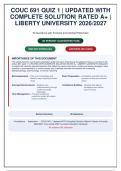
COUC 691 QUIZ 1 | UPDATED WITH
COMPLETE SOLUTION| RATED A+ |
LIBERTY UNIVERSITY 2026/2027
90 Questions with Answers and Detailed Rationales
100 PERCENT GUARANTEED PASS
INSTANT DOWNLOAD ANSWERS INCLUDED
IMPORTANCE OF THIS DOCUMENT
This comprehensive examination preparation guide has been meticulously developed to help you succeed in the
COUC 691 QUIZ 1 | UPDATED WITH COMPLETE SOLUTION| RATED A+ | LIBERTY UNIVERSITY 2026/2027.
It contains 90 carefully selected questions that reflect the most current exam content and testing strategies. Each
question is accompanied by a correct answer and a detailed rationale that explains the underlying
pathophysiology, pharmacology, or clinical reasoning.
Self-Assessment – Test your knowledge and Exam Preparation – Familiarize yourself with the
identify areas requiring further question format and content
study areas
Concept Reinforcement – Deepen your Confidence Building – Develop test-taking
understanding through strategies and reduce
evidence-based exam anxiety
rationales
Time Management – Practice answering
questions under simulated
exam conditions
Review Summary 90 Questions
Foundations - Application - COUC 691 1 Updated WITH Complete Solution Rated A Liberty University
2026/2027 Counseling AND Counselor Education Graduate
All answers with rationales
,Table of Contents
Content Area Questions Key Topics
Introduction TO Counseling 1-15 Counselor, Counseling, Ethical, Context, Dsm-5-tr
AND Ethics
Legal AND Ethical Issues IN 16-30 Counseling, Counselor, Researcher, According, Ethical
Counseling
Professional Identity AND 31-45 Counseling, Intervention, Disorder, Therapy, Ethical
Scope OF
Confidentiality AND 46-60 Counselor, Therapy, Counseling, Reports, Symptoms
Privileged Communication
Informed Consent AND Client 61-75 Counseling, Ethical, Client S, Counselor, Model
Rights
DUAL Relationships AND 76-90 Counselor, Ethical, Ethics, ACA CODE, Context
Boundaries
TOTAL 90 All questions include answers and detailed rationales
,Section A - Introduction TO Counseling AND Ethics
Q1.
Which of the following best describes the primary difference between the medical model
and the wellness model in counseling?
A. The medical model focuses on pathology, B. The medical model is evidence-based,
while the wellness model emphasizes while the wellness model is not.
strengths and prevention.
C. The medical model is used only in D. The medical model treats symptoms,
hospitals, while the wellness model is used while the wellness model treats underlying
in community settings. causes.
Correct: A - The medical model focuses on pathology, while the wellness model
emphasizes strengths and prevention.
Rationale:The wellness model is a paradigm shift from the traditional medical model,
focusing on holistic health, strengths, and prevention rather than solely on pathology and
symptom reduction. The other options mischaracterize the models' scope or evidence base.
Why the other answers are wrong:
B. Both models can be evidence-based; the distinction is not about evidence.
C. Both models can be applied across various settings; setting is not the defining difference.
D. Both models aim to address underlying causes; the key difference is the focus on strengths
vs. deficits.
Reference: Myers, J. E., & Sweeney, T. J. (2021). Counseling for wellness: Theory, research, and
practice.
Q2.
A counselor working with a client from a collectivist culture is using a Western
individualistic approach. Which of the following is the most significant ethical concern?
A. The counselor may impose values that B. The counselor may be too directive in the
conflict with the client's cultural worldview. therapeutic relationship.
C. The counselor may overlook the client's D. The counselor may use techniques that
individual strengths. are not empirically supported.
Correct: A - The counselor may impose values that conflict with the client's cultural
worldview.
Rationale:Ethical practice requires cultural competence; imposing Western values can be
harmful and violates the ethical principle of beneficence and respect for client autonomy. The
other options are less directly tied to cultural considerations.
Why the other answers are wrong:
Page 3
, Section A - Introduction TO Counseling AND Ethics
B. Directiveness is not inherently an ethical concern and is not specific to cultural mismatch.
C. Overlooking strengths is a general clinical issue, not the primary ethical concern here.
D. Empirical support is important but not the central ethical issue in cultural imposition.
Reference: American Counseling Association. (2014). ACA Code of Ethics.
Q3.
In the context of professional identity, which of the following is a key difference between a
licensed professional counselor (LPC) and a psychologist?
A. LPCs typically focus on psychotherapy, B. LPCs are trained in a medical model,
while psychologists focus on assessment while psychologists are trained in a
and research. developmental model.
C. LPCs can prescribe medication, while D. LPCs are only allowed to work with
psychologists cannot. individuals, while psychologists can work
with groups.
Correct: A - LPCs typically focus on psychotherapy, while psychologists focus on
assessment and research.
Rationale:Historically, LPCs emphasize clinical counseling and therapy, while psychologists
often have broader training in psychological testing, research, and sometimes more severe
psychopathology. The other options contain inaccuracies about scope of practice and training
models.
Why the other answers are wrong:
B. Both professions may use various models; this is not a defining difference.
C. Neither LPCs nor psychologists can prescribe independently in most states.
D. Both can work with groups; this is not a distinguishing factor.
Reference: Remley, T. P., & Herlihy, B. (2020). Ethical, legal, and professional issues in counseling.
Q4.
A counselor is using the DSM-5-TR to diagnose a client. Which of the following is a major
critique of the DSM-5-TR from a multicultural perspective?
A. It lacks a section on cultural formulation. B. It pathologizes normal variations in
behavior across cultures.
C. It is not based on empirical research. D. It is too brief and lacks diagnostic criteria.
Correct: B - It pathologizes normal variations in behavior across cultures.
Rationale:Critics argue that the DSM-5-TR can over-pathologize culturally normative
behaviors due to a Western-centric bias, despite including a cultural formulation interview.
The manual is research-based and comprehensive.
Why the other answers are wrong:
A. The DSM-5-TR includes a Cultural Formulation Interview and Outline.
Page 4
COMPLETE SOLUTION| RATED A+ |
LIBERTY UNIVERSITY 2026/2027
90 Questions with Answers and Detailed Rationales
100 PERCENT GUARANTEED PASS
INSTANT DOWNLOAD ANSWERS INCLUDED
IMPORTANCE OF THIS DOCUMENT
This comprehensive examination preparation guide has been meticulously developed to help you succeed in the
COUC 691 QUIZ 1 | UPDATED WITH COMPLETE SOLUTION| RATED A+ | LIBERTY UNIVERSITY 2026/2027.
It contains 90 carefully selected questions that reflect the most current exam content and testing strategies. Each
question is accompanied by a correct answer and a detailed rationale that explains the underlying
pathophysiology, pharmacology, or clinical reasoning.
Self-Assessment – Test your knowledge and Exam Preparation – Familiarize yourself with the
identify areas requiring further question format and content
study areas
Concept Reinforcement – Deepen your Confidence Building – Develop test-taking
understanding through strategies and reduce
evidence-based exam anxiety
rationales
Time Management – Practice answering
questions under simulated
exam conditions
Review Summary 90 Questions
Foundations - Application - COUC 691 1 Updated WITH Complete Solution Rated A Liberty University
2026/2027 Counseling AND Counselor Education Graduate
All answers with rationales
,Table of Contents
Content Area Questions Key Topics
Introduction TO Counseling 1-15 Counselor, Counseling, Ethical, Context, Dsm-5-tr
AND Ethics
Legal AND Ethical Issues IN 16-30 Counseling, Counselor, Researcher, According, Ethical
Counseling
Professional Identity AND 31-45 Counseling, Intervention, Disorder, Therapy, Ethical
Scope OF
Confidentiality AND 46-60 Counselor, Therapy, Counseling, Reports, Symptoms
Privileged Communication
Informed Consent AND Client 61-75 Counseling, Ethical, Client S, Counselor, Model
Rights
DUAL Relationships AND 76-90 Counselor, Ethical, Ethics, ACA CODE, Context
Boundaries
TOTAL 90 All questions include answers and detailed rationales
,Section A - Introduction TO Counseling AND Ethics
Q1.
Which of the following best describes the primary difference between the medical model
and the wellness model in counseling?
A. The medical model focuses on pathology, B. The medical model is evidence-based,
while the wellness model emphasizes while the wellness model is not.
strengths and prevention.
C. The medical model is used only in D. The medical model treats symptoms,
hospitals, while the wellness model is used while the wellness model treats underlying
in community settings. causes.
Correct: A - The medical model focuses on pathology, while the wellness model
emphasizes strengths and prevention.
Rationale:The wellness model is a paradigm shift from the traditional medical model,
focusing on holistic health, strengths, and prevention rather than solely on pathology and
symptom reduction. The other options mischaracterize the models' scope or evidence base.
Why the other answers are wrong:
B. Both models can be evidence-based; the distinction is not about evidence.
C. Both models can be applied across various settings; setting is not the defining difference.
D. Both models aim to address underlying causes; the key difference is the focus on strengths
vs. deficits.
Reference: Myers, J. E., & Sweeney, T. J. (2021). Counseling for wellness: Theory, research, and
practice.
Q2.
A counselor working with a client from a collectivist culture is using a Western
individualistic approach. Which of the following is the most significant ethical concern?
A. The counselor may impose values that B. The counselor may be too directive in the
conflict with the client's cultural worldview. therapeutic relationship.
C. The counselor may overlook the client's D. The counselor may use techniques that
individual strengths. are not empirically supported.
Correct: A - The counselor may impose values that conflict with the client's cultural
worldview.
Rationale:Ethical practice requires cultural competence; imposing Western values can be
harmful and violates the ethical principle of beneficence and respect for client autonomy. The
other options are less directly tied to cultural considerations.
Why the other answers are wrong:
Page 3
, Section A - Introduction TO Counseling AND Ethics
B. Directiveness is not inherently an ethical concern and is not specific to cultural mismatch.
C. Overlooking strengths is a general clinical issue, not the primary ethical concern here.
D. Empirical support is important but not the central ethical issue in cultural imposition.
Reference: American Counseling Association. (2014). ACA Code of Ethics.
Q3.
In the context of professional identity, which of the following is a key difference between a
licensed professional counselor (LPC) and a psychologist?
A. LPCs typically focus on psychotherapy, B. LPCs are trained in a medical model,
while psychologists focus on assessment while psychologists are trained in a
and research. developmental model.
C. LPCs can prescribe medication, while D. LPCs are only allowed to work with
psychologists cannot. individuals, while psychologists can work
with groups.
Correct: A - LPCs typically focus on psychotherapy, while psychologists focus on
assessment and research.
Rationale:Historically, LPCs emphasize clinical counseling and therapy, while psychologists
often have broader training in psychological testing, research, and sometimes more severe
psychopathology. The other options contain inaccuracies about scope of practice and training
models.
Why the other answers are wrong:
B. Both professions may use various models; this is not a defining difference.
C. Neither LPCs nor psychologists can prescribe independently in most states.
D. Both can work with groups; this is not a distinguishing factor.
Reference: Remley, T. P., & Herlihy, B. (2020). Ethical, legal, and professional issues in counseling.
Q4.
A counselor is using the DSM-5-TR to diagnose a client. Which of the following is a major
critique of the DSM-5-TR from a multicultural perspective?
A. It lacks a section on cultural formulation. B. It pathologizes normal variations in
behavior across cultures.
C. It is not based on empirical research. D. It is too brief and lacks diagnostic criteria.
Correct: B - It pathologizes normal variations in behavior across cultures.
Rationale:Critics argue that the DSM-5-TR can over-pathologize culturally normative
behaviors due to a Western-centric bias, despite including a cultural formulation interview.
The manual is research-based and comprehensive.
Why the other answers are wrong:
A. The DSM-5-TR includes a Cultural Formulation Interview and Outline.
Page 4